

There is a profound, dizzying sensation that comes with standing on the absolute fringe of a continent.
Perched on the rugged, wind-carved cliffs of the Avalon Peninsula in Newfoundland sits Cape Spear National Historic Site—the easternmost point of North America.
When you stand here, staring out across the vast, uninterrupted blue expanse of the Atlantic Ocean, you are closer to Ireland than you are to Vancouver.
It is a landscape defined by raw power, where massive ocean swells travel thousands of miles across the sea just to explode into magnificent plumes of white foam against the jagged stone shorelines.
For locals and travelers alike, a trip to Cape Spear is a powerful sensory reset.
Whether you are exploring Canada’s oldest surviving lighthouse, exploring underground World War II bunkers, or tracing the starting steps of the world-renowned East Coast Trail, this headland is an unmissable maritime wonder.
Here is everything you need to know to plan a perfect visit to the edge of the continent.
🗺️ Cape Spear Visitor Blueprint & Logistics
Location / Proximity:
Just a 15-to-20-minute drive (roughly 16 kilometers) southeast from the city center of St. John’s, Newfoundland.
Operating Hours:
The historic grounds and walking trails are open 24/7 year-round. The internal Parks Canada visitor center and historic lighthouse interiors operate seasonally from mid-May to mid-October.
Entry Fee:
Access to the coastal paths, viewpoints, and outdoor historic sites is entirely free. A small fee applies for guided interior tours of the 1836 lighthouse run by Parks Canada.
The Critical Safety Rule:
Stay off the black rocks. Cape Spear is notorious for violent, unpredictable rogue waves. Never step past the designated barricades or onto the wet, dark rock shelves near the surf line. The rocks are incredibly slick, and people have been tragically swept into the freezing, turbulent ocean currents.
The Sentinels of the Sea: The Historic Lighthouses
The stark silhouette of the headland is dominated by two entirely different generations of maritime engineering, each built to protect mariners from Newfoundland’s notorious, blinding fogs and treacherous rocky reefs.
The Old 1836 Lighthouse
Standing proudly as the center of the historic site is the original Cape Spear Lighthouse.
Constructed in 1836, this is the oldest surviving lighthouse structure in Newfoundland and Labrador.

Architecturally, it features a unique design: a square, classic stone keeper’s house wrapped completely around a central, cylindrical light tower.
Initially fueled by intensive oil lamps, the beacon was upgraded to electricity in 1955.
Today, Parks Canada has meticulously restored the interior to replicate the exact domestic life of the 1840s, telling the fascinating, multigenerational story of the famous Cantwell family, who served as the dedicated, heroic keepers of the light for over 150 years.

The Modern Tower
Just steps away sits the modern, automated concrete light tower erected in 1955. Standing roughly 30 meters (98 feet) above the cliff face, its powerful, automated beam still serves as an active, vital navigational beacon for international cargo ships and local fishing trawlers navigating the entrance to St. John’s Harbor.

Wartime Defenses: The World War II Coastal Battery
Cape Spear’s geographical position means it has stood on the front lines of global conflicts.
During the dark days of World War II, the headland was transformed into a heavily fortified military outpost known as Fort Cape Spear (Battery Construction No. 2).
Its mission was critical: protect the strategic shipping lanes and the narrow harbor mouth of St. John’s from stealthy German U-boat attacks.
The military installed massive, long-range 10-inch guns, searchlight bunkers, and a complex network of underground concrete ammunition magazines.
Today, visitors can walk directly through the preserved, atmospheric concrete bunkers and stand inside the old gun emplacements.
It offers a poignant, chilling look back at how close the theater of war came to North American soil, a reality driven home by the tragic sinking of the passenger ferry SS Caribou by a German torpedo just off the regional coast in 1942.
Hiking the Edge: The East Coast Trail Gateway
For outdoor enthusiasts, Cape Spear serves as one of the most iconic trailheads on the continent. It is a major pivot point for the East Coast Trail—a world-class wilderness path that traces over 300 kilometers of Newfoundland’s rugged coastline.

The Cape Spear Path to Petty Harbour
If you want an unforgettable day hike, lace up your boots and tackle the Cape Spear Path section.
This 10-kilometer (6.2-mile) linear trail tracks south along the exposed, undulating cliff edges, carrying you through tuckamore forests and high barrens before dropping down into the historic, postcard-perfect fishing community of Petty Harbour.
As you walk the coastal boardwalks and gravel tracks around the cape, keep your camera lens trained on the water.
If you visit in May or June, you can watch massive, iridescent icebergs drift past the cliffs along Iceberg Alley.
By July and August, the waters are alive with pods of breaching humpback whales and diving seabirds like puffins, northern gannets, and bald eagles.
Completing the Avalon Peninsula Loop
Because Cape Spear is so close to the capital, it serves as the ultimate starting point for a spectacular, self-guided coastal day trip.
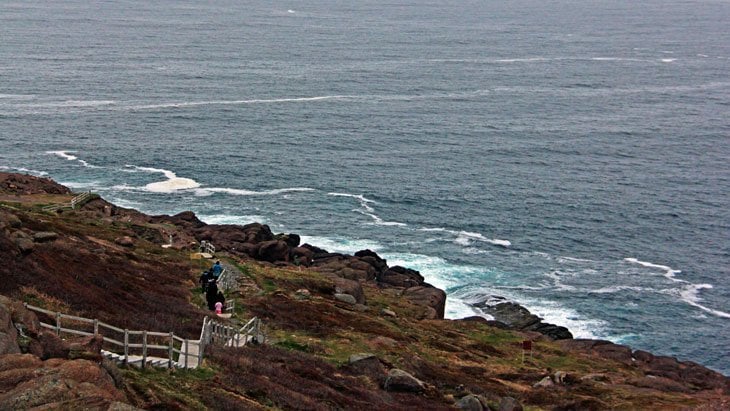
Once you have watched the waves hit the easternmost point, you can comfortably loop through the area’s neighboring highlights:
The Historical Cliffside: Head just 20 minutes north to explore the panoramic fortifications and walking tracks of Signal Hill National Historic Site.
The Traditional Architecture: Wind through the narrow streets of The Battery, a vibrant enclave of colorful houses perched over the harbor narrows.
The Artisan Village: Finish your afternoon in Quidi Vidi Village, sampling a local craft beer right on the edge of a historic, rock-walled wharf.
Cape Spear is a place where you can truly feel the immense scale of the natural world.

Whether you are watching a dramatic Atlantic sunrise—the very first sunrise on the continent—or listening to the rhythmic roar of the waves from the steps of a 19th-century lighthouse, Canada’s eastern edge is an escape that stays with you long after you leave the cliffs.
Explore More Spectacular Canadian Wilderness & Coastal Guides
- The Urban Cliff Walk: Hiking the North Head Trail: Signal Hill’s Most Dramatic Coastal Walk
- The Glacial Corridors: Majestic Giants: A Local’s Guide to Iceberg Alley, Newfoundland
- The Wilderness Island: A Journey from City to Wilderness: An Expert Guide to Vancouver Island


Gorgeous pictures! Haven’t made it out to that part of Canada yet but I definitely get wait till the day I make it there. Canada has so many beautiful places, it’s a gorgeous country
Thanks Tara. Agree – I would enjoy going a cross Canada Photo Journey when I retire!
Nice images, one of my favorite places.
Thanks Brian. Agree – I always make sure it is the last stop before I head back home.
I was at Cape Spear today (the day this was posted) for four hours. I then went to Signal Hill and the Cabot Tower. It was completely fogged in all day. It was cold (8 degrees), wet and foggy all day. Would have loved to have seen weather like this today.
Thanks Robert. 🙂 I had to leave when it started to rain. One day I will get out there when it is sunny!
Yes, really when it is sunny.