

Standing at the top of the sand dunes with my twin Basset Hounds, Monty and Jasmine, looking down at the three limestone peaks, it is easy to see why Three Cliffs Bay is one of the Gower’s most photographed spots.
It isn’t just a beach; it’s a wild theatre of limestone cliffs, winding rivers, and history buried in the sand. Whether you are a photographer, a hiker, or just someone looking for a perfect spot to let the dogs run free, the “step down” to this bay is an adventure in itself.
While the views are famous, the history here is just as dramatic—ranging from medieval castles swallowed by sandstorms to legends of angry fairies. Here is my complete guide to walking, exploring, and understanding Three Cliffs Bay.

Walk Information: Parkmill to Three Cliffs Bay
How to get to Three Cliffs Bay (Parking & Bus)
Getting to the bay requires a little effort, as you cannot drive directly to the beach. This preserves its wild beauty.
By Car & Parking The most popular starting point is the village of Parkmill.
- Gower Heritage Centre: Ample parking is available here (Postcode: SA3 2EH).
- Shepherds Shop: Located just across the road, this is another great spot to park. It is also perfect for grabbing an ice cream or coffee before you head off.
Alternative Route (Southgate) For a cliff-top walk rather than a valley walk, you can park at the National Trust car park in Southgate (Postcode: SA3 2DH). This route offers sweeping views from the top of the cliffs before descending the dunes to the beach.
By Public Transport The Gower is well-connected by bus from Swansea. The number 118 or 119 bus services run frequently from the Swansea Quadrant Bus Station to Parkmill.

The Three Cliffs Bay Walking Route
The walk from Parkmill is one of my favorites in Wales because of the variety of terrain. You start in a green, wooded valley and end up on a wild, sandy beach.
The Woods: From the car park, follow the path alongside the river (Pennard Pill). The trees form a canopy overhead, making it cool in the summer.
The Valley Floor: The woods open up into a flat, marshy valley floor. Here, the river winds its way slowly toward the sea. You will see stepping stones that cross the river—a favorite spot for kids (and brave dogs) to test their balance.
The Dunes: As you approach the sea, the ground turns to sand. You will climb over the dunes, and suddenly, the famous three limestone cliffs will appear ahead of you.
Tip: Check the tide times! At high tide, the beach is split into two, and you may get cut off from the stepping stones.
Pennard Castle: The Fortress Swallowed by Sand
Overlooking the bay stands the jagged silhouette of Pennard Castle. While it looks like a typical Norman ruin today, its history is unique because of how it fell.
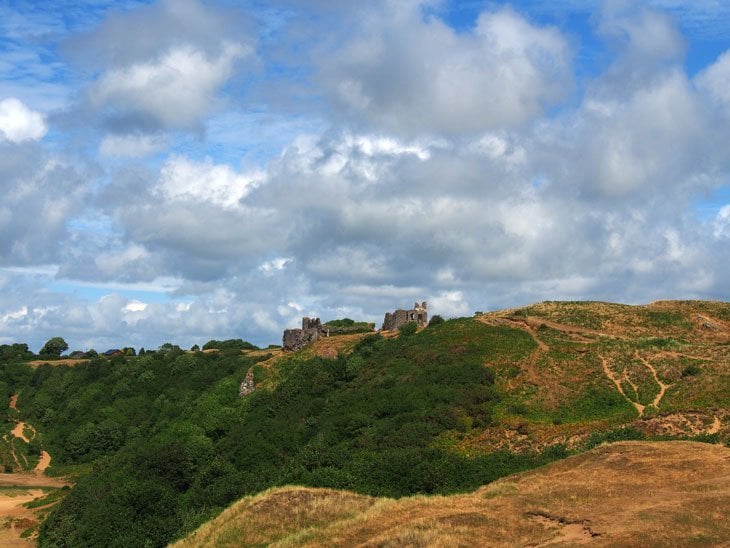
The “Besanding” Built originally in the 12th century, the castle was abandoned not because of war, but because of the weather. In the 14th century, massive sandstorms began to sweep across this part of the Gower.
The dunes you walk over today literally swallowed the medieval village and the castle, forcing the inhabitants to flee inland.
This process, known as “besanding,” turned a once-thriving fortress into the ghostly shell you see today.
The Legend of the Verry Volk If you prefer myths to meteorology, local folklore tells a darker story. Legend says the Lord of Pennard Castle once disturbed a group of “Verry Volk” (local fairies) who were dancing in the moonlight during his daughter’s wedding party.
He attacked them with his sword, and in retaliation, the fairies summoned a sandstorm that buried the castle in a single night.

The Geology: How the Three Cliffs Were Formed
The bay gets its name from the three signature limestone peaks that jut out into the bay, but they weren’t always separated.

Millions of years ago, this was a solid wall of Carboniferous Limestone. Over millennia, the sheer power of the Atlantic waves exploited weaknesses in the rock, carving out caves and eventually collapsing the roofs to create the separate jagged spires we see today.
- The Arch: Look closely at the cliffs and you will see a natural archway. It is possible to walk through it at low tide—a perfect natural frame for photos.
Things to Do at Three Cliffs Bay
It is not just a beach for sunbathing; it is an outdoor playground.
- Photography: The light here is incredible, especially at sunset when the sun drops behind the three peaks.
- Climbing: The limestone cliffs are popular with rock climbers. You will often see them scaling the arches.
- Dog Walking: As mentioned, my Bassets, Monty and Jasmine, love it here. The river is shallow enough for a safe paddle, and the dunes are perfect for “zoomies.”
- Picnics: The sheltered valley floor behind the beach is a great spot to escape the wind and have a picnic.

Swimming and Safety: A Word of Warning
While the water looks inviting, especially on a hot summer day, Three Cliffs Bay is known for having strong currents and rip tides.
- Lifeguards: Unlike nearby Caswell Bay or Langland, Three Cliffs Bay is not lifeguarded.
- The River: The river (Pennard Pill) flows into the sea here. Where the river meets the waves, the currents can be unpredictable.
- Advice: It is great for a paddle or cooling off your feet, but powerful swimmers should be cautious, and it is generally not recommended for weak swimmers or children to go out of their depth.
Camping with a View
If you want to wake up to this view, you are in luck. The Three Cliffs Bay Holiday Park sits on the cliffs overlooking the bay. It is often voted one of the best campsites in the UK simply for the view.
- They accept tents, caravans, and motorhomes.
- Pro Tip: It is incredibly popular, so you usually need to book months in advance for summer weekends.
- Waking up here allows you to get down to the beach at sunrise before the day-trippers arrive—a photographer’s dream.
Conclusion
I was on a visit through the Gower Peninsula, South Wales, and if you love a beach or love the outdoors, then you must stop and spend some time down on Three Cliffs Bay.
Whether you laze in the sunshine, brave the stepping stones, or explore the ruins of the castle, there is something here for everyone.
What to do nearby
After the beach, if you are looking for more adventure or a place to eat, I highly recommend driving down the road to The Mumbles. It is the perfect spot to end your day with a walk along the pier or some fresh seafood.






The coast is amazing and the Brecon Beacons not too far away either. Whilst Pembroke is lovely, this area is more accessible whilst still leaving further west within easy reach. I’m house-hunting around the Swansea area – returning my ancestral homeland you could say 🙂
Hi manda, yes a wonderful area to live I can imagine