

There’s a peculiar feeling you get standing amidst the ruins of Penrith Castle. On one side, the fells of the Lake District promise adventure. On the other, the rumble of a train to Glasgow reminds you it’s the 21st century.
And just across the road, the golden arches of a McDonald’s glow with modern promise. But here, within these crumbling red sandstone walls, you’re standing in the heart of a 600-year-old story of war, power, and the making of a king.
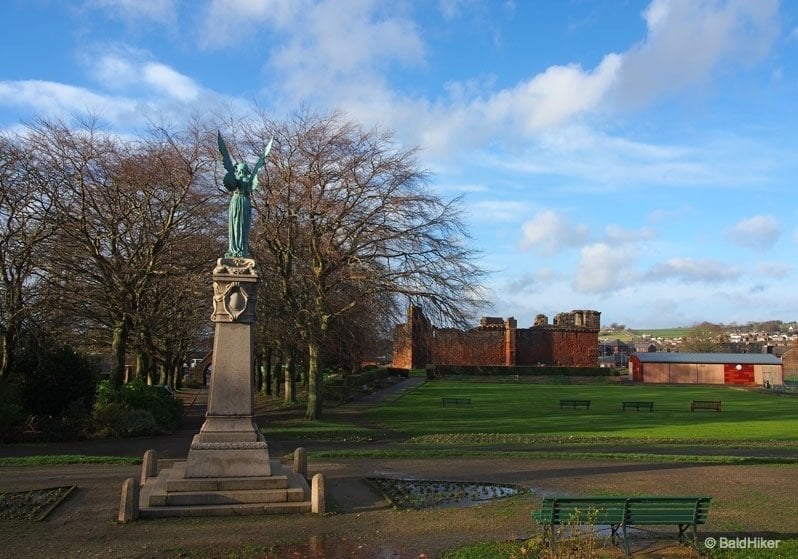
Today, these ruins are a peaceful feature of a public park, a place for picnics and dog walks. But don’t let the quiet fool you.
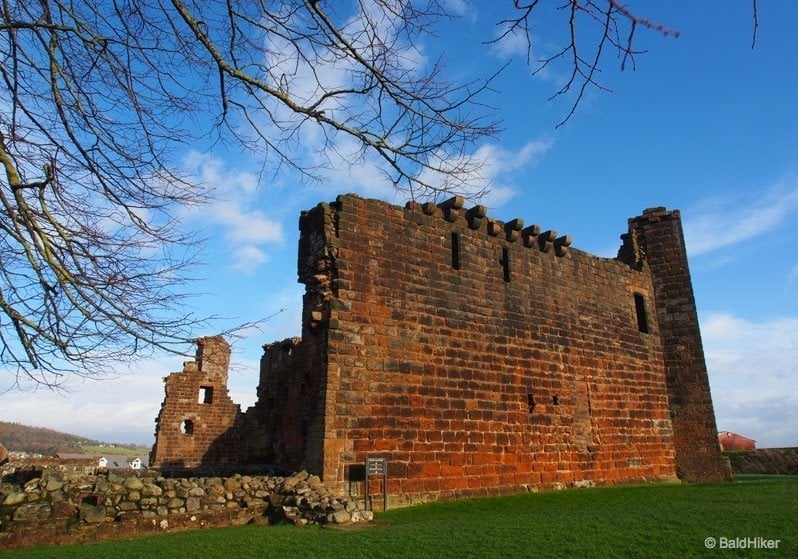
These stones have witnessed centuries of bloodshed, echoed with the ambitions of England’s most powerful families, and once formed the luxurious northern palace of one of history’s most controversial figures: the future King Richard III.
Join me as we peel back the layers of this modern park to uncover the brutal, brilliant, and often forgotten history of Penrith Castle.
We’ll journey from a violent frontier outpost, forged in the fire of the Anglo-Scottish wars, to a magnificent ducal residence, before tracing its slow descent into the romantic ruin we see today.
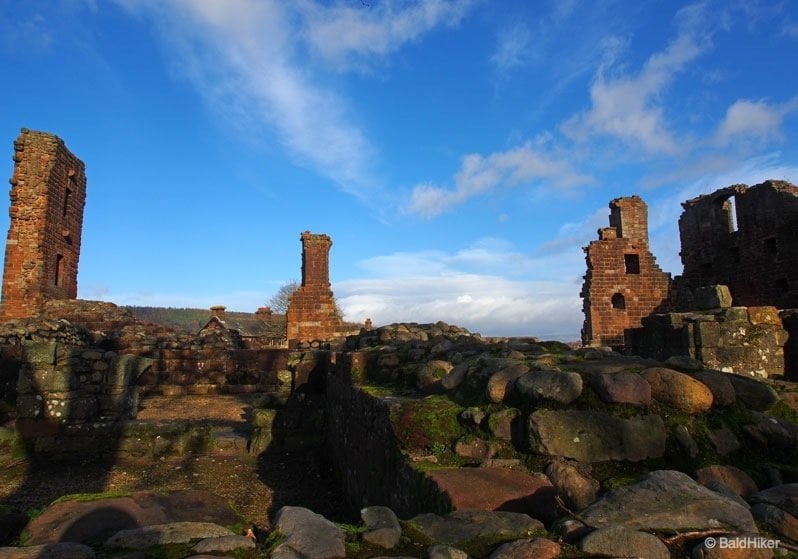
This isn’t just a pile of old stones; it’s a story etched into the Cumbrian landscape.
A Fortress Forged in Fire and Blood
To understand why Penrith Castle exists, you first have to imagine a world of constant fear. For over a century before the first stone was laid, the Anglo-Scottish border was less a line on a map and more an open wound.
Following King Edward I’s campaigns to subjugate Scotland in the late 13th century, the north of England became a perpetual war zone.
Penrith, a key market town set back from the immediate border, became a prime target. The raids were relentless and savage. The progress of Scottish armies, it was said, could be “marked by the smoke from the burning villages in the landscape”.
The town was plundered and burned to the ground in 1314, 1315, and again in a devastating attack in 1322, during which many inhabitants were carried away by the Scots, never to be seen again.
Another raid in 1345 left the surrounding villages smouldering. The violence was so endemic that in 1348, a Scottish force attacked during the annual town fair, unwittingly carrying not just plunder but also the plague back with them into Scotland.
This wasn’t just organised warfare. The chaos gave rise to the notorious Border Reivers—lawless clans like the Armstrongs and Grahams who held allegiance to no one but themselves.
They raided and stole (‘reived’) on both sides of the border, making life for ordinary people a terrifying lottery of survival.
Early defences were scant. Small, fortified towers known as Pele Towers offered some refuge, but they were no match for a determined army.
For the people of Penrith, who had endured a century of terror, the construction of a proper castle in the 1390s wasn’t just a strategic military decision by a distant lord. It was a promise of survival, a symbol that centralised power and protection had finally arrived in a land that had been all but abandoned to chaos.

The Northern Kings: How the Nevilles Built a Power Base
The man who answered that desperate need was Ralph Neville, 1st Earl of Westmorland (c. 1364–1425), one of the most powerful and ambitious noblemen in the north.
Granted the manor of Penrith in 1396, he began building the castle soon after, his authority bolstered by his official role as Warden of the West March—the man responsible for the security of this volatile border region.
But Neville’s motives were about more than just national defence. The castle was a calculated move in a high-stakes game of regional power.
For centuries, the dominant family in the area had been the Cliffords, who held the ancient fortress of Brougham Castle just a couple of miles away. The Cliffords relied on Penrith’s market to supply their castle, effectively controlling the town.
By building a new, rival fortress that literally overlooked the town, Neville was making a bold statement. He was challenging the Cliffords’ authority and asserting his family’s dominance over this corner of Cumbria.
This local rivalry was so intense that it would later see the two families fight on opposite sides during the Wars of the Roses.
Interestingly, the castle was not built on the highest point of the hill, the most defensible position. Instead, it sits on a lower rise, likely the site of an old Roman fort whose ditches could be reused, but more importantly, a spot that directly overlooked the medieval town.
Its purpose was clear: to dominate and administer as much as to defend.
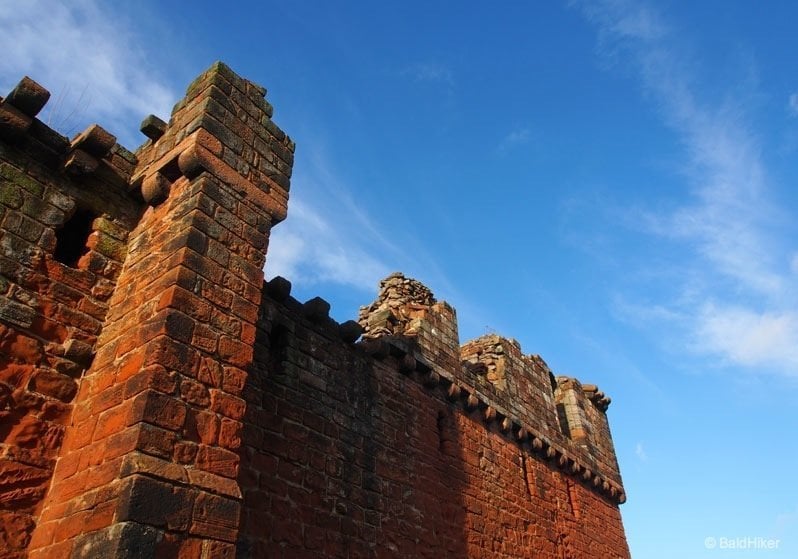
The Neville dynasty continued to enhance the castle. Ralph’s son, Richard Neville, 5th Earl of Salisbury, made it his headquarters and likely added the imposing “Red Tower,” fragments of which still stand today.
The castle then passed to his son, the most famous Neville of all: Richard, Earl of Warwick, better known to history as the “Kingmaker”.
His dizzying shifts of allegiance during the Wars of the Roses ultimately led to his death at the Battle of Barnet in 1471. With no male heir, his vast estates, including Penrith Castle, reverted to the Crown, setting the stage for its most celebrated chapter.
The White Boar’s Lair: Richard III’s Royal Palace
Following the Kingmaker’s death, King Edward IV granted the castle and the immense Neville lands in the north to his loyal and capable younger brother, Richard, Duke of Gloucester.
He was just 18 years old. This was no ceremonial gift. Richard was appointed Sheriff of Cumberland and Warden of the West March, making him the supreme military and political authority in a region that was historically a Lancastrian stronghold and still seethed with old resentments.
The young duke faced an immense task: to secure the border against the Scots, keep the rival local families in check, and enforce the loyalty of a populace that had recently supported the other side.
He did so with remarkable skill, and Penrith Castle became the heart of his northern power base. It was from here that he established a reputation for firm but fair governance that won him great popularity in the north.
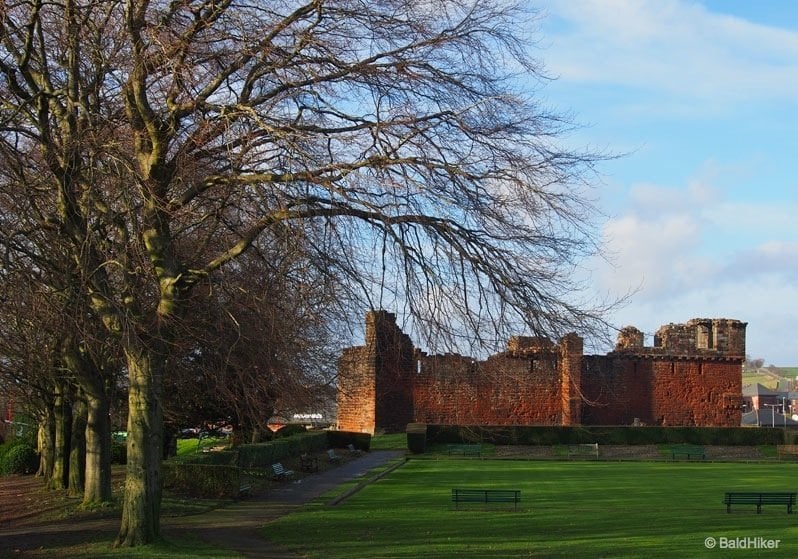
But Richard did more than just occupy the castle; he transformed it. He embarked on a major building programme, turning the grim border fortress into a “luxurious residence” befitting a royal duke.
The spartan Neville-era buildings were upgraded with a grand banqueting hall, a new gatehouse, an expanded kitchen range, and comfortable private apartments lit by large new windows—a clear sign that this was now a home, not just a barracks.
These renovations were a masterful exercise in power. A magnificent banqueting hall was not just for personal comfort; it was a political theatre.
It was here that Richard could host local dignitaries and rival lords, using lavish hospitality and patronage to win their allegiance and overawe them with the wealth and stability of the House of York.
The transformation of the castle from a functional fortress into a comfortable domestic complex projected an image of peace and royal authority in a land long defined by chaos.
For the twelve years Richard lived here intermittently, from 1471 until he left to become King Richard III in 1483, the castle experienced its golden age—the undisputed political and social centre of the north.
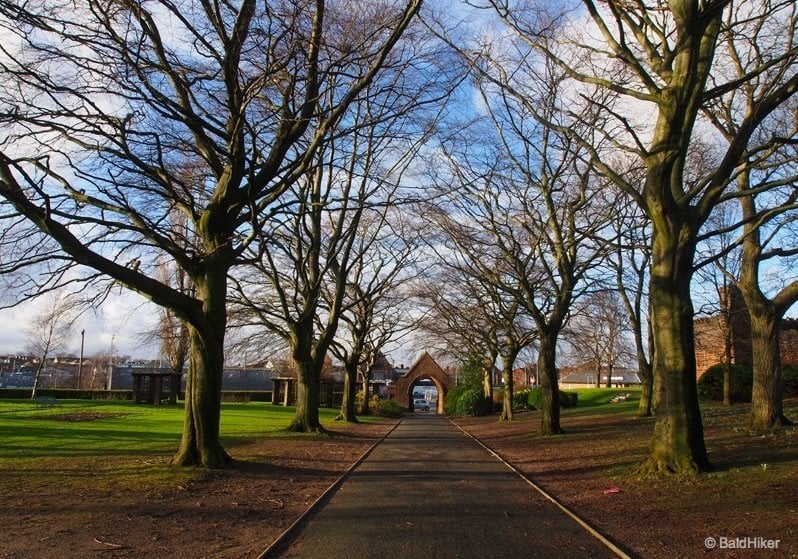
Echoes in the Ruins: From Palace to Picturesque Park
The castle’s glory was fleeting. After Richard’s death at the Battle of Bosworth Field in 1485, Penrith Castle remained Crown property, but it was “never again used as a permanent residence”.
Without a high-status resident to maintain it, the magnificent palace began a long, slow slide into decay. By the mid-16th century, official surveys already described the castle as “partly decayed” and a “ruin”.
Its decline was, in a way, a sign of its success. The very threat it was built to counter was fading.
With the Union of the Crowns in 1603, when James VI of Scotland also became James I of England, the centuries of official Anglo-Scottish warfare came to an end, and the great border fortresses became militarily redundant. The castle had essentially succeeded itself out of a job.
Its magnificent red stones became a convenient local quarry, repurposed for the construction of farmhouses and other buildings in and around Penrith, its physical fabric literally absorbed into the town it once protected.
The castle had one last, brief military role during the English Civil War, when it served as the headquarters for the Parliamentarian General John Lambert in 1648. Shortly after, it was deliberately “slighted,” or dismantled, to prevent it from ever being used as a military stronghold again.
For the next 250 years, it passed through the hands of various dukes before being sold to the Lancaster & Carlisle Railway Company.
Finally, in the 1920s, the local council acquired the site, cleared away the farm buildings that had grown up within its walls, and created the public park we see today.

A Hiker’s Guide to a King’s Castle
Walking through Penrith Castle today is an exercise in imagination. As you approach, you cross the remains of a deep, dry moat that once would have been a formidable obstacle.
The first thing that strikes you is the sheer height of the surviving curtain walls; in places, they still stand to their full, original height, giving you a real sense of the fortress’s scale.
As you wander inside, look for these key features:
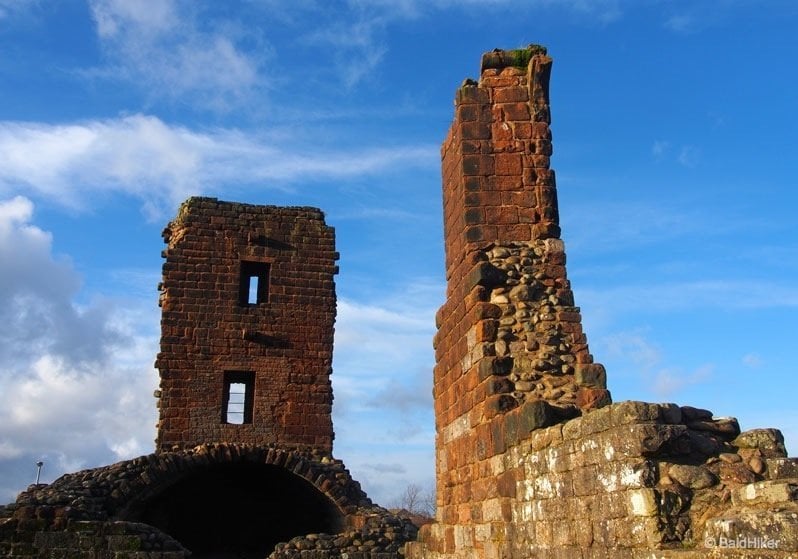
- The Red Tower: To the north, you can see the fragments of the tower built by the Earl of Salisbury in the mid-15th century, its red sandstone glowing in the Cumbrian sun.
- Richard’s Great Hall: On the eastern side, look for the projecting stone corbels. These once supported the floor of Richard III’s magnificent banqueting hall. The gaps in the wall where his large windows once were are still visible, hinting at the lost luxury.
- Courtyard Foundations: In the grassy central courtyard, you can trace the low stone foundations of the kitchens, various apartments, and a well that would have been the heart of daily life in the castle.
As you explore, you might feel a slight chill. Local legend tells of a phantom army seen marching across the fells near the castle on Midsummer’s Eve.
First spotted by a farmer in 1735, the ghostly procession of foot soldiers, cavalry, and carriages has reportedly been seen by others over the years.
As dusk falls over the ruins, it’s easy to imagine these spectral soldiers, a final, ghostly echo of the castle’s violent past.

Beyond the Moat: Exploring Historic Penrith
Your journey into Penrith’s past doesn’t have to end at the castle walls. The town is rich with history directly connected to the castle’s story.
St. Andrew’s Church and the Giant’s Grave: A short walk from the castle brings you to this beautiful church. While much of it was rebuilt in the 18th century, the tower is medieval and dates to the same period as the castle’s origins. In its churchyard lies the “Giant’s Grave,” a mysterious collection of 10th-century Anglo-Saxon or Viking crosses and hogback tombstones, said to be the burial place of Owen Caesarius, a king of Cumbria.
The Penrith Beacon: For a fantastic view and another piece of the story, take the short hike up Beacon Hill. The stone tower you see today was built in 1719, but a warning beacon has stood on this spot since at least 1296. Its purpose was to light a fire to warn the town of the very Scottish raids the castle was built to defend against, creating a vital link in a chain of signals down the Eden Valley.
Brougham Castle – The Rival Fortress: Just a five-minute drive away lie the impressive ruins of Brougham Castle, home of the Clifford family. Visiting their fortress in the Eden Valley, like Appleby Castle too, provides the other half of the story of medieval power in Cumbria and a richer understanding of why Penrith Castle was so important.

Plan Your Visit & Final Thoughts
From a desperate defence against chaos to a king’s palace and now a tranquil park, Penrith Castle has had an extraordinary journey.
It’s a place where you can touch the brutal realities of the medieval border, walk in the footsteps of Richard III, and reflect on how peace can turn the mightiest fortress into a picturesque ruin.
It is a Grade I listed building, freely accessible, and a powerful stone reminder of a life lived hundreds of years ago, now looking out over a modern Cumbrian town.
| Visitor Information | Details |
| Location | Castle Terrace, Penrith, Cumbria, CA11 7EA |
| Opening Times | Summer (31 March – September): 7:30 am – 9:00 pm or dusk. Winter (October – 30 March): 7:30 am – 4:30 pm or dusk. |
| Entrance Fee | Free Entry |
| Parking | Limited on-street parking on Ullswater Road. The most convenient option is the Pay and Display car park at Penrith Railway Station (CA11 7JQ), directly opposite the park’s main entrance. Other town centre car parks are a short walk away. |
| Accessibility | The surrounding park paths are generally suitable for wheelchairs and prams. However, access to some areas within the castle ruins involves steps. The main disabled access point to the park is from the Ullswater Road entrance. |
| Facilities | Public toilets, a café (often seasonal), a children’s playground, tennis courts, and a putting green are available within the wider Castle Park. |
| Dogs | Dogs are welcome throughout the park but must be kept on a lead. |
You may also like to read:


These bring back memories, because I studied travel journalism in Carlisle and often went to Penrith during my 3 years in Cumbria! I’ve always associated seeing Penrith Castle from the train on the way North with a comforting sign that you’re almost home.
ahhh yes.. across from the train station 🙂 thank you
Stunning castle ruins, thanks for sharing these photos!
Hi Charlie. Thanks
Interesting. It looks very different to Edward’s castles in Wales and the Welsh Marches.