This 8-mile linear stretch forms the dramatic opening gateway of the Tyne to Tees coastal path.
Transitioning from the industrial heritage of the River Tyne to the soaring, wild Magnesian Limestone cliffs of the Durham Heritage Coast, it is a route defined by smuggling lore, pioneering maritime engineering, and vast North Sea vistas.
🗺️ Part of the Tyne to Tees Coastal Path Master Series This article is Stage 1 of a 5-part definitive guide to walking the entire Tyne to Tees coast.
Next Up: Stage 2: Sunderland to Seaham Guide
View the Full Route: The Tyne to Tees Coastal Path Master Guide

⏱️ Essential Trail Logistics & Planning
Exact Start Point:
The Customs House, Mill Dam, South Shields (Postcode: NE33 1ES)
Exact Finish Point:
Roker Pier / Marine Walk, Sunderland (Postcode: SR6 0PL)
Distance & Time:
8 miles (13 km) | Allow 3.5 to 5.5 hours depending on pace.
Terrain Profile:
Flat paved riverside promenades to start, transitioning to undulating grassy clifftop singletrack, ending on flat asphalt sea fronts.
Public Transport Links:
Flawless. Take the Tyne & Wear Metro from Sunderland station back to South Shields interchange, or use the regular E1 or E2 bus services connecting the two seafronts.
Public Toilets:
Available at Littlehaven Beach, Souter Lighthouse (National Trust), Seaburn Promenade, and Roker Marine Walk.
🥾 The Route Breakdown: Step-by-Step Milestones
The Industrial Tyne to Trow Rocks
Miles 0 – 1.5
Begin at the historic Customs House at Mill Dam. Keeping the River Tyne firmly on your left, follow the paved riverside path past the ferry landing and out toward the modern Littlehaven Promenade.
Here, you’ll walk directly through “Conversation Piece” (locally known as The Weebles)—a striking collection of 22 egg-shaped bronze figures overlooking the sand.
After pausing for a photo with them, continue past the iconic red-jacketed Herd Groyne Lighthouse.
Rounding the corner, the path cuts behind the dunes of Sandhaven Beach, passing Ocean Beach Pleasure Park before the tarmac ends at Trow Rocks’ historic disappearing gun.
The Leas, Marsden Rock & Souter Lighthouse
Miles 1.5 – 5
From Trow Rocks, climb the brief incline onto The Leas—a sweeping, three-mile stretch of coastal limestone grassland protected by the National Trust.
The trail here transitions to a network of grassy paths. Hug the clifftop trail, keeping a safe distance from the eroding limestone edges. Soon, the dramatic sea stack of Marsden Rock comes into view.
To visit Marsden Grotto, look for the steep zig-zag concrete steps or the cliff-face lift. Continuing south along the clifftop, follow the obvious path toward the bold red-and-white horizontal stripes of Souter Lighthouse, which dominates the skyline.
Whitburn Coastal Park to Roker Pier Finish
Miles 5 – 8
Pass through the wooden gate south of Souter Lighthouse to enter Whitburn Coastal Park, a beautifully restored former colliery site.
The path here is a well-maintained gravel track that weaves through coastal scrub and past limestone quarries.
As you approach Whitburn Rifle Range (check for red flags indicating live firing, though a safe bypass path is always open), the trail transitions back to tarmac.
Drop down onto the wide, bustling promenades of Seaburn and Roker. Your final destination is the magnificent, granite-faced Roker Pier, arching half a mile out into the sea.

🏛️ Deep Dives & Local Lore: Beneath the Surface
The Mystic Figures of Littlehaven: “The Weebles”
As you walk along Littlehaven Promenade, it is impossible to miss the crowd of 22 bronze, round-bottomed figures staring out to sea or huddled in silent groups.
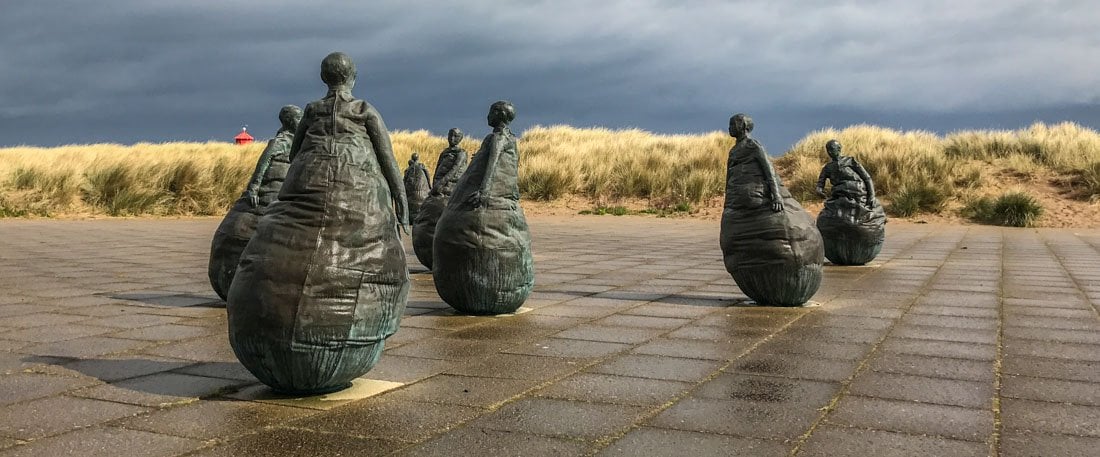
Created by Spanish sculptor Juan Muñoz and installed in 1999, this artwork is officially titled Conversation Piece.
While the artist meant them to represent the universal human desire to communicate, the people of South Tyneside immediately took one look at their wobbling, base-heavy shape and permanently branded them “The Weebles.”
They have become one of the most loved, photographed, and iconic landmarks on the entire North East coast.
The Innovative Failure of the Trow Rocks “Disappearing Gun”
Perched on the headland at the southern end of Sandhaven Beach sits a massive, imposing artillery piece inside a circular concrete pit.
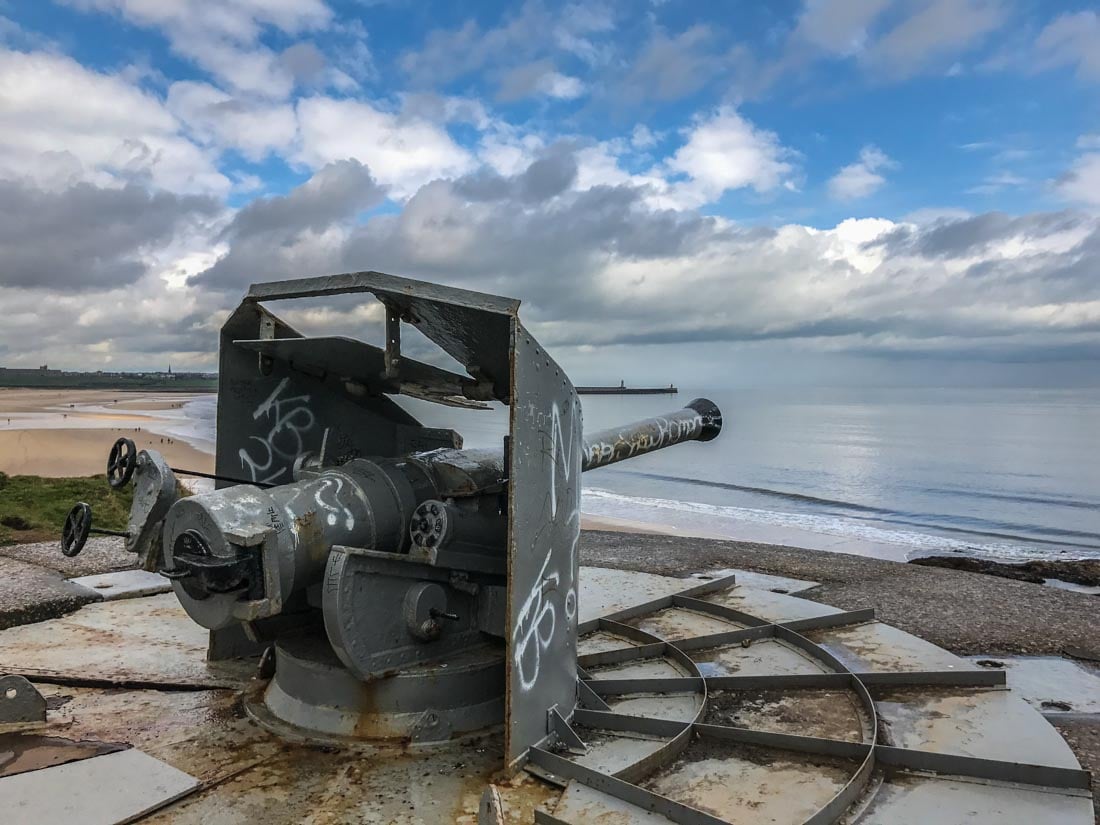
This is the Trow Rocks Disappearing Gun. While it looks like a standard defensive fortification, it was actually the site of a radical, top-secret military experiment in 1887.
During the late 19th century, naval artillery was advancing rapidly, leaving static clifftop gunners highly vulnerable to counter-fire while reloading.
To solve this, a design was put forward by the Clarke-Maxim Company (famous for the Maxim machine gun). They built a massive underground concrete cylinder—21 feet wide and 14 feet deep—where a 6-inch naval gun sat on a steel platform floating on water.
The concept was ingenious: air pressure pumps would force the gun up to the surface to fire, and the massive natural recoil of the shot would plunge the gun safely back down into the subterranean pit out of sight to reload.
It was quite literally a “pop-up” weapon.
There was only one fatal flaw. During the official War Office trials on December 15, 1887, the mechanism proved to be devastatingly slow.
After firing, it took the steam-powered air pumps nearly eight hours to build up enough pressure to lift the gun back into the firing position.
Needless to say, the military abandoned the project, stripped the ironwork, and buried the pit in 1894.

The gun you stand next to today is a meticulously constructed full-scale replica, built and winched into the original concrete pit by the Royal Electrical and Mechanical Engineers (REME) in the late 1980s to honor the North East’s pioneering coastal engineering history.
The Subterranean Secrets of Marsden Grotto
Nestled into the rock face directly opposite the towering Marsden Rock stack is Marsden Grotto.

It is one of the only cave bars in Europe, and its history is entirely real. In 1782, a local miner known as “Jack the Blaster” used explosives from the nearby quarries to blast a home directly into the cliffside.
It quickly became a notorious haven for smugglers hiding contraband slipped off ships under the cover of darkness.
If you want to experience one of the UK’s most unusual pubs, read my full Marsden Grotto cave bar review for opening times and menu recommendations.
Souter Lighthouse: A World Pioneer
Don’t just walk past Souter Lighthouse—it is a monumental piece of maritime history.

Opened in 1871, it was the first lighthouse in the world specifically designed and built to be powered by alternating electric current.
At a time when the rest of the world was relying on oil and candles, Souter was a technological marvel, casting a beam that could cut through the notoriously thick North Sea fog for over 20 miles.
🍽️ The Hospitality Stop: Where to Refuel
Mid-Way Pitstop: The Tea Rooms at Souter Lighthouse. Ideal for a mid-hike flat white and a proper slab of homemade cake. It’s dog-friendly in the outdoor courtyard.
The Unique Experience: Marsden Grotto. You cannot pass up the chance to have a pint of local ale inside a cave. Access is via the cliff steps or the lift from the clifftop.
The Finish Line Feast: The Smugglers Den or Poetic License. Located near Roker beachfront, these spots offer fantastic post-hike recovery meals, excellent craft beers, and a welcoming atmosphere for tired walkers.
🐾 The Four-Legged Team Dispatch
Malc & Pete’s Trail Notes
This is an absolute paradise for dogs, but it requires active management. The Leas offers miles of wide-open, glorious grass where Malc and Pete love to stretch their legs, but coastal erosion is real here.

Keep your eyes peeled for sudden drops and unprotected cliff edges, particularly as you approach Marsden. If your dogs don’t have a reliable emergency recall, keep them on a short lead for this 3-mile stretch.
The Reward: Once you clear Whitburn and drop down onto Seaburn and Roker beaches, the sand is spectacular (just double-check seasonal dog ban signs if you are walking during the peak summer months).
Wrap up the day at the dog-friendly pubs near Roker Marina, where a cold bowl of water and a warm hearth are always waiting.
Ready for the Next Milestone?
You’ve unlocked the industrial mouth of the Tyne and conquered the limestone cliffs of Marsden. Now, the trail shifts toward industrial heritage, hidden beaches, and world-famous coastal geology.
👉 Advance to Tyne to Tees Stage 2: Sunderland to Seaham