

I. The Call of the Wild: Embracing the Spirit of Escapism
The air was so still you could almost hear the stars. I remember the moment with perfect clarity: the gentle hiss of the stove melting away into silence, the first sip of hot tea warming my hands through my gloves, and the vast, velvet dome of a Lake District night sky unfolding above me.
There was no phone signal, no distant hum of traffic, no blue light from a screen.
There was only the quiet breathing of the mountains, the faint rustle of the tent fabric in a breeze I couldn’t feel, and a profound sense of solitude that felt less like being alone and more like being whole.
That night, camped high on a grassy shelf overlooking a silent valley, wasn’t just about sleeping outdoors. It was a reset button for the soul.
For me, this is the essence of wild camping. It is the pursuit of moments like that one. In our hyper-connected, relentlessly noisy world, the desire to escape is a powerful and natural instinct.
It’s a yearning to shed the layers of digital distraction, social obligation, and the low-level anxiety of modern life.
Wild camping is the answer to that call. It’s more than a hobby; it’s a practice. It’s the deliberate act of stepping out of the familiar and into a world governed by simpler, more fundamental rhythms: the rising and setting of the sun, the shifting of the weather, the needs of your own body for warmth, shelter, and sustenance.
This guide is born from countless nights spent under canvas, from mistakes made and lessons learned on rain-lashed hillsides and in sun-drenched valleys.

It is not a rulebook designed to constrain, but a map intended to empower.
It is a sharing of knowledge to help you find your own moments of quiet connection, to build the confidence and competence to rely on yourself and your kit, and to experience that unique, quiet confidence that comes from knowing you can make a temporary home in a wild place.
We will journey through the practicalities—the laws, the gear, the skills—but we will never lose sight of the magic. This is your invitation to answer the call of the wild, to pack your bag, and to discover the profound escapism that awaits.
II. Navigating the Landscape: The Legalities and Ethics of Wild Camping in the UK
Introduction: A Tale of Two Countries (and a Principality)
Before you even think about which sleeping bag to buy or what route to plan, you must understand one fundamental truth: the UK is not a single entity when it comes to wild camping.
The legal and cultural landscape is a complex patchwork, and navigating it responsibly is the first and most important skill you will learn.
What is a celebrated right in the mountains of Scotland is a matter of tolerated trespass in the fells of the Lake District.
Understanding these differences is not just about avoiding trouble; it’s about respecting the land, the landowners, and the very traditions that allow this activity to continue.
Scotland: A Right to Roam
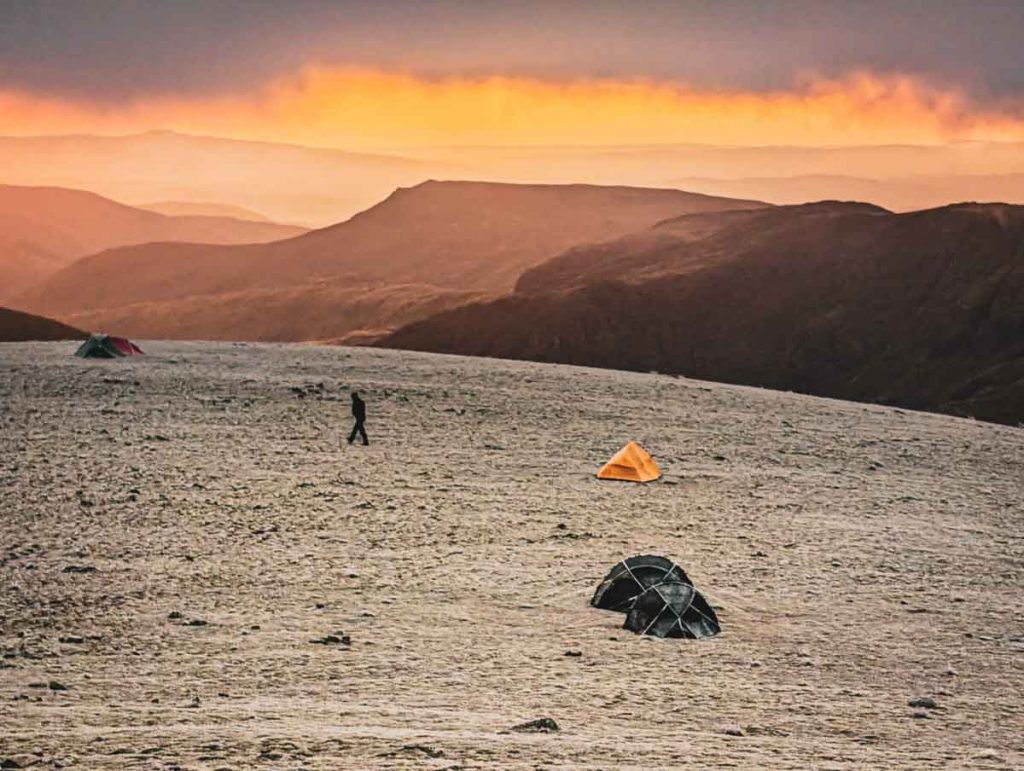
Scotland is, for the wild camper, the promised land.
Here, the right to camp on most unenclosed land is enshrined in law. The Land Reform (Scotland) Act 2003 establishes a right of responsible access to land and inland water for recreation, which explicitly includes camping.
This is a truly enlightened piece of legislation, born from a deep cultural understanding of the relationship between people and the landscape.
It means that when you pitch your tent by a remote loch or high in the Cairngorms, you are not a trespasser; you are exercising a legally protected right.
However, this right comes with a crucial set of responsibilities, which are laid out in the Scottish Outdoor Access Code.
This isn’t just a list of suggestions; it’s the ethical framework that makes the whole system work. The core tenets are simple: respect the interests of other people, care for the environment, and take responsibility for your own actions.
This means you cannot camp in enclosed fields with crops or livestock, near buildings, or in any way that impedes the work of farmers or landowners.
Furthermore, some specific areas, most notably a large part of Loch Lomond & The Trossachs National Park, have byelaws that restrict camping during the busy season (March to September) to designated permit areas to manage environmental pressure.
Always check the specific park authority’s website before you go. The Scottish model fosters a culture of open responsibility; you are a steward of the land you have the right to enjoy.

England and Wales: The Path of Permissive Trespass
South of the border, the situation is entirely different.
In England and Wales, every piece of land is owned by someone. Therefore, with one significant exception, there is no legal right to wild camp.
Pitching your tent without the landowner’s permission is technically an act of civil trespass.
While this sounds intimidating, the reality on the ground is more nuanced.
Civil trespass is a dispute between landowners and individuals, not a criminal offence, and you will typically be asked to move on long before any legal action would be considered.
The Dartmoor Anomaly
The one shining exception in England is Dartmoor National Park. For decades, a tradition of wild camping has been upheld by the park’s byelaws, which permit camping in certain areas.
This isn’t a blanket permission; the Dartmoor National Park Authority (DNPA) publishes detailed maps showing the specific areas where “backpack camping” is allowed.
It’s essential to consult these maps, as large parts of the moor are excluded, including sensitive archaeological sites, farmland, and areas used for military live firing.
Always check the firing times on the government website before planning a trip.
Seeking Permission
The most straightforward way to camp legally in England and Wales is also the one people are most hesitant about: asking for permission.
If you can identify the landowner—often a local farmer—knocking on their door and politely explaining your intentions can transform your experience.
I’ve done this myself, heart in my mouth, expecting a flat refusal, only to be met with a warm smile and directions to a sheltered spot with a good view.
This simple act of communication changes the dynamic from one of stealth to one of welcome, creating a positive connection with the people who live and work in the landscape you wish to enjoy.
The Unwritten Rules of Tolerated Camping
In the great upland areas like the Lake District, Snowdonia, and the Brecon Beacons, wild camping, while not legal, is largely tolerated on the high fells, provided a strict, unwritten code of conduct is followed.
This code has evolved to ensure campers have minimal impact and go unnoticed. It is the foundation of the ‘permissive trespass’ culture.
Arrive Late, Leave Early: This is the golden rule. The aim is to pitch your tent as dusk is falling and be packed up and gone shortly after sunrise. This ensures you do not interfere with other people’s enjoyment of the landscape during the day and minimises your visual impact.
Be Discreet: The goal is to be invisible. Camp high and away from popular paths, roads, and dwellings. Use the contours of the land to your advantage, tucking your tent into a small hollow or behind a rise. Choose a tent with muted, natural colours (greens, browns) that blend in.
Small Groups Only: Wild camping is an activity for individuals or pairs. This is not the place for a large group or a party. Keep noise to an absolute minimum; the silence of the hills is a resource to be protected.
The difference in legal frameworks has a profound effect on the entire experience.
In Scotland, camping feels like an act of freedom and public ownership, guided by a clear code of responsibility.
In England and Wales, it is an act of quiet discretion, governed by an unwritten social contract.
This distinction shapes everything, from your choice of campsite (more open in Scotland, more hidden in England) to your mindset.

The Leave No Trace (LNT) Philosophy: Our Social Contract
Underpinning all the laws and unwritten rules is a single, unifying philosophy: Leave No Trace.
This is not just a catchy phrase or a checklist of actions; it is an ethical mindset. It is the commitment to leave a wild place exactly as you found it, ensuring that the next person—and the next generation—can experience the same sense of discovery and wildness.
In areas where camping is only tolerated, adhering to LNT principles is not just about environmentalism; it is an act of collective self-preservation.
One badly-behaved camper who leaves litter, damages the ground, or starts a fire can jeopardise access for the entire community.
Following these principles is our side of the bargain, the social contract that keeps wild camping viable.
The Seven Principles in Practice:
- Plan Ahead and Prepare: Proper planning is the foundation of LNT. It means studying your map, checking multiple reliable weather forecasts, and ensuring your gear and skills are up to the task. This prevents situations where you might have to make poor, high-impact decisions out of desperation.
- Travel and Camp on Durable Surfaces: The ground beneath your feet is a living thing. When you pitch your tent, choose a durable surface like dry grass, rock, or gravel. Avoid fragile ecosystems like alpine meadows, mosses, and boggy ground, which can take years to recover from compaction.
- Dispose of Waste Properly: This is non-negotiable. If you can carry it in full, you can carry it out empty. “Pack it in, pack it out” applies to everything—food wrappers, tea bags, and even organic waste like apple cores and orange peels, which take a surprisingly long time to biodegrade and can attract animals. For human waste, walk at least 30-50 metres away from any water source, paths, or your camp. Dig a small “cathole” 6-8 inches deep, and bury your waste and the toilet paper. The trowel you carry for this purpose is one of the most important pieces of kit you own.
- Leave What You Find: Resist the temptation to build elaborate shelters, dig trenches around your tent, or take natural “souvenirs” like rocks or flowers. The goal is to leave the landscape as you found it.
- Minimise Campfire Impact: This is a critical point for the UK. Our peat-rich uplands and moorlands are incredibly vulnerable to fire, which can smoulder underground for weeks and cause catastrophic, long-lasting damage. For this reason, open fires should be avoided entirely in most wild camping scenarios. A modern camping stove is a far safer, more efficient, and more responsible choice for cooking.
- Respect Wildlife: You are a visitor in their home. Observe animals from a distance and never feed them. Feeding wildlife can alter their natural behaviours and harm their health. Store your food securely to avoid attracting curious creatures to your tent overnight.
- Be Considerate of Other Visitors: The mountains are for everyone. Keep noise levels to a minimum and let the natural sounds prevail. Pitch your tent away from others to respect their search for solitude.
|
Region |
Legal Status |
Key Rules / Byelaws |
Best Practice / Etiquette |
|---|---|---|---|
|
Scotland |
Legal right of access under the Land Reform (Scotland) Act 2003. |
Follow the Scottish Outdoor Access Code. Avoid camping near buildings or in fields with crops/livestock. |
Camp responsibly and openly. Follow LNT principles as part of your legal responsibility. |
|
England – Dartmoor |
Permitted in specific areas as defined by park byelaws. |
Must consult the official DNPA camping map. Check military firing times. No large groups or open fires. |
Stick to designated zones. Practice LNT meticulously to protect this unique privilege. |
|
England – Other National Parks (e.g., Lake District) |
No legal right; technically civil trespass without landowner permission. |
No specific byelaws permitting camping. Governed by the principle of tolerated, responsible behaviour. |
“Arrive late, leave early”. Be discreet, camp high, small groups only. LNT is paramount to maintain tolerance. |
|
Wales (e.g., Snowdonia) |
No legal right; technically civil trespass without landowner permission. |
Governed by convention and tolerance. The Snowdonia National Park Authority discourages it but provides LNT advice. |
“Arrive late, leave early”. Be discreet, camp high, small groups only. LNT is the social contract. |

III. The Essential Kit: Equipping Yourself for Comfort, Safety, and Self-Sufficiency
Introduction: Your Life-Support System
Your equipment is more than just a collection of items you carry on your back; it is an integrated life-support system.
Each piece of gear is a link in a chain designed to keep you warm, dry, safe, and self-sufficient in an environment that can be unforgiving.
Good kit is not necessarily the most expensive or the lightest, but it must be reliable. When the wind is howling and the rain is driving sideways against your tent at 2 AM, you will not care about the brand name; you will only care that it works.
Thinking about your gear not as individual items, but as interconnected systems, is the first step towards true competence in the wild.
The Big Three: The Core of Your Mobile Home
The combination of your shelter, sleep system, and pack forms the nucleus of your wild camping setup. Getting these three elements right is crucial for a successful trip.

1. The Shelter System (Tent, Bivvy, or Tarp)
Your shelter is your primary defence against the elements. The choice depends on your personal philosophy and the conditions you expect.
Tents:
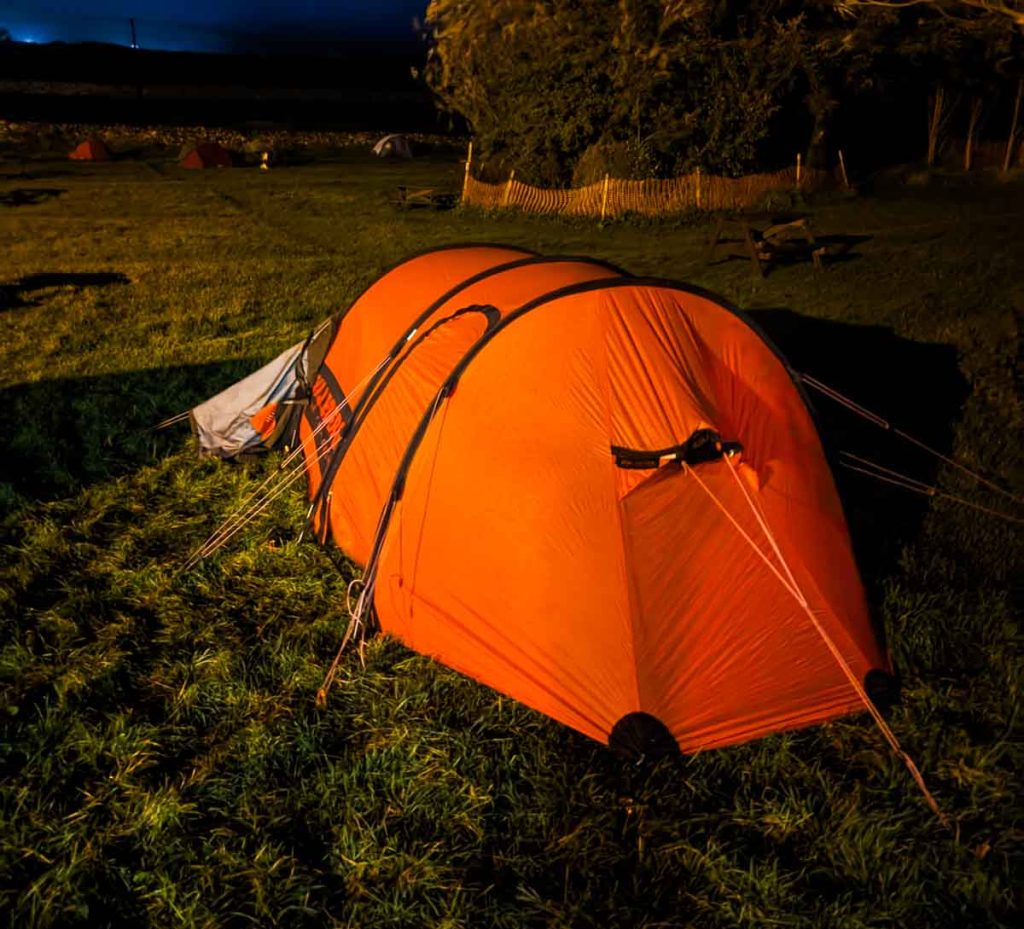
Offer the most protection, space, and comfort. For the UK’s often windy conditions, a tent with a good pole structure is vital. Geodesic or semi-geodesic designs, with multiple crossover points in the poles, are exceptionally strong and stable in high winds.
Tunnel tents offer a great space-to-weight ratio but must be pitched carefully with their tail into the wind. Look for a tent with a good hydrostatic head (HH) rating—a measure of how waterproof the fabric is. Similar to how we measure waterproof jackets.
A rating of 3000mm HH for the flysheet and 5000mm for the groundsheet is a solid benchmark for three-season UK use.
I once, many years ago spent a night in a cheap tent on the Carneddau plateau when a storm rolled in. The poles flexed to alarming angles, and the flysheet flapped like a machine gun.
I didn’t sleep a wink. The next week, I invested in a robust semi-geodesic tent, and the peace of mind on subsequent windy nights was worth every penny.
Bivvy Bag:
A bivouac bag is essentially a waterproof, breathable sack that you put your sleeping bag inside.
It is the choice for minimalists and those who want the most immersive experience—there is nothing quite like lying in a warm bag, looking directly up at the stars.
They are lightweight, discreet, and have a tiny footprint. The downsides are condensation management and the lack of space to store gear or wait out a prolonged storm.
Tarp:
A simple sheet of waterproof fabric, a tarp is the ultimate in lightweight, minimalist shelter. It requires more skill to pitch effectively and offers less protection from wind-driven rain and insects, but provides an unparalleled connection to your surroundings.
A tarp is great for woodland wild camping as you can use the trees as anchors for the tarp.
2. The Sleep System (Bag & Mat)
A warm night’s sleep is the foundation of an enjoyable trip. Your sleeping bag and sleeping mat work together as a system; one is ineffective without the other.
Sleeping Bag:
The most important feature is its temperature rating. You will see three figures: Comfort (the temperature at which a ‘standard’ woman can expect to sleep comfortably), Limit (the lowest temperature for a ‘standard’ man), and Extreme (a survival rating only).
For three-season camping in the UK, you should choose a bag where the Comfort rating matches the lowest nighttime temperature you anticipate.
The next choice is insulation: down or synthetic. Down offers the best warmth-to-weight ratio and is highly compressible, but it is expensive and loses all its insulating properties when wet.
Synthetic insulation is bulkier and heavier but performs much better in the damp, humid conditions common in the UK and is more affordable.
Sleeping Mat:
Your sleeping mat’s primary job is not comfort; it’s insulation.
It protects you from losing precious body heat to the cold ground. This insulating ability is measured by its R-value; the higher the R-value, the warmer the mat.
A mat with an R-value of 2-4 is suitable for most three-season UK use.
A high-quality sleeping bag is rendered useless if paired with a low R-value mat, as your warmth will simply be sucked away by the earth.
This is the perfect example of thinking in systems: the bag provides insulation on top, the mat provides it underneath. They are two halves of a whole.
Foam mats are cheap, light, and indestructible, but bulky. Inflatable mats are more comfortable and pack down smaller, but are more expensive and can be punctured.
3. The Pack System (Rucksack)
Your rucksack is your mobile home. We have a great guide to help you choose and fit your rucksack.
For a one or two-night trip, a capacity of 40-65 litres is usually sufficient.
The single most important factor is fit. A well-fitted 60-litre pack carrying 15kg will feel more comfortable than a poorly-fitted 40-litre pack carrying 10kg.
Take the time to adjust the back length, load lifters, sternum strap, and hip belt.
The majority of the weight should be taken on your hips, not your shoulders. How you pack is also a skill: place heavy items like your tent, stove, and food close to your spine in the middle of your back.
Put your sleeping bag at the bottom and essentials you might need quickly (waterproofs, map, first-aid kit) at the top or in external pockets.
Essential Support Systems
The Galley (Cooking System)
As discussed, a camp stove is the only responsible way to cook in the UK uplands.
Integrated Systems (e.g., Jetboil): These combine the burner and pot into one efficient unit. They are incredibly fast at boiling water, making them perfect for dehydrated meals and hot drinks, but less suitable for more complex cooking.
I use the Alpkit Brukit when I go wild camping.
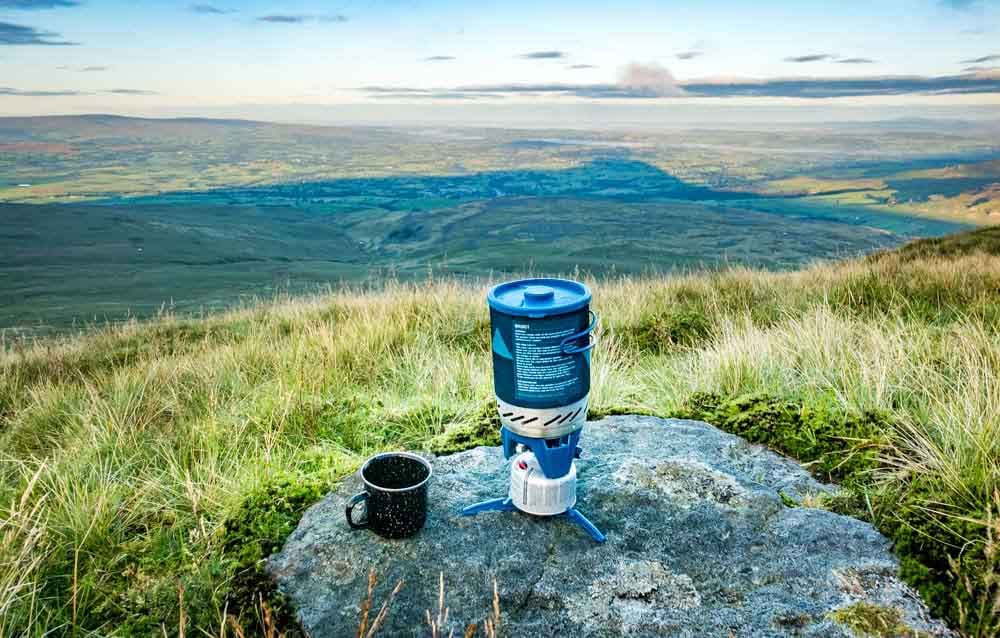
Separate Burner and Pot Systems: These offer more versatility. A small, screw-on gas burner paired with a titanium or aluminium pot allows you to simmer and cook more “real” food. They are often lighter than integrated systems.
The Navigation & Safety Kit
This system is your lifeline. Technology is a fantastic aid, but it can fail.
The Unbreakables: A physical, waterproofed map (Ordnance Survey 1:25,000 scale is the walker’s choice) and a compass are non-negotiable, essential items. You must know how to use them. Batteries die, screens break, and GPS signals can be lost. A map and compass, when protected, will always work.
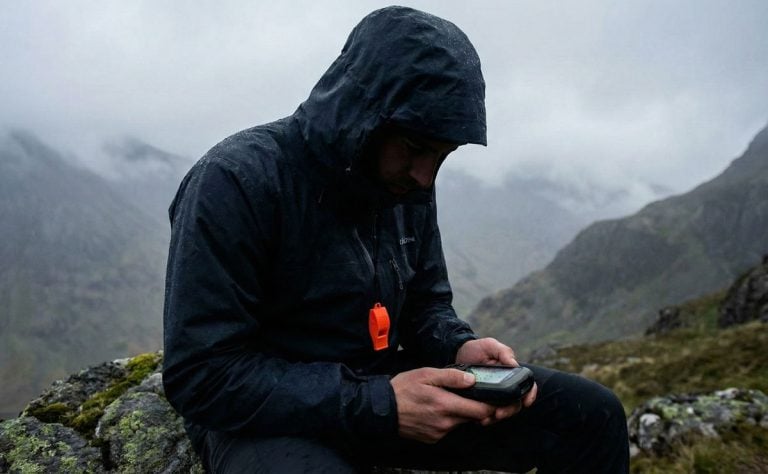
The Tech: A GPS device or a smartphone with a good mapping app (like OS Maps or ViewRanger) is an excellent secondary tool. They are brilliant for pinpointing your exact location quickly. However, their reliance on batteries is their Achilles’ heel, especially in cold weather which can drain them rapidly. Always carry a power bank, but never rely on it as your sole source of navigation.
Lighting: A headtorch is essential for hands-free operation when pitching your tent or cooking in the dark. Choose one with a red light mode to preserve your night vision. Always carry spare batteries.
First-Aid Kit: Your kit should be personal and tailored to the trip, but a good baseline includes: blister plasters (Compeed are excellent), antiseptic wipes, sterile dressings, painkillers, tick remover, and any personal medication you require.

The Wardrobe (Clothing System)
The UK’s changeable weather demands a flexible clothing system based on layering. Read our complete guide to layering for the UK.
Base Layer: Worn next to the skin, its job is to wick sweat away to keep you dry. Merino wool or synthetic fabrics are ideal.
Mid Layer: This is your insulation layer. A fleece jacket or a lightweight insulated jacket (down or synthetic) traps your body heat.
Outer Layer (Shell): This protects you from wind and rain. A high-quality waterproof and breathable jacket and trousers are absolutely essential, no matter what the forecast says.
The Golden Rule: No Cotton. Cotton absorbs moisture, draws heat from your body when wet, and takes a very long time to dry. It has been linked to countless cases of hypothermia. Stick to wool and synthetics.
IV. The Art of the Pitch: Mastering Campcraft from Map to Morning
Introduction: The Perfect Spot
A successful wild camp is more than just having the right gear; it’s about having the right skills.
The most crucial of these is the art of selecting and setting up your campsite. Finding that perfect spot—one that is safe, comfortable, sheltered, and has minimal environmental impact—is a craft that blends map-reading, observation, and foresight. It begins not on the hillside, but at your kitchen table.
Phase 1: The Armchair Explorer (Map Reading)
Your Ordnance Survey map is a treasure trove of information that allows you to identify promising campsites before you even lace up your boots. Learning to read its language is a game-changer.
Decoding Contour Lines: These brown lines are the key to understanding the shape of the land. Closely packed contours indicate steep, unsuitable ground. Widely spaced contours show flat or gently sloping terrain—these are the areas you’re looking for. Scan the map for small, flat areas high on ridges, in the crook of a stream, or on a shelf just below a summit (offering shelter from the wind). A ‘col’ or ‘saddle’ between two peaks can often provide a flat, sheltered pitch.
Identifying Water Sources: The thin blue lines on the map are your streams and rivers. A reliable water source is a key ingredient for a good campsite. Try to identify a spot that is close, but not too close, to a stream marked as perennial (a solid blue line, not a broken one). Plan to pitch upstream of any areas where livestock might be grazing to reduce contamination.
Spotting Hazards: The map also warns you of what to avoid. Blue tussock symbols indicate boggy or marshy ground—a camper’s nightmare. Areas marked with scree symbols or crags should be given a wide berth to avoid the risk of rockfall.
By the time you leave the house, you should have two or three potential pitch locations marked on your map. This gives you options and flexibility once you are out on the hill.
Phase 2: Boots on the Ground (Site Selection)
Having reached your target area, it’s time for the final checks. The map gets you close; your eyes and feet make the final decision.
The Ground: Is the ground truly flat? A slight slope that seems insignificant can become incredibly annoying when you’re trying to sleep. Is it dry and well-drained? Probe the ground with your walking pole; what looks like lush grass can be a disguised bog. Look for a durable surface of short, dry grass. Avoid camping on fragile vegetation like mosses, lichens, or wildflowers, which are easily damaged.
Shelter: Assess the prevailing wind direction. Even a slight breeze can feel chilling over several hours. Look for natural shelter. Can you tuck your tent into the lee side of a small hillock, a large boulder, or a solid stone wall (while still keeping a respectful distance)?
Water: Locate the water source you identified on the map. Does it look clean and fast-flowing? Is it easily accessible?
Safety: Always look up before you pitch. Are there any large, dead branches on trees overhead (known ominously as “widowmakers”)? Are you in the bottom of a narrow valley or a dry riverbed that could be prone to flash floods in heavy rain? Are you directly beneath a steep, loose crag?
Phase 3: The Camp Routine
Once you’ve found your spot, a smooth and practised routine makes life easier and safer.
Setting Up: Pitch your tent with the door facing away from the wind to prevent it from billowing inside every time you open it. Once the tent is up, get your sleeping bag and mat unrolled inside so the bag has time to loft and regain its full insulating power. Organise your gear methodically so you can find things easily, even in the dark.
Water and Sustenance:
Sourcing and Purification: No matter how clear and pure it looks, you must always treat water collected from streams in the UK hills. The risk of contamination from livestock or wild animals is ever-present. Collect your water from a fast-flowing section, well away from your camp.
Methods for purification include: boiling (the most reliable method, but uses fuel), chemical tablets (chlorine or iodine; lightweight and simple but can leave a taste), and filters (like the Sawyer Squeeze or Katadyn BeFree; these physically remove bacteria and protozoa and are fast and effective).
Food Strategy: Wild camping food should be lightweight, calorie-dense, and easy to prepare. Modern dehydrated meals are a fantastic option; they are surprisingly tasty, weigh very little, and require only hot water.
Other staples include pasta, couscous, instant noodles, and oatcakes.
High-energy snacks like nuts, dried fruit, and chocolate are essential for keeping your energy levels up. Always plan your meals and pack one extra emergency meal, just in case.
Breaking Camp: This is the final and most important test of your LNT ethic. After you’ve packed everything away, do a slow, methodical sweep of your campsite.
Look for tiny scraps of litter or dropped food. Leave it exactly as you found it—or even better. Before you leave, take a moment to fluff up the grass where your tent was sitting with your fingers.
This helps it recover more quickly and erases the final sign of your passing.
The Safety Plan: Your Invisible Partner
Your safety plan is not a single item but an integrated process that begins before you leave and runs through your entire trip. It is a system of risk management where each part supports the others.
Weather is King:
The weather is the single greatest objective danger in the UK mountains. It can change with frightening speed. Before any trip, you must check multiple, reliable mountain-specific forecasts, such as the Mountain Weather Information Service (MWIS) and the Met Office’s mountain forecasts.
These provide detailed information on wind speed at different altitudes, precipitation, and visibility. This forecast directly informs the route you plan and the gear you pack. If the forecast is for gale-force winds, your plan to camp on an exposed summit must change.
Tell Someone Your Plan:
This is a simple, non-negotiable rule that could save your life. Before you leave, give a reliable person a “route card.”
This should include your start and end points, your intended route (with grid references if possible), your potential wild camp locations, your car registration number, and, crucially, a “panic time”—the time by which they should call for help (dial 999 and ask for Police, then Mountain Rescue) if they have not heard from you.
This creates a safety net. The route you give them is the one you formulated based on the weather forecast. If something goes wrong, rescuers will know where to start looking.

This holistic approach—weather informing the route, the route being shared with a contact—forms a closed loop of safety and preparedness.
The ability to find and purify water is another fundamental enabler of true wild camping freedom. Without this skill, you are tethered to civilisation, limited by the two or three litres of heavy water you can carry on your back.
This effectively restricts you to short, overnight trips. Mastering a reliable purification method cuts this chain. It unlocks the potential for multi-day treks, high-level traverses, and the ability to travel light and self-sufficiently through the wilderness for days at a time. It fundamentally expands the scope of what is possible.
V. A Patchwork of Wilderness: A Regional Guide to the UK’s Premier Wild Camping Locales
Introduction
With the ‘how’ covered, we can now turn to the ‘where’. The UK offers a stunning variety of landscapes for the wild camper. Each region has its own unique character, its own rules, and its own rewards.
A wild camp is not a uniform experience; its nature is shaped by the specific legal, topographical, and cultural landscape of the place you choose.
Understanding this character is key to planning a successful and respectful trip. What follows is not an exhaustive list, but a personal tour of some of my favourite wild camping heartlands.
Dartmoor: The English Anomaly
The Vibe: Dartmoor feels ancient and elemental. It is a vast, rolling expanse of high moorland punctuated by magnificent granite tors that stand like ruined castles against the skyline. There’s a unique, slightly eerie beauty to the place, steeped in folklore and Bronze Age history. The weather can sweep in with incredible speed, transforming a sunny afternoon into a disorienting, misty wilderness.
The Rules: This is the one place in England where wild camping is generally permitted, but this is a privilege, not a free-for-all. You must follow the Dartmoor National Park Authority’s guidance. This involves consulting their official interactive camping map to ensure you are in one of the permitted zones and avoiding all farmland, moorland enclosed by walls, flood plains, and sensitive archaeological sites. Large parts of the northern moor are used for military training, so checking the live firing times is an absolute necessity before you go.
A Classic Route Idea: For a classic Dartmoor experience, a two-day loop starting from Okehampton Camp takes you into the heart of the high northern moor. You can tick off the two highest points in southern England, Yes Tor and High Willhays, before dropping down to find a pitch near the headwaters of the West Okement River. Waking up to the sound of the stream with the silhouettes of the tors against the dawn sky is an unforgettable experience.
The Lake District: The Romantic’s Choice
The Vibe: The Lake District is pure drama. It’s a compact area of soaring fells, knife-edge ridges, deep, reflective lakes, and stone-walled valleys. This is the spiritual home of British hillwalking, immortalised by Wainwright, and its beauty can take your breath away. It is rugged, challenging, and immensely popular, which presents its own challenges.
The Rules: Wild camping here exists in the grey area of tolerated trespass. It is not legal, but there is a long-standing tradition of it on the high fells, away from the valleys and roads. This tolerance is entirely dependent on the behaviour of campers. The “arrive late, leave early” mantra and the entire Leave No Trace ethic are not just best practice here; they are the essential social contract that allows the tradition to continue. The spirit of a Lake District wild camp is one of quiet, respectful discretion.
A Classic Route Idea: A high-level camp in the Langdale Pikes offers some of the most iconic views in the national park. A classic route involves ascending via Jack’s Rake (a Grade 1 scramble, for the experienced) or the path from Stickle Ghyll, and finding a pitch near one of the high tarns like Stickle Tarn or the more remote Angle Tarn. The reward is waking up to a sublime mountain vista, often with a cloud inversion filling the valleys below.

Snowdonia (Eryri): Land of Legends
The Vibe: Snowdonia, or Eryri, is a land of myth and jagged grandeur. It feels wilder and more rugged than the Lakes. Its mountains are fierce and rocky, from the famous ridges of Yr Wyddfa (Snowdon) and Crib Goch to the vast, boulder-strewn plateaus of the Glyderau and the Carneddau. There is a deep sense of Welsh culture and history embedded in the landscape.
The Rules: The legal situation is the same as the Lake District: no legal right, but a tradition of tolerance for responsible campers on the higher, wilder mountains. The National Park Authority asks people not to camp wild, especially in the “honeypot” areas around Snowdon itself, but the practice continues. The key is to get away from the crowds and seek out the more remote ranges.
A Classic Route Idea: While the Snowdon and Glyderau ranges are magnificent, they can be busy. For a true sense of space and solitude, the Carneddau range to the north of the Ogwen Valley is hard to beat. A two-day circuit starting from near Llyn Ogwen can take you over the high summits of Carnedd Llewelyn and Carnedd Dafydd. This vast, high plateau feels a world away from the queues on Snowdon and offers countless opportunities for a spectacular and remote wild camp.
The Brecon Beacons (Bannau Brycheiniog): The Rolling Giants
The Vibe: The landscape of the Brecon Beacons is one of sweeping scale and grandeur. The mountains here are not the jagged peaks of Snowdonia but great, rolling ridges of old red sandstone that form vast, grassy plateaus. The views are immense, and on a clear day, you can feel on top of the world.
The Rules: The situation here is slightly different again. Much of the park is actively farmed, meaning that seeking landowner permission is a more common and often necessary approach. However, there are large areas of open common land, particularly in the Black Mountain (Mynydd Du) and Black Mountains ranges, where responsible wild camping is often tolerated.
A Classic Route Idea: The classic Pen y Fan horseshoe is one of Britain’s great day walks. To turn it into a wild camping adventure, you can extend the route eastwards along the long, broad ridges towards the Brecon Beacons’ eastern fans. Finding a pitch up high allows you to witness a spectacular sunrise over the highest peak in southern Britain, watching the morning light spill across the Usk valley far below.
Scotland: The Ultimate Freedom
The Vibe: The scale of the Scottish Highlands is on another level entirely. This is the UK’s wild camping heartland, a place of genuine wilderness and remoteness. From the vast, arctic-like plateau of the Cairngorms to the impossibly jagged peaks of Torridon and the dramatic coastlines of the west, the opportunities are almost limitless. A wild camp here is an exercise in navigating true wilderness.
The Rules: As detailed earlier, the Land Reform (Scotland) Act 2003 gives you the right to wild camp on most unenclosed land. This freedom, however, comes with the immense responsibility of navigating a challenging and potentially dangerous environment while adhering strictly to the Scottish Outdoor Access Code. The challenge here is less about legality and more about self-sufficiency and respect for a wild environment.
A Classic Route Idea: For the experienced and ambitious, a multi-day traverse of the Cairngorms 4000-foot peaks represents a pinnacle of UK wild camping, requiring superb navigation and resilience. For a more accessible but no less spectacular experience, a camp in the Lost Valley (Coire Gabhail) in Glencoe is unforgettable. Hidden away behind a screen of moraines, this high, flat-bottomed valley feels like a secret world, surrounded by the towering peaks of the Three Sisters.

VI. Beyond the Basics: Final Reflections from the Trail
As you gain experience, new horizons will open up. The skills and equipment that saw you through a summer’s night in the Brecon Beacons can be built upon to unlock even wilder adventures.
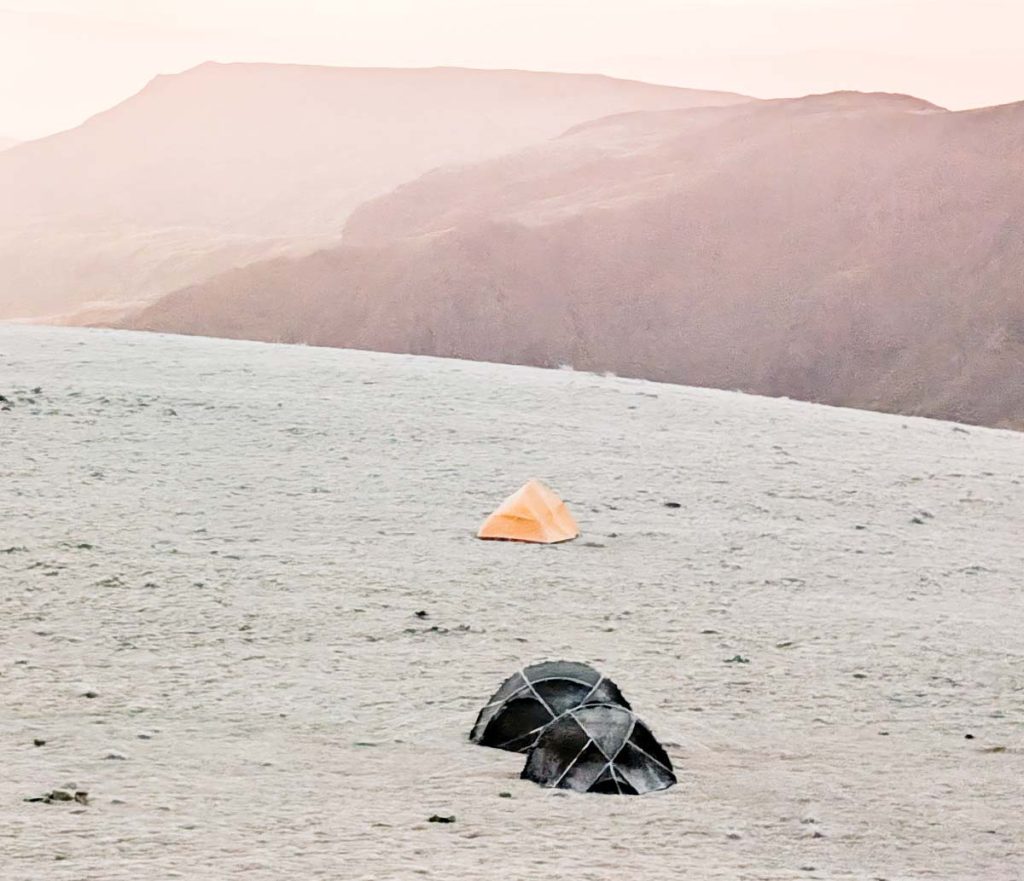
Four-Season Camping: Taking your wild camping into winter is a serious undertaking but offers incredible rewards: crisp, silent nights, snow-covered peaks, and a solitude that is absolute. It requires a significant step up in gear—a four-season tent built to handle snow loading and high winds, a much warmer sleep system, and technical equipment like an ice axe and crampons—and, most importantly, the skills to use them safely.
The Ultralight Philosophy: For some, the journey becomes about moving faster and further. The ultralight philosophy is a mindset focused on scrutinising every single gram in your pack. It involves swapping gear for lighter alternatives, multi-purposing items, and sometimes sacrificing a little comfort for the freedom of a lighter load, allowing you to cover more ground and explore more remote areas.
Dealing with Midges: No guide to UK camping would be complete without mentioning Scotland’s infamous Highland Midge. From late May to September, on still, damp evenings, these tiny biting insects can descend in clouds that can test the sanity of the most hardened camper. A good midge net for your head, insect repellent containing DEET or Saltidin, and a tent with a fine mesh inner are your best lines of defence.
The Responsibility of Freedom
If there is one thread that runs through this entire guide, it is this: wild camping is a privilege, not just a right.
Whether granted by law, as in Scotland, or by tolerance, as in much of England and Wales, it is a freedom that depends entirely on our collective responsibility. Every time we pitch a tent and leave no trace, we are casting a vote for the future of this activity.
We are honouring the trust of landowners and respecting the wild places that give us so much.
I think back to another night, this time in the Lake District. The forecast had been for showers, but the clouds broke just after sunset.
I wasn’t on a famous peak or by an iconic tarn. I was on a simple, grassy patch on the side of a nameless fell. As the last light faded, the valley below filled with mist, creating a sea of white under a sky full of stars. There was no grand achievement, no peak bagged, no record broken. There was just a quiet, simple, perfect moment of peace.
That is the heart of it. That is the escapism we seek. My hope is that this guide does more than just inform you.
I hope it inspires you to respectfully seek out your own quiet corners of the UK, to find your own moments of connection, and to return from the hills with more than just photographs, but with a renewed sense of perspective. The mountains are waiting. Go find them.



Hi Paul Steele!
Loved reading Your article on “The Escapism of Wild Camping”. So interesting
and adventurous, as also wonderful. Especially traveling with Malc.
Thank You!
Thanks so much Anita, glad you enjoyed
I always have trouble getting over shyness to ask permission to camp in someone’s field. I’ve done it once, and eventually they said yes but at first gave me the “you wanna do what??” look. Everything turned out fine though and I was given a very lovely spot next to their pond.
Would you ever consider doing a group camp, accompanying others who would love to, but are a bit afraid alone??
Hi! What a great idea. Will try to work on something
always wanted to try camping, but my SO doesn’t like hiking and sleeping out in a tent so.. 🙁
awww hope you get chance to do it soon
Any suggestions for us in Australia? There are some sensational areas you would love here. What a gorgeous dog! How do you field for snakes? Love the red tent!!! Do they have reversible ones, or a camo throw…
Hi, alas I don’t know the rules over there. This is for UK and we do not have any dangerous creatures out here. Yes I use a red tent. Just have to place it well of tracks
I am totally with you on this….you cant beat waking up to natures treasures….sadly unable these days due to arthritic knees but still try to get out very early once in a while! Fabulous post thanks
awww yes can’t beat waking to natural treasures. Hope you get more chance to get ot