

When you travel through Rome, it’s impossible to miss. Sandwiched between other ancient giants, you’ll find what looks like a mishmash of ruins.
And in a way, that’s exactly what it is. This is the Roman Forum (or Forum Romanum), and on my first visit, I was struck by how this sprawling, beautiful chaos was once the absolute centre of the known world.
What started as a simple marketplace grew over centuries to become the stage for the empire’s most significant events. It’s incredible to stand there and imagine everything that happened right under your feet:
- Fiery public speeches and political debates
- Triumphant military marches with cheering crowds
- Dramatic criminal trials and even gladiatorial matches
- The daily business of the ancient government
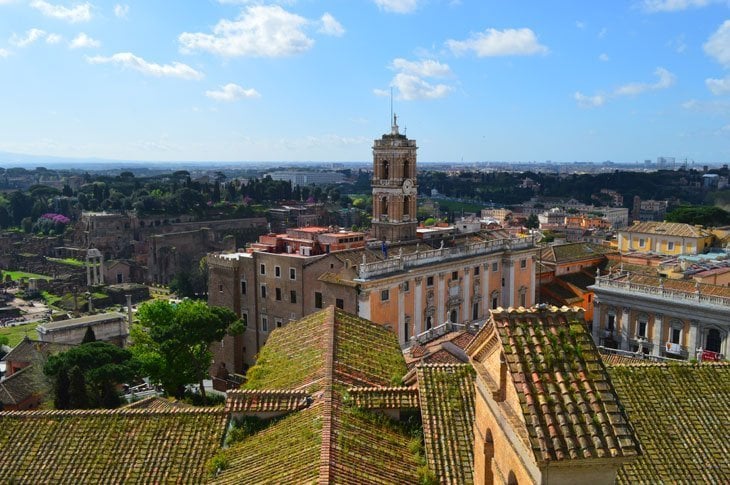
** Suggested Alt Text: “Sweeping view of the Roman Forum ruins on a sunny day, with the Arch of Septentimius Severus prominent in the background.”
A Layered History of Rise and Fall
The Roman way was to build on top of what came before, and you can feel that layered history everywhere in the Forum.
Different leaders and eras left their mark, creating a dense tapestry of temples, churches, and grand arches.
Eventually, the space became so built up that leaders like Caesar began constructing their own grander Imperial Fora nearby.
This marked the beginning of the end for the original, once-great Forum. It’s hard to picture, but by the Middle Ages, this sacred heart of the empire was falling apart, even disgracefully used as a refuse dump.

What to See at the Roman Forum Today
Walking through the Forum today is like exploring the intriguing skeleton of a time long past.
While much is gone, what remains is powerful. Here are a few of the sights that always stop me in my tracks.
Curia Julia (The Senate House)
What truly amazed me was seeing the Curia Julia. It’s a remarkably intact brick building, and it’s hard to wrap your head around the fact that this was the meeting place of the Roman Senate.
Started by Julius Caesar himself in 44 BCE, it was the administrative heart of the empire.
The only reason it’s so well-preserved is that it was converted into a church in the 7th century. If you look inside, you can still see the original, beautiful marble floor—a stunning piece of ancient artistry.

Arch of Titus
As you walk the main path, the Via Sacra, you can’t miss the Arch of Titus.
Built to commemorate the Roman victory and the brutal sacking of Jerusalem in 70 CE, its carvings are like a newspaper frozen in stone.
The most incredible detail for me is the inner panel showing Roman soldiers carrying away the spoils from the Temple of Jerusalem, including the famous seven-branched Menorah. It’s a stunning and somber piece of history.

Temple of Saturn
For me, the most iconic image of the Forum has to be the eight towering columns of the Temple of Saturn.
This was one of the oldest sacred sites in Rome, but it was more than just a temple—it was also the state treasury.
Rome’s gold and silver were stored right here, under the high podium. It’s a powerful symbol of the link between faith and the immense wealth of the empire.
Temple of Vesta and the House of the Vestal Virgins
I’ve always been fascinated by the story of the Vestal Virgins, and seeing the remains of their home and the circular Temple of Vesta is a powerful experience.
Inside this small shrine, an eternal flame burned, representing the safety and prosperity of Rome itself.
The six priestesses who tended it lived in the grand palace next door, theAtrium Vestae, a place that reflected their immense status in Roman society.

Basilica of Maxentius and Constantine
You can’t help but be awestruck by the sheer scale of the Basilica of Maxentius and Constantine.
The three massive barrel vaults that still stand today give you a real sense of the grandeur of late Imperial Rome.
This wasn’t a church but a colossal public hall for law courts and business, with engineering so advanced it resembled the great imperial baths.
It once held a gigantic statue of Constantine; you can see fragments of it—including a foot that’s taller than a person—in the Capitoline Museums today.

A Modern Tragedy: Mussolini’s Via dei Fori Imperiali
For me, as I stood there, the real tragedy isn’t just what time has eroded, but what modern ambition has buried.
In the 1930s, the dictator Mussolini, wanting a grand view from his office window to the Colosseum, ordered a massive road built straight through the ancient sites.
This road, the Via dei Fori Imperiali, cut a scar across history. Ancient remains, churches, and entire neighborhoods were demolished and paved over, a loss that authoritative historical sources describe as a devastating blow to our understanding of ancient Rome.
The irony, of course, is that the road was built to celebrate the very glories it was destroying.

A Wander Through Time: The Visitor Experience
To wander through the Forum is a welcome escape from the tighter, bustling Roman streets.
It’s a chance to slow down and just… be. You can walk pathways excavated down to Imperial times and know you are literally standing in the footsteps of huge ancient names.
It’s a profound look back in time, offering a tangible connection to a world that feels both impossibly distant and surprisingly close.

Practical Tips for Your Visit
To help you make the most of your own wanderings, here are a few practical tips I’ve picked up:
- Location and Tickets: The Roman Forum is centrally located next to the Colosseum and Palatine Hill. Entry is typically included in a combination ticket that covers all three sites, which is the most economical way to see them.
- Best Time to Visit: To avoid the largest crowds and the intense midday heat, especially in summer, plan your visit for early in the morning or late in the afternoon.
- Footwear: The site is large and the ground is uneven with ancient cobblestones. Comfortable walking shoes are essential.
You can book your isit and tickets online too.
The Forum is a must-see, but Rome is full of incredible secrets. For a truly unique view of the city, discover the surprising panoramic perspective of the entire city from Il Vittoriano. Or for symbolic places in the network of streets you can visit the Trevi Fountain or grab a coffee and watch all go by at Piazza Navona.
Or take a look at 3 countries at once on Aventine Hill.
Frequently Asked Questions about the Roman Forum
I often get asked a few common questions, so I’ve put together some quick answers here.




Rome is a beautiful place to visit which can’t be missed.Nice photographs.
Very beautiful photographs. Great photography. Rome is very beautiful place. I wish to visit Rome.
Great photos! Rome is one of my favorite cities and I never tire of seeing the ruins. I can’t imagine why they would use the Forum as a dump in the Middle Ages – what a waste! (no pun intended)