

In the heart of one of the world’s busiest cities lies a vast expanse of green that is more than just a park—it is London’s green heart.
Hyde Park, one of the capital’s most famous Royal Parks, has a dual identity that few places can match.
It is at once a modern playground, a vibrant hub of activity, and a living museum—a historic landscape where centuries of London’s most dramatic, peculiar, and revolutionary stories have unfolded.
This is a park where kings once hunted, where duellists settled matters of honour with pistol and sword, and where the world’s most legendary rock bands have played to seas of adoring fans.
It is a place of quiet reflection and loud revolution. To truly know Hyde Park is to understand the story of London itself.
This guide will take you beyond the well-trodden paths, weaving together the practical tips you need for a perfect day out with the unique and unforgettable stories that lie hidden in plain sight.

A Stage for History: Duels, Protests, and Palaces
Long before it was a public park, this land was the Manor of Hyde, owned by the monks of Westminster Abbey.
That all changed in 1536 when a king with a voracious appetite for both land and sport, Henry VIII, seized it to create his own private hunting ground.
For a century, it remained the exclusive domain of royalty, until King Charles I opened it to the public in 1637, and it quickly became the place for London’s elite to see and be seen.
Many of the striking features you see today in Hyde Park were created in the 1700s by a keen royal gardener, Queen Caroline… She annexed almost 300 acres from Hyde Park to form Kensington Gardens, the private grounds of Kensington Palace, the future birthplace of Queen Victoria
The 19th century saw its global fame cemented when it hosted the Great Exhibition of 1851, for which the magnificent Crystal Palace was constructed on its southern edge.
As the decades passed, the park transformed into a stage for the public voice, hosting protests by the Suffragettes and establishing itself as a cradle of free speech.
This legacy continued into the 20th century, with legendary concerts by bands like The Rolling Stones and Queen echoing across its great lawns.
To this day it remains a Royal Park, but it’s a space that’s intricately bound to everyday London life, connecting the green expanse of West London to iconic public spaces like Trafalgar Square.

Things to Do in Hyde Park: A Complete Guide
This is the heart of the article, where the park’s modern attractions meet their fascinating past.
The Serpentine: A Royal Lake of Surprising Drama
Practical Information: The park’s watery centrepiece is a hub of activity. You can hire colourful rowing boats and pedalos from April to September, or for the more adventurous, take a dip in the Serpentine Lido, which is open for public swimming on summer weekends from May and daily from June to September.
The lakeside Lido Café is the perfect spot for an ice cream or a coffee.

Unique History: The Serpentine may look natural, but it was a revolutionary piece of landscape design when it was created in the 1730s.
At the direction of Queen Caroline, the River Westbourne was dammed to create one of England’s first artificial lakes designed to curve and snake through the landscape like a real river.
Its history isn’t all tranquil, however. In 1814, to celebrate the end of the Napoleonic Wars, a full-scale mock naval battle re-enacting the Battle of Trafalgar was staged on its waters, complete with miniature ships and the sinking of the French fleet.
A more charming tradition is the Peter Pan Cup, a 100-yard swimming race held every Christmas morning since 1864. Author J.M. Barrie, creator of Peter Pan, donated the first cup in 1904, and the chilly tradition continues to this day.
Speakers’ Corner: The World’s Stage for Free Speech
Practical Information: Located in the park’s northeast corner near Marble Arch, this is a living monument to free speech.
While orators can appear any day of the week, Sunday is traditionally the best time to witness the full, boisterous spectacle of debate and heckling.
Unique History: The tradition of public speaking here has dark origins. The site is near the former location of the Tyburn Gallows, where, until 1783, condemned criminals were permitted to make a final speech from the scaffold.
The modern Speakers’ Corner was forged in the political fires of the 1860s.
Protests for voting rights centred on a particular tree that became known as the “Reformers’ Tree.” After it was burned down in a riot, public pressure led to the Parks Regulation Act of 1872, which formally set aside this corner for public speaking.
Since then, some of history’s most influential figures, including Karl Marx, George Orwell, Vladimir Lenin, and the Suffragette Sylvia Pankhurst, have stood on their soapboxes here to address the crowds.

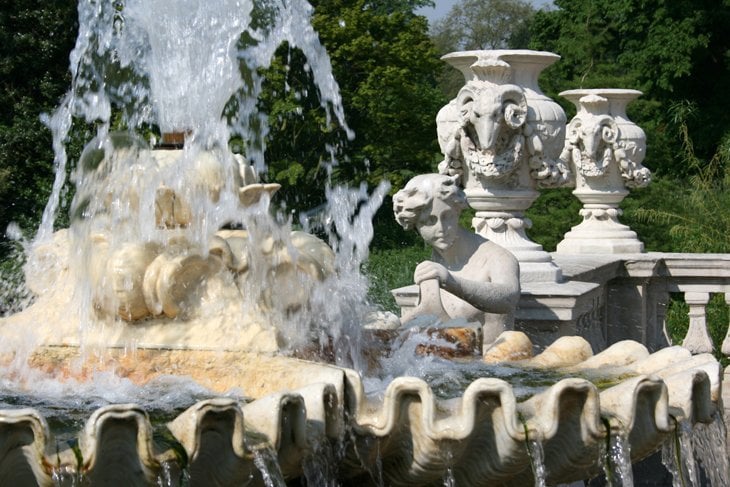
The Diana, Princess of Wales Memorial Fountain
Practical Information: Just south of the Serpentine, this unique, circular stone fountain is a popular spot for families and quiet reflection.
Made from 545 individual pieces of Cornish granite, its design is intended to reflect the Princess’s life and open nature.
Unique History: When it opened in 2004, the memorial was plagued by technical issues and received mixed reviews from critics. However, it has since settled into the landscape and become a much-loved and peaceful part of the park.

Rotten Row: A Path Paved with History
Practical Information: This broad, sandy track runs along the park’s southern edge and is still a popular route for horse riding.
You can watch the Household Cavalry exercise their horses here or even book a ride yourself from nearby stables.

Unique History: The unusual name is a corruption of the French ‘Route du Roi,’ or “King’s Road”.
In the 1690s, King William III found travelling through the dark, dangerous park unnerving.
To deter the highwaymen who preyed on travellers, he had the route lit with 300 oil lamps, creating the first artificially lit highway in Britain.
Secrets in the Landscape: Hidden Gems and Forgotten Stories
For those willing to look a little closer, Hyde Park reveals a history that is stranger and more compelling than you could imagine.
The Victorian Pet Cemetery: A Touching Tribute
Tucked away near Victoria Gate is one of London’s most charming and unusual secrets: a Victorian pet cemetery.
It began in 1881, not by official decree, but as an act of kindness. When the beloved Maltese terrier of a family friend, named Cherry, passed away, the keeper of the Victoria Lodge allowed the dog to be buried in his garden.
Word spread among London’s upper classes, and by the time it closed in 1903, over 300 pets had been laid to rest here under tiny, elaborate headstones bearing touching inscriptions.

The Duelling Grounds: Where Honour Was Settled in Blood
For much of the 18th century, the park’s secluded groves were London’s premier, albeit grim, destination for duels. Records show 172 duels were fought within its bounds, resulting in 63 deaths.
The Hamilton-Mohun Duel (1712): This was the most infamous duel in British history, a savage confrontation between James, Duke of Hamilton (a leading Tory) and Charles, Lord Mohun (a notorious Whig).
Fought with swords over a bitter inheritance dispute and deep political animosity, the duel was brutal.
Both men were mortally wounded, and the affair was mired in controversy, with accusations that Mohun’s second treacherously stabbed the Duke after the fight was over.
The “Petticoat Duel” (1792): Proving that matters of honour were not exclusively male, this extraordinary duel was fought between two society ladies.
When a Mrs. Elphinstone made a cutting remark about Lady Almeria Braddock’s age, the dispute escalated to weapons.
The two met in Hyde Park, first exchanging pistol shots (both missed) before drawing swords. The fight ended only when Mrs. Elphinstone received a wound to her arm and agreed to write a formal apology.

Forgotten Monuments: Stories in Stone
The Royal Artillery Memorial: Located at Hyde Park Corner, this is one of the world’s most powerful and controversial war memorials.
Unveiled in 1925, its sculptor, Charles Sargeant Jagger, was a veteran who refused to glorify war.
He insisted on including a shockingly realistic bronze sculpture of a dead artilleryman on the side of the monument.
This stark depiction of the reality of conflict was met with outrage by some, but it remains a profound and unflinching statement on the human cost of war.
The Hudson Memorial: This memorial to the naturalist W. H. Hudson features a sculpture by the modernist artist Jacob Epstein.
When it was unveiled in 1925, the public was horrified by its avant-garde style. The press dubbed it “the Hyde Park Atrocity,” and it was repeatedly vandalized.
Today, it stands as a testament to the often-fierce clash between traditional and modern art.
The Park Comes Alive: A Guide to Annual Events
Hyde Park’s calendar is dominated by two massive annual events that transform the landscape.
Winter Wonderland (November – January)
Each winter, a huge section of the park becomes London’s largest festive destination.
Winter Wonderland is a sprawling extravaganza of carnival rides, German-style Christmas markets, an enormous outdoor ice rink, food stalls, and festive bars.
It’s essential to book tickets in advance, especially for peak evening and weekend slots, to guarantee entry.
BST Hyde Park Concerts (June – July)
For several weeks each summer, the park hosts the British Summer Time (BST) concert series, bringing some of the biggest names in music to its Great Oak Stage.
Past headliners have included The Rolling Stones, Bruce Springsteen, Adele, and Taylor Swift, cementing the park’s status as one of the world’s premier outdoor music venues.
Tickets for major acts sell out quickly, so it’s wise to book as soon as they are released.

Planning Your Visit to Hyde Park: Practical Information
Here is the essential information you need to plan your trip.
Entrances and Getting There
The park is easily accessible via public transport. The best tube station depends on where you want to go:
Hyde Park Corner (Piccadilly line): For the south-east corner, including the Rose Garden and Apsley House.
Marble Arch (Central line): For Speakers’ Corner and the north-east.
Lancaster Gate (Central line): For the Serpentine and the north side of the park. Numerous bus routes also serve the park’s perimeter.

Opening Times and Facilities
Hyde Park is open daily from 5 a.m. until midnight. Public toilets, sports facilities (including tennis courts), and accessibility services are available throughout the park.
Food and Drink
There are several cafes and kiosks within the park, most notably the Serpentine Bar and Kitchen and the Lido Café, which offer meals, snacks, and drinks. The park is also an ideal and popular spot for a picnic.
Hyde Park London FAQ
If this guide has inspired you to explore more of the capital on foot, continue your journey along the river with our detailed self-guided tour of the London South Bank Walk, from Westminster to Tower Bridge.
More Green Spaces in London: Walthamstow Wetlands: Wild London and London’s Vauxhall Park – A Hidden Gem


Beautiful pictures! I have heard a lot about Hyde park. Looks so serene and vibrant. It reminds me of Cubbon Park in Bangalore, India.
I saw my first ever squirrel in Hyde Park. And bluebells. Very special!!
I was fortunate to have an apartment on Eaton Square just across the road from Hyde Park and had many memorable weekends and evenings relaxing and watching the world go by. Its an amazing place to visit and not mentioned in the article, at weekends the northern side of the park there ia a gigantic art display where artists can display their works. Not mentioned is the statue of the never grew up fella Peter Pan and on the south side is the famous Albert memorial put up by Queen Victoria in memory of her husband. Thanks for all those fab photographs!
Ian Hargraves,
New Smyrna Beach
Florida
These photos are so beautiful!
Baby birds are adorable
I had the chance to pass this park when we went to Buckingham palace last autumn 2008..hope to visit it again! love ur blog!