

To arrive in Trafalgar Square is to step onto one of the world’s grandest stages. It is an experience that engages every sense. The air carries the constant, soothing rush of water from its great fountains, a sound that underpins the multilingual chatter of a global audience.
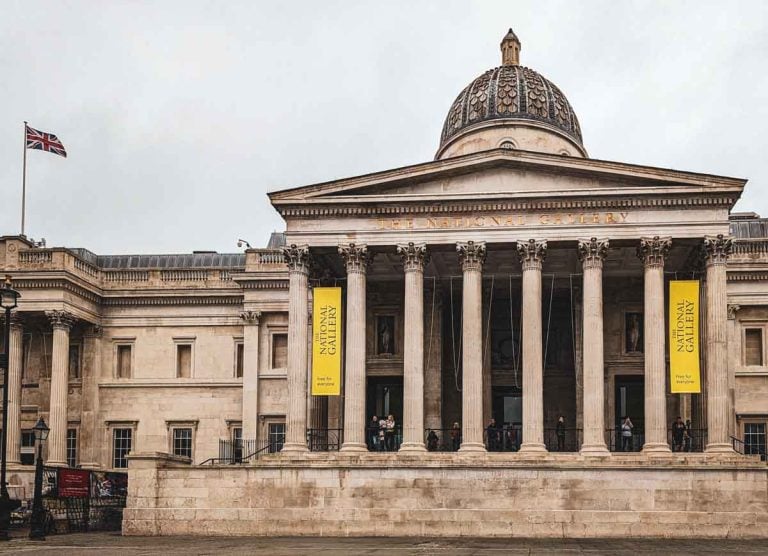
From the south, the distant chime of Big Ben marks the passage of time, while to the north, the magnificent neoclassical facade of the National Gallery stands as a temple to art, its steps offering a perfect proscenium view of the drama below.
Presiding over it all, from his perch 169 feet in the air, Admiral Lord Nelson surveys his city, eternally guarded by four colossal bronze lions whose stoic presence seems to absorb the ceaseless energy of the capital.
Whenever I am passing through London I always like to pass through Trafalgar Square and take it all in if I can.

This space, however, is far more than a collection of monuments on a tourist itinerary. It is a place of profound paradox: a permanent, stone-etched testament to history that is simultaneously a canvas for constant, dynamic change.
It is here that the story of an empire, the passion of artistic debate, the roar of political protest, and the joy of communal celebration are performed daily for the world to see.
This guide invites you on a journey beyond the postcard view, to uncover the hidden narratives, the contested histories, and the vibrant, beating heart of London’s most iconic public space.
Trafalgar Square is not merely a landmark in London; in many ways, it is London in miniature. Its very fabric encapsulates the city’s complex evolution from an imperial powerhouse to a modern, multicultural metropolis.
The monuments commemorating the 1805 Battle of Trafalgar and the statues of Victorian-era generals speak to a specific, martial history of British power. Yet, just yards away, the ever-changing contemporary sculptures on the Fourth Plinth often question and subvert those very narratives.
This tension between the permanent and the provocative, the historic and the contemporary, mirrors London’s own identity—a city forever in dialogue with its past as it forges its future.
The square is where these different versions of London meet, clash, and coexist, creating a space that is as challenging and vibrant as the city itself.

From Royal Hawks to Public Grandeur: The Unlikely Birth of a Landmark
A Deeper Past – Before the Square
The story of Trafalgar Square begins long before any architect drew a single line. It starts in a time when London was an ice-covered wilderness.
During construction work in the 1950s, excavations on the south side of the square unearthed river terrace deposits containing the fossilised remains of creatures from the Last Interglacial period, some 130,000 years ago.
The findings painted an astonishing picture of a prehistoric landscape roamed by cave lions, rhinoceroses, straight-tusked elephants, and hippopotamuses—a world away from the urban landscape of today.
The site’s recorded history began in the 13th century when it became home to the King’s Mews. The name itself is a relic of a forgotten aristocratic pastime.
A “mew” was an old word for a cage where royal hawks were kept while they moulted, and this area served as the monarch’s falconry headquarters for centuries.
After a devastating fire in 1534, the mews were rebuilt as stables for the royal horses, a function they would serve until George IV moved them to their current location at Buckingham Palace in the 1820s.

A Contested Vision – The Making of the Square
The transformation of the royal stables into a grand public square was not the result of a single, unified master plan.
Instead, it was a messy, protracted process defined by competing visions, architectural challenges, and financial constraints, making its eventual success as a cohesive and beloved landmark all the more remarkable.
The first seeds were sown in 1812, when the visionary architect John Nash proposed developing the area into a cultural space open to the public as part of a grand new street connecting Charing Cross to Portland Place.
However, progress was painfully slow. Nash’s death shortly after clearance began impeded the project, and the square’s very identity remained in flux. Initially, it was to be named King William the Fourth’s Square to commemorate the monarch’s accession in 1830.
It was not until around 1835 that the architect George Ledwell Taylor suggested naming it Trafalgar Square, a tribute to Admiral Nelson’s pivotal 1805 naval victory over the combined French and Spanish fleets. This decision was crucial, anchoring the square’s identity in a moment of national triumph.
Even with a name, the design remained contested. The National Gallery, designed by William Wilkins, was constructed on the north side between 1832 and 1838, but Wilkins’s own plan for the square’s layout was approved and then never put into effect.
The final, definitive shape of the square came from architect Sir Charles Barry, who was commissioned in April 1840. Barry’s primary challenge was the site’s awkward slope. His ingenious solution, driven by a desire to enhance the visual impact of the widely criticised National Gallery, was to excavate the main area and create the multi-level, terraced layout with grand staircases that defines the space today.
Nelson’s Column, which seems so integral to the design, was in fact planned entirely separately by a memorial committee, and Barry initially expressed his displeasure at its placement, believing the area should be free of “insulated objects of art”.
This history reveals that the square we know today is a product of negotiation, adaptation, and even disagreement, an organic creation forged through decades of debate rather than a singular artistic statement.

The Admiral on the Skyline: The Saga of Nelson’s Column
At the very heart of the square, and of London’s historical consciousness, stands Nelson’s Column. It is more than a monument; it is an artifact imbued with layers of human stories, from celebratory stunts and dark humour to its role as a potent symbol of national defiance.
The column was conceived as a national tribute to Vice-Admiral Horatio Nelson, honouring his leadership in the decisive victory at the Battle of Trafalgar and his heroic death aboard HMS Victory, struck by a French musket ball at the height of the battle.
An Engineering Marvel
Construction took place between 1840 and 1843, a full 35 years after Nelson’s death and his state funeral at St. Paul’s Cathedral.
The project was a significant feat of Victorian engineering. The fluted column, made from granite sourced from Dartmoor, rises to a total height of 169 feet and 3 inches.
At its summit stands an 18-foot statue of Nelson himself, sculpted by Edward Hodges Baily from three massive blocks of Craigleith sandstone donated by the Duke of Buccleuch from his private quarry.
The story of its design is one of perseverance; the architect, William Railton, had to win the public competition for the commission not once, but twice, after his initial contract was controversially rescinded and the competition was reopened.

Secrets in the Stone and Bronze
The column’s most powerful symbolism lies in the details. The four enormous bronze reliefs adorning the pedestal depict key moments from Nelson’s career: the Battle of the Nile, the Battle of Copenhagen, the Battle of Cape St. Vincent, and his death at Trafalgar.
These panels are not merely decorative; they are forged from the melted-down bronze of cannons captured from the defeated French fleet, a tangible and triumphant recycling of the spoils of war.
The monument’s history is also rich with anecdotes that transform it from a static object into a character in London’s story.
Just days before the 18-foot statue of Nelson was hoisted into place in 1843, a group of 14 stonemasons and dignitaries scaled the scaffolding to hold a celebratory steak dinner at the top, a perilous feast high above the London skyline.
Decades later, in 1896, the column was struck by lightning, chipping a piece from Nelson’s left shoulder. This event sparked a wave of dark British humour, with Londoners joking that the admiral, who had lost his right arm in battle, might now lose the other one as well.

A Symbol of Defiance
The column’s symbolic power was not lost on Britain’s enemies. During World War II, Adolf Hitler became so fixated on its significance as a beacon of British resilience that he made plans to have the entire monument dismantled and shipped to Berlin as a trophy following a successful invasion of Britain.
This historical fact re-contextualizes the column’s meaning; it is not simply a memorial to a 19th-century naval victory but a 20th-century symbol of defiance against tyranny.
Its story is not frozen in 1843 but continues to evolve, accumulating new layers of meaning and securing its place as a living piece of the nation’s history.
The Guardians of the Square: The Dramatic Tale of the Landseer Lions
Guarding the base of Nelson’s Column are four of London’s most beloved residents: the magnificent bronze lions. Their story is a perfect example of how a controversial and troubled artistic process can ultimately result in a deeply cherished public icon.

Though lions were part of William Railton’s original vision for the monument, the quartet we see today was not installed until 1867, almost a quarter of a century after the column itself was erected.
Artistic Controversy and Public Impatience
The journey to their creation was fraught with delay and debate. The commission was first given to sculptor Thomas Milnes, who produced a set of four stone lions.
However, these were famously judged by the planning committee as “not impressive enough” for such a grand national monument.
Milnes’s rejected lions were subsequently purchased by the industrialist Sir Titus Salt and can still be seen today in the village of Saltaire, West Yorkshire.
In 1858, the commission was controversially awarded to Sir Edwin Landseer, a celebrated painter renowned for his depictions of animals, particularly dogs and horses, but who had no prior experience as a sculptor. What followed was a near decade-long delay that tested the patience of the public and the press.
Contemporary journals mocked Landseer for taking “so many years to think about” the lions, with one publication, The Athenaeum, wryly predicting in 1863 that when the lions were finally in place, they would “greatly add to the amusements of the young urchins who now scramble over the various blocks of granite”.
A Gruesome Model
The lengthy process was partly due to Landseer’s meticulous, if unconventional, methods. To ensure anatomical accuracy, he acquired the carcass of a lion that had died at the London Zoo to use as a model.
According to legend, the animal began to decompose before his studies were complete. This gruesome detail is often cited as the reason for some of the lions’ noted anatomical quirks, particularly their paws, which more closely resemble those of a domestic cat or a sphinx than a real lion.
An Enduring Legacy
Despite their difficult birth and the initial public ridicule, the Landseer Lions were an immediate success upon their unveiling.
Cast in bronze by Baron Carlo Marochetti, they became, as predicted, a playground for Londoners and visitors alike, and are now among the most photographed statues in the world.
While they appear identical at a glance, each lion is unique, with subtle differences in the details of their manes and facial expressions.
Their journey from a painter’s controversial sketches and a decaying model to eternal bronze guardians is a testament to artistic perseverance, eventually winning them an unshakeable place in the public’s affection.

A Tale of Four Corners: The Plinths of Past, Present, and Future
The four corners of Trafalgar Square are marked by stone plinths, three of which are occupied by permanent monuments that anchor the space in the 19th-century history of the British Empire.
In the northeast corner stands an equestrian statue of King George IV, originally intended for Marble Arch.
The southern corners are occupied by statues of two decorated military leaders: General Sir Charles James Napier, remembered for campaigns in India, in the southwest; and Major-General Sir Henry Havelock, also a key figure in India, in the southeast.
Together, they present a clear narrative of monarchy and military might. It is the fourth plinth, in the northwest corner, that deliberately disrupts this narrative, transforming the square into a dynamic space for contemporary debate.
The Story of the Empty Pedestal
The Fourth Plinth was designed by Sir Charles Barry and built in 1841, intended to hold an equestrian statue of King William IV. However, due to insufficient funds, the statue was never commissioned, leaving the plinth conspicuously empty.
For over 150 years, it remained a curious void in one of the world’s most prominent public spaces, its future use the subject of endless debate.
A Stage for Contemporary Art
This changed in 1998, when the Royal Society of Arts initiated a project to use the plinth for a rotating series of temporary contemporary art commissions.
Now managed by the Mayor of London’s office, the Fourth Plinth programme has become one of the most famous public art commissions globally, bringing challenging, provocative, and often playful art to millions of people for free.
The brilliance of the programme lies in the juxtaposition it creates. The temporary, often critical, artworks are placed in direct conversation with the permanent historical monuments, forcing a re-evaluation of history, power, and representation.
Past commissions have included Marc Quinn’s Alison Lapper Pregnant, a Carrara marble sculpture celebrating a disabled body, which starkly contrasted with the traditional male military figures nearby. Yinka Shonibare’s Nelson’s Ship in a Bottle directly addressed the square’s history by recreating HMS Victory with sails made of colourful West African fabric, invoking themes of colonialism and global trade.
Antony Gormley’s One & Other turned the plinth over to the public, with 2,400 different people occupying it for an hour each over 100 days.
The current commission, Samson Kambalu’s Antelope, continues this tradition of critical engagement. The sculpture restages a 1914 photograph of the pan-Africanist Baptist preacher John Chilembwe and the European missionary John Chorley.
In a powerful act of defiance against colonial rule, which forbade Black people from wearing hats in front of whites, Chilembwe keeps his hat on.
Kambalu deliberately alters the scale of the original photograph, making Chilembwe significantly larger than Chorley to amplify his voice and challenge the colonial narratives embodied by the generals on the opposite plinths.
The Fourth Plinth is not just a stand for art; it is a platform for a counter-narrative, ensuring that Trafalgar Square remains a site of active debate rather than passive commemoration.

The People’s Forum: A History of Protest and Celebration
Trafalgar Square has always been more than an architectural ensemble; it is London’s great public forum, a space defined by the people who gather within it.
Its history is written in the echoes of angry chants and joyous songs, serving as the nation’s stage for both fierce dissent and unified celebration.
A Stage for Dissent
From its earliest days, the square has been a flashpoint for political and social unrest. One of its darkest chapters occurred on November 13, 1887, a day that became known as “Bloody Sunday.”
Thousands of marchers protesting unemployment and the British government’s coercive policies in Ireland converged on the square, where they were met by 2,000 police officers and 400 soldiers. The ensuing clashes were brutal.
Eyewitnesses, including the artist Walter Crane, described the scene as “real warfare… only the attack was all on one side”.
Three people were killed and over 200 injured, cementing the square’s reputation as a symbolic battleground between the people and the state.
This tradition of protest has continued through the centuries, from anti-war marches in the 1960s to the infamous 1990 Poll Tax Riots that helped bring an end to Margaret Thatcher’s premiership, and to the climate and Black Lives Matter demonstrations of the 21st century.
A Venue for Joy and Unity
The same space that has hosted anger and conflict has also been the setting for the nation’s most profound moments of joy.
On VE Day in 1945, vast, jubilant crowds surged into the square to celebrate the end of the war in Europe.
Thomas Barry, a Sergeant in the US Air Force who was in London on that day, wrote home in a letter, “I have never seen such a crowd of joyful people in my life. One couldn’t help but be happy at a time like that”.
The square became the epicentre of a national outpouring of relief and unity, with people dancing, singing, and climbing the statues in celebration.
For decades, it was also the traditional heart of London’s New Year’s Eve celebrations, with personal recollections from the 1970s and 80s describing an “electric” atmosphere of “alcohol induced friendliness” as strangers came together to welcome the new year.
A Modern Multicultural Hub
Today, the square continues its role as a gathering place, reflecting London’s modern, multicultural identity.
The Mayor of London oversees a vibrant, year-round calendar of free cultural events that transform the space. These include the colourful celebrations for Chinese New Year, the festival of Diwali, St. Patrick’s Day, and Japan Matsuri. A recent and popular addition is Black on the Square, a festival that showcases Black culture, creativity, food, and entrepreneurship, filling the historic space with the sounds of Lovers Rock and Garage music.
The Gift of a Tree: A Symbol of Enduring Friendship
Perhaps the most poignant of all the square’s traditions is the annual Christmas tree.
Every year since 1947, a magnificent Norwegian spruce has been erected in the square, a gift from the people of Norway to the people of London in gratitude for Britain’s support during the Second World War.
The tradition may have even deeper roots; a recently emerged story suggests that during the war, James Bond creator Ian Fleming, then working in naval intelligence, helped arrange for a tree smuggled from occupied Norway by commandos to be erected for the exiled Norwegian King Haakon VII.
Each November, a tree—often described as the “queen of the forest”—is carefully selected from the woods near Oslo and felled in a ceremony attended by the mayors of Oslo and Westminster before being shipped to the UK.
It is decorated in traditional Norwegian style, with simple vertical strings of lights, a symbol of enduring friendship and peace that shines brightly in the heart of London each festive season.

An Insider’s Guide to Experiencing Trafalgar Square
Beyond the grand monuments and bustling crowds, Trafalgar Square is filled with hidden details and surprising stories. Knowing what to look for can transform a casual visit into a fascinating exploration.
Secrets in Plain Sight: What to Look For
Britain’s Smallest Police Box: Tucked away on the southeast corner is an ornamental lamp post that conceals what is often called Britain’s smallest police station. Installed in 1926, it was hollowed out to accommodate a single officer who could monitor protests and had a direct phone line to Scotland Yard. A flash of the lamp would signal to other officers in the area that assistance was needed. Today, it is used for storage.
The Imperial Measures: Set into the stone of the north terrace wall are bronze plaques displaying official Imperial units of measurement from the inch and foot to more archaic measures like the “perch” and “chain.” They were installed in 1876 so that surveyors and tradesmen could verify the accuracy of their instruments against a national standard.
The Washington Anomaly: In front of the National Gallery stands a statue of George Washington, a seemingly odd tribute to the man who led a revolution against Britain. It was a gift from the Commonwealth of Virginia in 1921. Legend holds that Washington once vowed he would never again set foot on British soil; to honour this, the statue was placed upon a foundation of soil imported from the United States.
The Seven Noses of Soho: Look closely at the inside of Admiralty Arch, the grand gateway to The Mall at the southwest corner of the square. Here you will find one of seven “noses” sculpted onto buildings in the area by artist Rick Buckley in 1997. It is said to be placed at a height visible to those on horseback, a nod to the Household Cavalry who pass through the arch.
The Pigeon Wars: For much of the 20th century, the square was famous for its vast population of feral pigeons, numbering up to 35,000 at their peak. Feeding them was an iconic tourist activity. However, concerns over health hazards and damage to the monuments led then-Mayor Ken Livingstone to enact a controversial ban on feeding in 2003. The measures to disperse the birds even included the regular use of trained hawks to patrol the square.
Beyond the Paving Stones: The Immediate Surroundings
The experience of Trafalgar Square is inseparable from the world-class cultural institutions that frame it.
The National Gallery: Dominating the north side, this is one of the world’s greatest art museums and an essential part of any visit. Its vast collection includes masterpieces by Leonardo da Vinci, Titian, Turner, Monet, and Van Gogh. Admission to the permanent collection is free, making it one of the most accessible cultural treasures in the world.
St Martin-in-the-Fields: On the northeast corner stands this beautiful and historic church, designed by James Gibbs in the 1720s. It is renowned for its excellent classical music programme, including popular free lunchtime concerts.
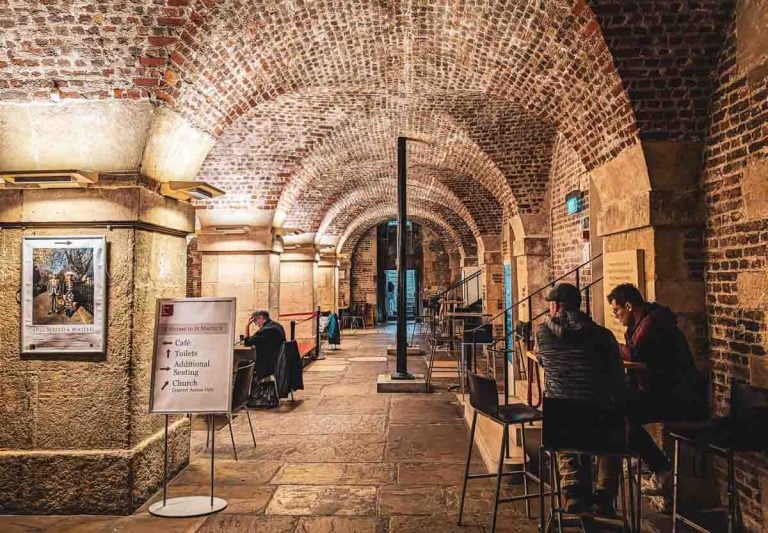
A visit to its atmospheric Café in the Crypt, located amongst the 18th-century brick vaults and tombstone-lined floors, offers a unique and peaceful respite from the bustle of the square above.
Your Visit to Trafalgar Square: A Practical Planner
To help you make the most of your time at this iconic London landmark, here is a summary of essential visitor information.
Trafalgar Square at a Glance
|
Category |
Details |
|---|---|
|
Location |
City of Westminster, Central London, WC2N 5DN |
|
Nearest Tube Stations |
Charing Cross (Bakerloo, Northern lines), Leicester Square (Piccadilly, Northern lines), Embankment (District, Circle, Bakerloo, Northern lines) |
|
Opening Hours |
The public square is open 24/7. Attractions like the National Gallery and St Martin-in-the-Fields have their own operating hours. |
|
Key Attractions |
Nelson’s Column, The Landseer Lions, The Fountains, The Fourth Plinth, National Gallery, St Martin-in-the-Fields Church. |
|
Facilities |
Public toilets are located on the west side of the square at the base of the central staircase (a 20p charge applies, contactless payment available). There is also a disabled toilet and baby change facility. The Café on the Square is at the bottom of the central staircase. |
|
Official Events Info |
For the latest schedule of festivals, celebrations, and other public gatherings, check the official Mayor of London events page. |
FAQ
Why is Trafalgar Square so famous?
Trafalgar Square is famous because it commemorates one of Britain’s most significant naval victories, features globally recognised landmarks like Nelson’s Column and the bronze lions, and serves as the geographical and cultural heart of London. It is the nation’s primary venue for public celebrations, festivals, and political protests.
Is it worth visiting Trafalgar Square?
Absolutely. It is an essential London experience, offering a unique combination of monumental history, world-class art at the adjacent National Gallery, stunning architecture, and a vibrant, ever-changing atmosphere. It provides a snapshot of the city’s past and present, all in one dynamic public space.
Who is the man on the column in Trafalgar Square?
The statue atop the column is of Vice-Admiral Horatio Nelson, the celebrated naval hero who led the British fleet to victory in the Battle of Trafalgar in 1805, during which he was fatally wounded.
How far is Trafalgar Square from Buckingham Palace?
It is a pleasant and scenic 15 to 20-minute walk. The route takes you through Admiralty Arch and down The Mall, one of London’s most famous ceremonial avenues, directly to the gates of the palace.
What is on the Fourth Plinth?
The Fourth Plinth hosts a rotating series of temporary contemporary art commissions. A new sculpture by a leading international artist is unveiled every couple of years, making it a dynamic and ever-changing attraction that often sparks public debate.
Can you still feed the pigeons in Trafalgar Square?
No. The practice of feeding the once-massive flocks of pigeons has been banned since 2003. The ban was put in place to protect the monuments from damage and for public health reasons, and it is strictly enforced.
Conclusion: London’s Living Heartbeat
Trafalgar Square is no museum piece, frozen in the amber of its Victorian past. It is a living, breathing entity, a place where the cold stone of history is warmed by the ceaseless pulse of modern life.
It is where the solemnity of a war memorial coexists with the joyful noise of a cultural festival, where imperial statues are challenged by provocative modern art, and where the voices of the past echo alongside the urgent debates of the present.
To stand by its fountains is to feel the energy of a global crossroads, to sit on its steps is to watch the story of a great city unfold. A visit to Trafalgar Square is not just about seeing the sights; it is about feeling the city’s rhythm, standing where history was made, witnessing the art that sparks conversation, and finding one’s own small moment in the enduring story of London’s heart.
You may also like:
Sunny Days by the River Thames and London’s Southbank Landmark Sites
Hyde Park: London’s Green Heart



They say that regardless of where you are from that if you stand in the Square long enough, some one you know will walk past!
I can imagine that is a big chance yes 🙂
Beautiful pictures! Living in London it’s easy to dash around without taking the time to stop and look at places around us; Trafalgar Square is definitely one of those places.
Just out of this world pictures. They just reach out and touch you!
Thanks so very much Barbara 🙂
Amazing photos..Trafalgar Square is a lovely place in London,been a lot of times and I love it.Congrats for your site..good work!
Daniel
Thank you Daniel, yes it is a wonderful spot
I love to travel and I would love to go to Trafalgar Square in London some day. I am just wondering about the significance of the blue chicken. It was quirky and I love that but did it serve a special purpose for being there? Love the photos!!
Hi Carli, ty.. Yes one of the 4 plinths has a piece of commissioned art that changes every so often.. Now.. it is a big blue chicken.. I know 🙂
Great place and great pictures Paul…if it wasn’t for those bloody pigeons 😀
Thanks ever so much.. The pigeons have long since gone through banning of feeding and bird of prey use in the past. There are now only about 6 resident pigeons there 🙂
This particular page caught my attention with many photos of Trafalgar Square, as this was one of the places where I spent quite a bit of time, when I stayed in London (at Horsequards by Thames). You live in the country where you have many things to be proud of. Thanks for letting me enjoy seeing many of your photos, Paul!! Cheers! – Saach
Hi Saach, thx.. yes so much to see yet even for me 🙂