

When outdoor enthusiasts map out mountain expeditions across Europe, their focus almost exclusively leans toward the overcrowded, heavily commodified trail networks of the Western Alps or the Pyrenees.
Yet, if you head into the wild, rugged heart of the Balkans, the Dinaric Alps of Montenegro offer an entirely different caliber of wilderness—one defined by raw limestone peaks, deep canyons, and vast, silent glacial basins that remain completely untouched by mass commercial tourism.
At the absolute center of this protected landscape sits Black Lake (known locally as Crno Jezero).
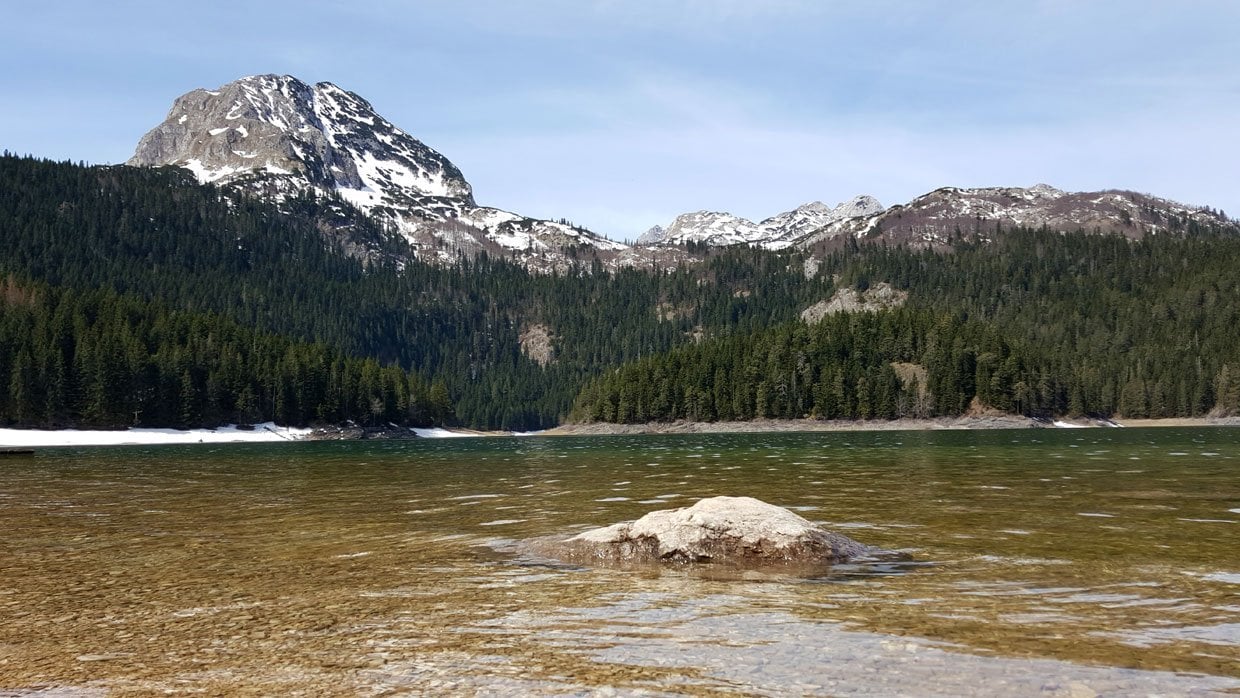
Located within the UNESCO-protected boundaries of Durmitor National Park, this striking body of water sits in the shadow of the sheer, vertical rock face of Međed Peak.
During a recent shoulder-season expedition to map the region’s trail networks, I traveled to the Balkan highlands to investigate the mechanics of the Black Lake trail system firsthand.
Here is my first-person field manual to navigating this glacial jewel.
🌲 Black Lake & Durmitor Trail Blueprint
Location:
Situated in northern Montenegro, positioned on the immediate edge of the mountain hub of Žabljak.
The Altitude Metric:
The lake sits at an elevation of 1,416 metres (4,646 feet). Keep in mind that the gateway town of Žabljak rests at nearly 1,500 metres, making it the highest permanent urban settlement in the entire Balkan peninsula.
Trail Distance:
A level, highly accessible 1.8-mile (3 km) paved walking path runs directly from the center of Žabljak to the lake entrance. Once at the shore, a dedicated 2.5-mile (4 km) unpaved perimeter loop circles the water
Terrain & Footwear:
The perimeter trail consists of packed dirt, exposed tree roots, and occasional stone steps. While the approach road is flat, the shoreline loop demands a sturdy pair of hiking shoes with reliable tread, especially during the muddy spring thaw.
National Park Admission:
Entering the Black Lake zone requires a standard Durmitor National Park day pass, which costs €5 per person. Keep cash on hand, as the entry kiosk at the trailhead frequently experiences off-grid card machine dropouts.
The Gateway Hub: Tracking the Trailhead
My journey began in the alpine town of Žabljak. Arriving in early spring, I was met with an incredible atmospheric contrast: the jagged limestone peaks towering above the valley were still heavily caked in winter snow, yet the clear mountain sun was driving ground temperatures up to a comfortable 20°C.
It is a phenomenal microclimate that makes mountain foot-travel an absolute joy.
The approach to Black Lake from the edge of town is exceptionally straightforward, making it an ideal acclimatization walk.

The route follows a flat, 3km dedicated pedestrian path lined with towering spruce and pine trees. The forest is so dense that the lake remains entirely concealed from view during the entire approach.
It isn’t until you round the absolute final bend in the trail that the treeline suddenly fractures, opening up an immediate, panoramic “wow” factor.

The Hydrological Phenomenon: The Glacial Twin Lakes
What appears to the casual tourist as a single, massive body of water is actually a fascinating, complex hydrological twin system.
Black Lake is structurally divided into two separate basins: Great Black Lake (Veliko jezero) and Little Black Lake (Malo jezero).
The two basins are separated by a narrow, shallow land strait known as Struga.
This layout creates a unique seasonal phenomenon. Throughout the spring, massive volumes of cold meltwater roar down from the snowfields of the surrounding Dinaric ridges, completely flooding the basins and merging the twin pools into one singular, deep lake.
During the dry peak of summer, however, the water level drops significantly, exposing the land bridge and splitting the feature into two independent bodies of water.
The depth contrast is stark: while the larger basin spreads out widely, it is the smaller, narrower Little Black Lake that holds the true volume, plunging down to a maximum depth of 49 metres (160 feet).
The clarity of the water is exceptional, radiating deep shades of emerald green and turquoise while casting a mirror-sharp reflection of the surrounding pine canopies and snow-capped crags.

A Guide’s Review of the 4km Perimeter Trail
For any hiker using Žabljak as a base camp, the 4km loop tracing the shoreline of Black Lake is the perfect warm-up circuit to calibrate your lungs to the altitude before tackling higher alpine ascents like Bobotov Kuk.
The path circles both basins tightly, winding directly through the roots of the ancient spruce forests that crowd the shoreline.
On the day I cleared the loop, the trail was beautifully quiet.

I tracked past a handful of technical mountaineers packing gear for the high-altitude interior ridges, a couple of wild swimmers utilizing the freezing glacial water for a shock of physical restoration, and a few local families resting along the banks.
Because the perimeter is completely free of commercial storefronts and vehicles, it retains a deep, silent tranquility.
It is incredibly easy to find a secluded limestone outcrop all to yourself to sit back, check your maps, and absorb the sheer scale of Međed Peak looming directly overhead.
Launching Deeper into the Durmitor Massif
Completing the shoreline loop provided the perfect physical reset and fresh-air fuel injection needed to jumpstart my broader Montenegrin itinerary.
Setting out with basic trail gear during the spring shoulder season requires close attention to changing mountain logistics, but the rewards are unmatched.
With the initial scouting run of Black Lake complete, it was time to source provisions in Žabljak and prepare to ascend higher into the extreme limestone passes and adrenaline-heavy canyons that define this wild frontier.
Durmitor National Park proves conclusively that Eastern Europe holds some of the most formidable, rewarding wilderness terrain on the continent.

If you value true mountain escapism, deep glacial topography, and trails that belong entirely to nature, this region demands a permanent spot on your trekking radar.


