

Seeing a photograph of a landmark can prepare you for its shape, but it can never prepare you for its scale.
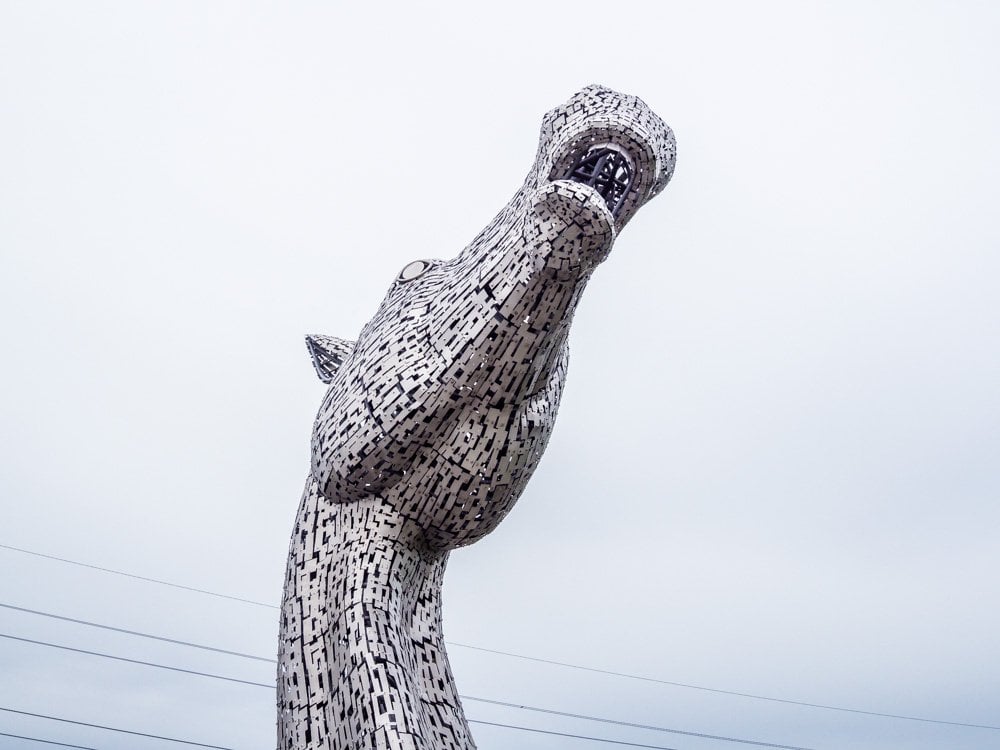
Standing on the grassy flatlands of Falkirk, looking up at two colossal, shimmering steel horse heads rising 30 meters into the Scottish sky, is a moment that leaves you entirely breathless.
The Kelpies are the largest equine sculptures in the world.

Positioned as a dramatic gateway at the extension of the Forth and Clyde Canal, these monuments dominate the low-lying landscape, serving as a striking bridge between Scotland’s ancient folklore and its heavy industrial past.
During my recent travels through Stirlingshire, I stayed just a few miles away at the Macdonald Inchyra Hotel. Grabbing the chance first thing in the morning to see them with my own eyes, I realized instantly that the local recommendations were entirely correct: you simply cannot comprehend the architectural power of these structures until you are standing directly in their shadow.
Whether you are an outdoor walker tracing the local canal paths or a photographer tracking the perfect light, here is your practical guide to visiting the Kelpies.
🦧 The Kelpies & Helix Park Visitor Blueprint
Location & Address:
The Helix Park, Home Forth & Clyde Canal, Grangemouth, Falkirk, FK2 9EE.
Operating Hours:
The surrounding Helix Park and the outdoor viewing areas directly around the sculptures are completely open 24 hours a day, 365 days a year. The central visitor centre and gift shop operate daily from 10:00 AM to 5:00 PM.
Admission & Parking:
Walking around the park and viewing the sculptures is entirely free. The site features two parking zones: the Helix Car Park (near the multi-use parklands) is free, while the Kelpies Premium Car Park sits right beside the structures and requires a small pay-and-display fee, which helps fund the local conservation project.
Dog Policy:
Exceptionally dog-friendly. Dogs are welcome across all the outdoor pathways of the Helix Park, though they must be kept on a short lead right beside the water basins and the sculptures.
The Indoor Experience:
While you can admire the exterior for free, you can book a 30-minute guided tour through the visitor centre. This allows you to step directly inside the hollow steel structure of the horses to view the intricate engineering assembly from within.
What is a Kelpie? Scottish Lore and Robert Burns
To understand the soul of these monuments, you have to dig down into the dark corners of traditional Scottish mythology.
In ancient folklore, a Kelpie was a powerful, shape-shifting water spirit said to haunt the deep lochs, pools, and river crossings of Scotland.
Possessing the sheer physical strength and endurance of ten standard horses, these creatures would typically manifest as a magnificent, wild horse standing quietly beside the water’s edge to lure weary night-travelers onto their backs.
Once mounted, the victim would find themselves magically stuck to the beast’s hide before the Kelpie plunged deep into the watery abyss.
These mythical spirits held a massive presence in regional storytelling, frequently used as cautionary tales to warn children away from dangerous, fast-flowing currents.
The boundary between folklore and traditional religion blurred so often that Scotland’s national poet, Robert Burns, explicitly referenced them alongside the devil in his famous 1785 poem, Address to the Devil:
“When thowes dissolve the snawy hoord An’ float the jinglin’ icy boord Then, water-kelpies haunt the foord By your direction An’ ‘nighted trav’llers are allur’d To their destruction”
The Birth of a Monument: Irn-Bru Giants and Industrial Roots
Designed by the renowned Scottish sculptor Andy Scott, the Kelpies were formally unveiled to the public in 2013.

While the choice of horses honors ancient lore, the sculptures serve primarily as a massive, industrial tribute to the flesh-and-blood working horses that drove the economic engine of the early Industrial Revolution.
Falkirk was once a loud, smoke-filled hive of heavy iron foundries and shipping trade.
Long before diesel engines or steam locomotives arrived, it was massive tow-horses that walked the narrow canal paths, pulling heavy cargo barges laden with coal, iron, and timber up and down the Forth and Clyde Canal.
Scott modeled the two heads—one representing a horse looking down in quiet repose, the other rearing its head high into the wind—on two real-life, contemporary Clydesdale horses named Duke and Baron.

But Falkirk’s connection to giant horses runs even deeper into the 20th century.
In the 1930s, the town was home to Carnera, a legendary Clydesdale gelding owned by a local soft-drink manufacturer.
Standing an astonishing 19 hands tall (6ft 6ins at the shoulder) and weighing a full metric ton, Carnera was recognized at the time as the single largest working horse on the planet, famously pulling heavy wooden delivery wagons packed with Scotland’s favourite iconic drink, Irn-Bru.
An Engineering Marvel: 600 Tonnes of Blasted Steel
When you walk right up to the edge of the canal basin, the artistic flow of the horses transitions into a mind-boggling display of modern structural engineering.
The construction of the Kelpies was completed in an astonishingly short 90-day window.
The structural foundations are buried deep into the marshy ground, secured by over 1,200 tonnes of steel-reinforced concrete on either side of the canal canal locks.

Each individual horse head weighs a colossal 300 tonnes.
The exterior skin of the structures is composed of 928 unique, individual stainless steel plates, each precision-cut and bolted hand-by-hand onto a complex internal tubular steel skeleton.
As you circle the basin, the visual character of the sculptures shifts dramatically with every step.
The angular gaps between the steel plates allow the natural Scottish light to pass completely through the structures, making the horses appear almost kinetic—changing their shape, texture, and reflection depending on the angle of the sun or the drift of the clouds.

Exploring The Helix: Trails and Night Photography
The Kelpies function as the visual centerpiece of The Helix, a brilliant 350-hectare parkland development designed to connect 16 distinct communities across Falkirk via green corridors.
The park features miles of wide, smooth, and fully accessible tarmac walking and cycling tracks that loop through wetlands, sensory gardens, and woodland boardwalks.
The Ultimate Night Photography Hook
While visiting first thing in the morning delivers beautiful, crisp morning light, the site undergoes a spectacular transformation after dark.
The National Trust and local authorities installed a state-of-the-art internal LED lighting system inside the hollow cores of both structures.
At night, the Kelpies are illuminated from within, glowing in brilliant, shifting hues of deep red, electric blue, vibrant green, and purple.
The coloured light blasts out through the gaps between the steel skin plates, reflecting perfectly into the still waters of the canal basin below.
For landscape photographers, capturing this neon glow against a dark Scottish sky is an absolute must-shoot frame.

Extending the Route: The Falkirk Wheel Connection
If you are looking for a fantastic, level day walk, you can easily turn your visit into a classic 4-mile linear canal hike.
Start right from the Kelpies visitor center and follow the flat towpath of the Forth and Clyde Canal westward through the valley.
The path tracks cleanly through the countryside before terminating at another world-class Scottish feat of engineering: The Falkirk Wheel.
As the world’s only rotating boat lift, the Wheel dynamically lifts canal boats over 115 feet to connect the historic Forth and Clyde Canal with the Union Canal.

Combining these two modern icons into a single walking itinerary offers an exceptional look at how Scotland continues to redefine its industrial waterways for a new generation of outdoor adventurers.
Explore More Spectacular Scottish Landscapes & Monument Walks
- The Highland Boundary: Crianlarich: A Complete Hiker’s Guide to Scotland’s Highland Gateway
- The Coastal Path: A Local’s Walking Guide Along the East Neuk of Fife
- The Historic Border: A Visit to the Historical Town of Jedburgh, Scotland




Wowww… Best one of landscape… Why sir dont make a little video about your traveling In your article. Some times, it Will be easy to understand. I Will enjoyed it..
Hi, yes videos are coming soon 🙂 thank you