When you think of traditional canal architecture across the UK, your mind naturally conjures images of rustic, brick-built locks, heavy wooden balance beams, and the slow, rhythmic process of manually cranking open iron sluices.
It is a system unchanged since the height of the Industrial Revolution.
Yet, hidden in the green valleys of Stirlingshire sits The Falkirk Wheel—a structure that throws out the historical rulebook entirely.
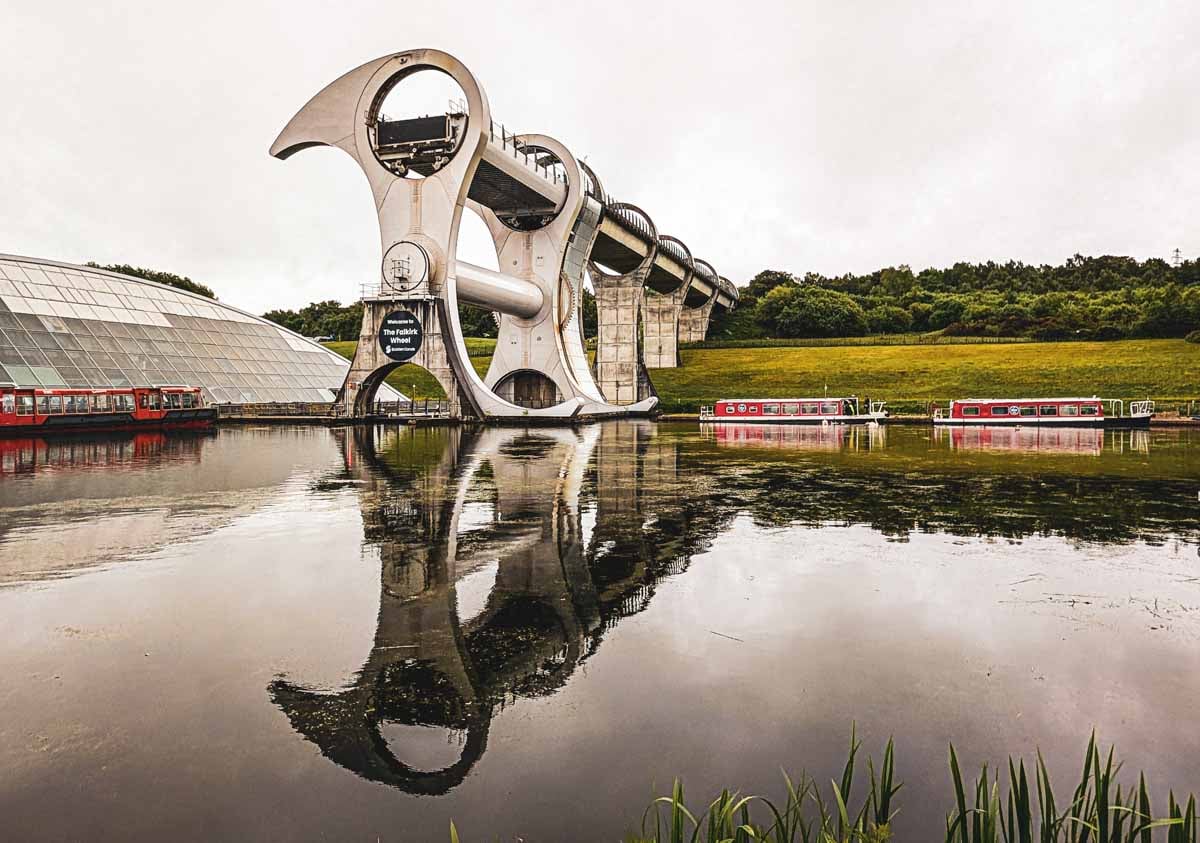
Standing as a towering, 35-metre-tall structural masterpiece, the Falkirk Wheel is the world’s only rotating boat lift.
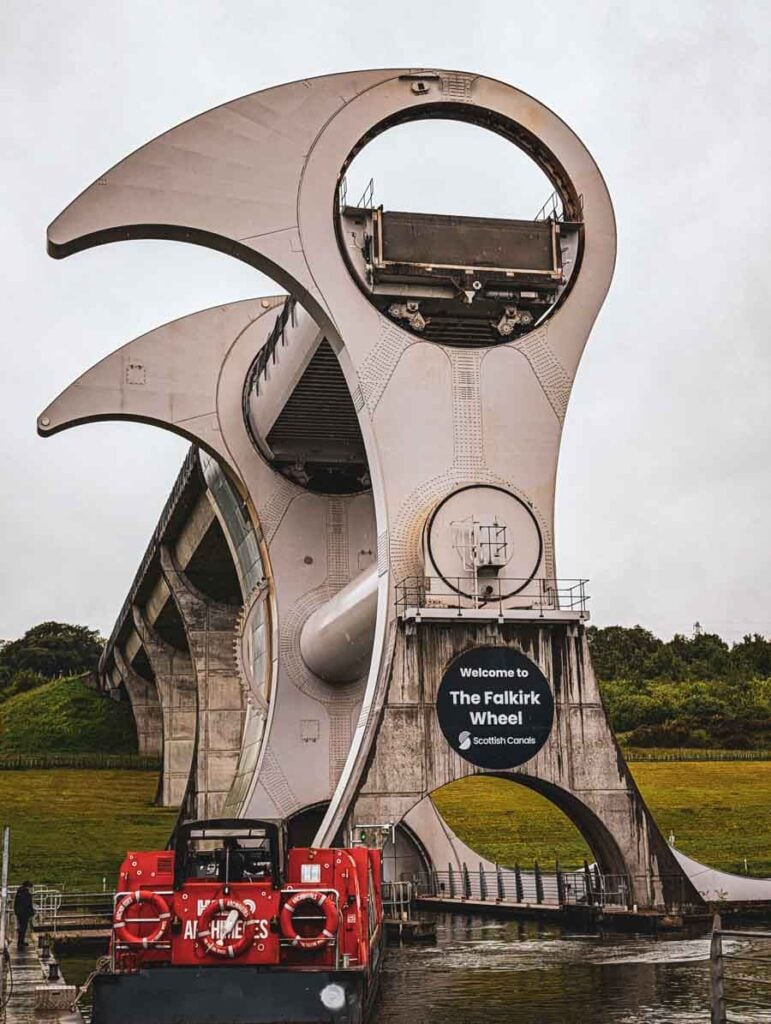
It acts as a monumental, kinetic sculpture that connects two of Scotland’s grandest historic waterways: the Forth and Clyde Canal and the Union Canal.
During my recent travels through the area following a trip to see the Kelpies, I made sure to head down to the basin to see this mechanical marvel in action.
Whether you are an outdoor hiker tracing the trans-Scotland towpaths or a design enthusiast, here is your practical guide to exploring the Falkirk Wheel and its surroundings.
⚙️ The Falkirk Wheel Visitor Blueprint & Logistics
Location & Address:
Lime Road, Tamfourhill, Falkirk, Stirlingshire, FK1 4RS.
Operating Hours:
The surrounding grounds, walking paths, and the viewable canal basin are completely open 24/7 year-round. The central visitor centre, café, and ticket desk operate daily from 10:00 AM to 5:00 PM.
Admission & Parking:
Walking around the basin and watching the wheel rotate from the shoreline is entirely free. The site features a large on-site car park managed via a flat-rate daily pay-and-display fee.
The Boat Experience:
To actually ride inside one of the water caissons as the wheel rotates, you must purchase an official 60-minute boat trip ticket at the visitor centre. Pre-booking online is highly recommended during summer weekends.
Dog Policy:
Brilliantly dog-friendly. Dogs are welcome across all the outdoor towpaths, view terraces, and woodland tracks, and are even permitted inside the lower levels of the visitor centre (excluding the main café food service areas).
The Missing Link: Reconnecting Scotland’s Waterways
To appreciate why the Falkirk Wheel exists, you have to look back at the dramatic layout of Scotland’s industrial geography.
In the 18th and 19th centuries, the Forth and Clyde Canal and the Union Canal were the primary commercial shipping lanes of the nation, allowing cargo barges to transport coal, iron, and goods directly between Glasgow and Edinburgh.
However, the two canals didn’t meet on a level playing field. The Union Canal sits a massive 35 metres (115 feet) higher than the Forth and Clyde.
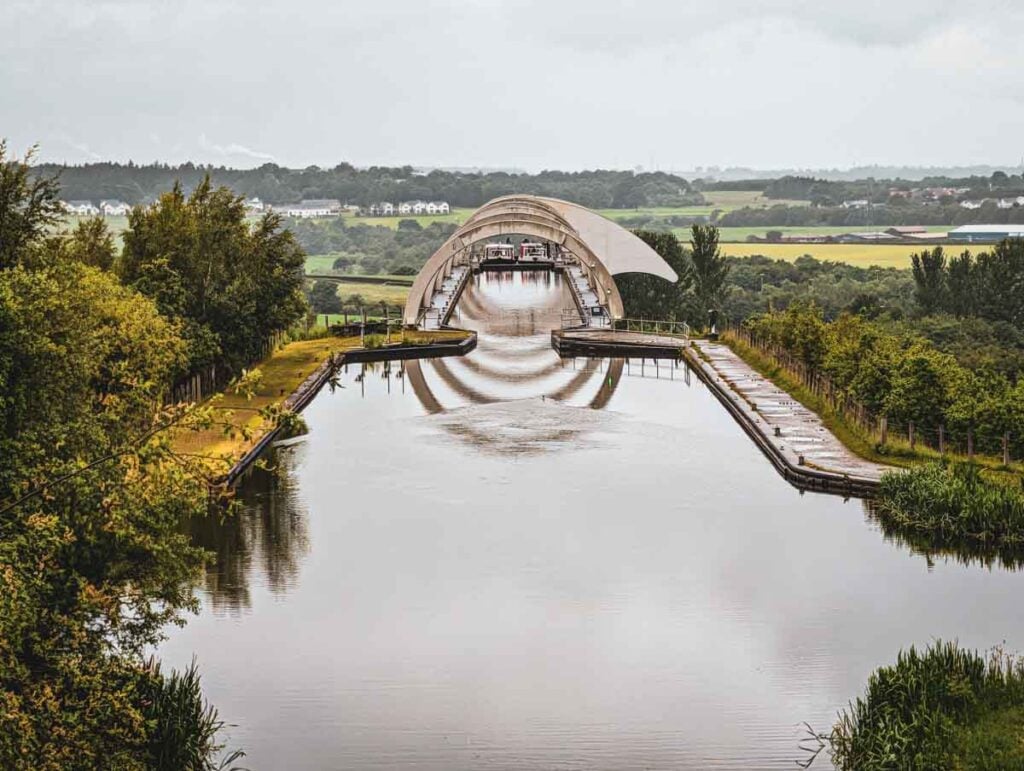
Historically, engineers bypassed this vertical ridge using a flight of 11 independent canal locks that snaked down the hillside.
It was a brutal, exhausting process; a single barge required nearly a day of intensive manual labor and millions of gallons of water just to navigate the flight.
By the 1930s, the rise of rail and road transport saw both canals fall into complete decay, and the historic flight of locks was completely dismantled and buried under tarmac in 1933.
The dawn of the millennium brought a radical change.
As part of the massive Millennium Link project to restore Scotland’s coast-to-coast waterways, British Waterways determined to reconnect the two canals.
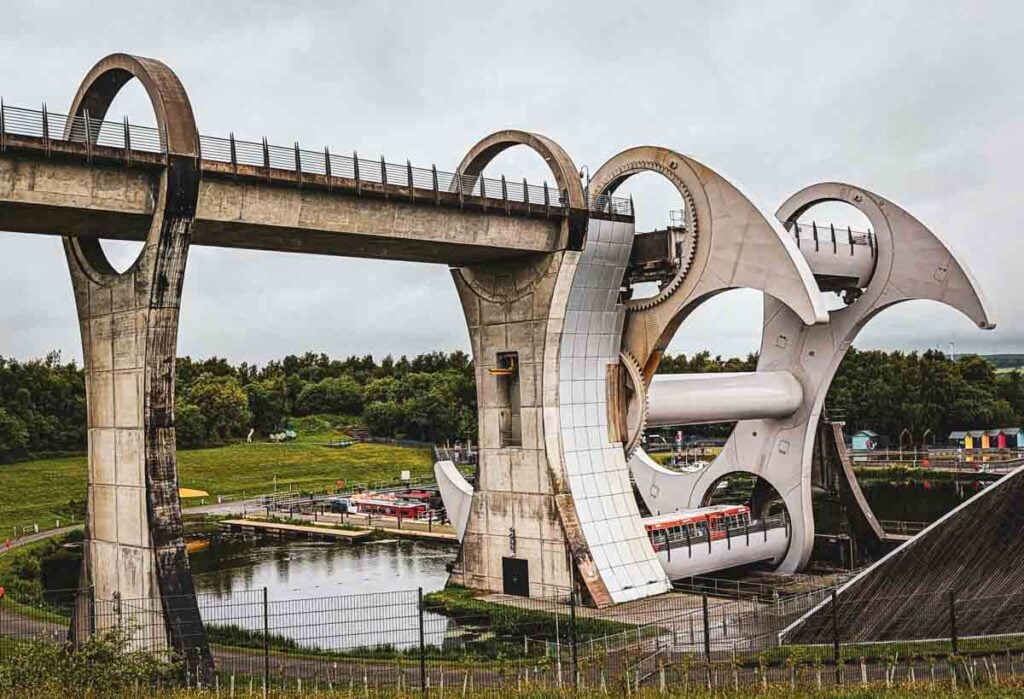
Rather than rebuilding 11 slow, old locks, they decided to construct a futuristic, world-unique engineering icon.
Unveiled by Queen Elizabeth II in 2002, the Falkirk Wheel was born.
The Archimedes Principle: 60 Watts of Pure Physics
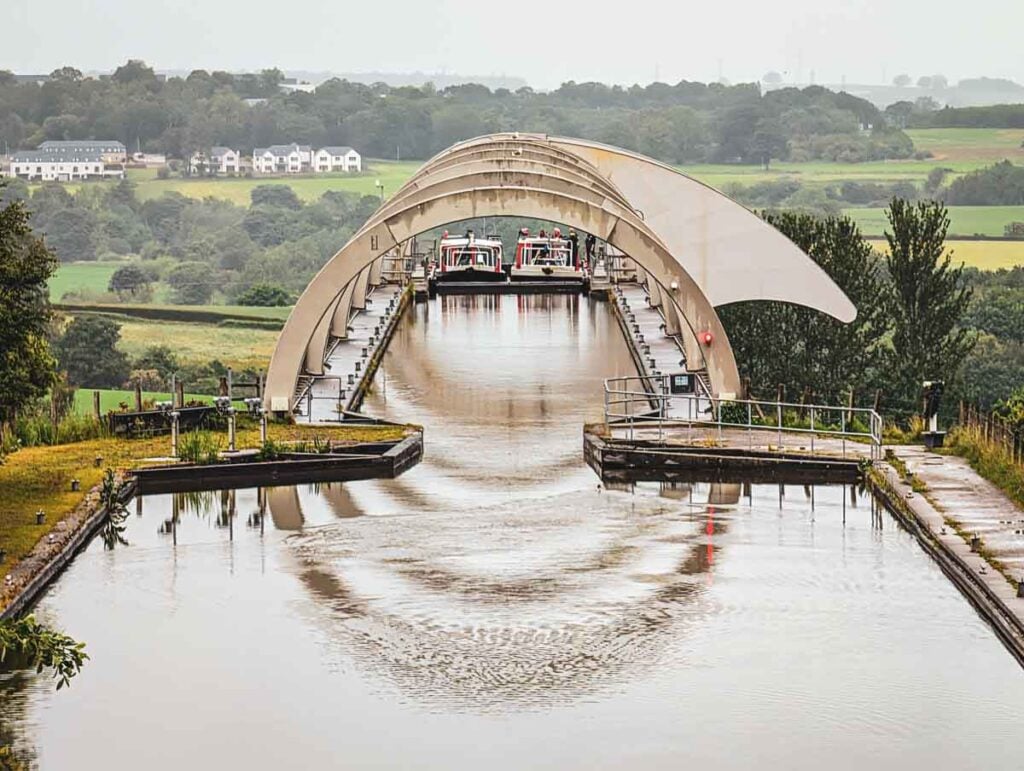
When you stand at the edge of the lower visitor basin, the visual shape of the wheel is instantly striking. Designed to replicate the double-headed blade of a traditional Celtic axe, the structure is an incredibly fluid piece of heavy steelwork.
But the real magic of the wheel lies in its jaw-dropping mechanical efficiency.
The lift features two diametrically opposed, water-filled pods known as caissons, each holding 250,000 litres of water.
The operation relies entirely on the Archimedes Principle of displacement.
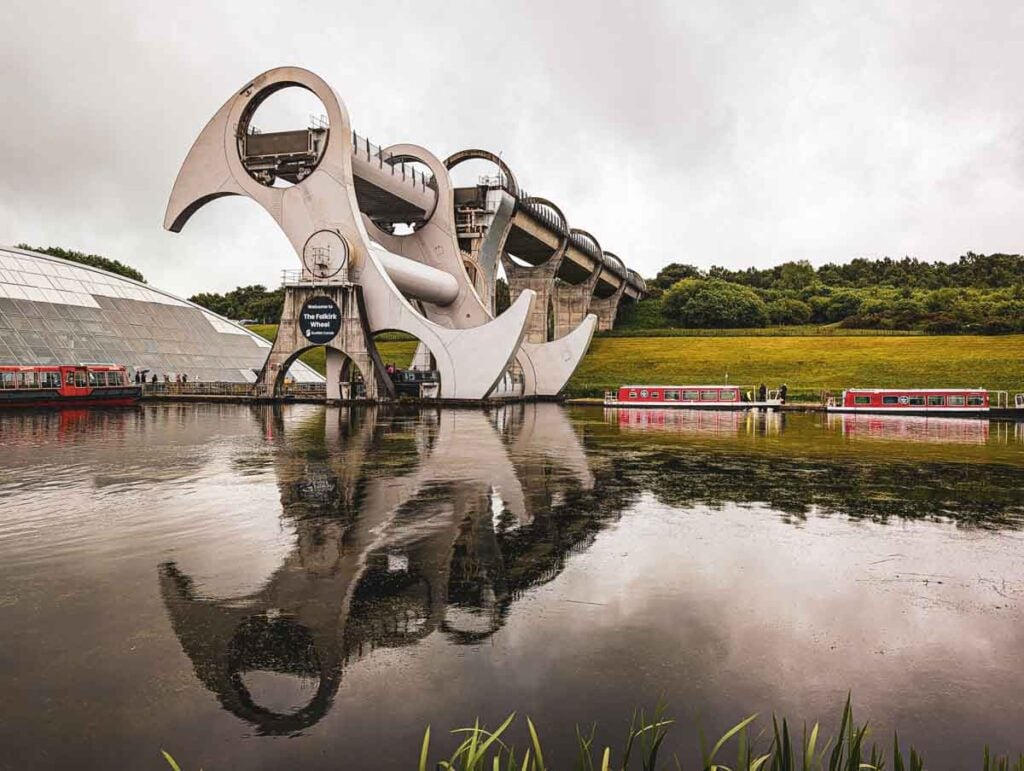
When a 20-tonne canal boat enters the upper caisson, it displaces an exact, identical weight of water out of the pod. Because of this perfect mathematical balance, the two caissons always weigh exactly the same—500 tonnes each—regardless of whether they are carrying a full line of tourist boats or completely empty.
Because the system is perfectly counterbalanced, the mechanical effort required to rotate the massive structure 180 degrees is astonishingly low.
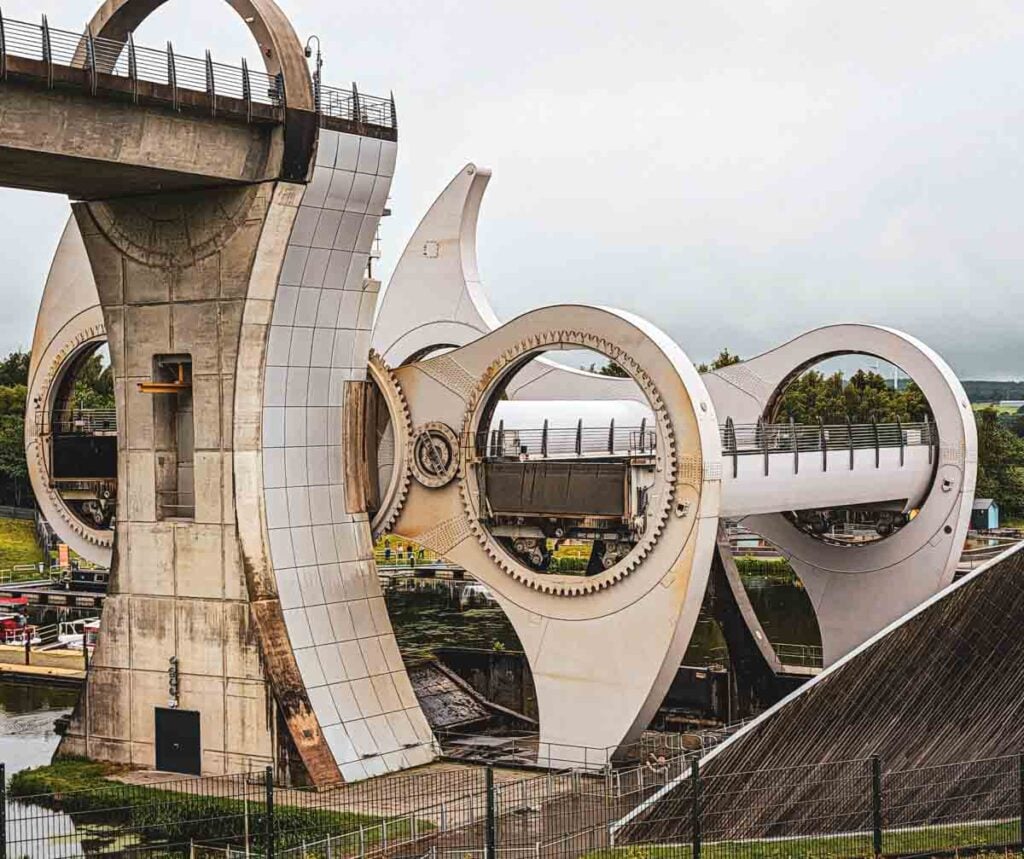
The wheel utilizes a simple internal gear train powered by a collection of small hydraulic motors.
To turn 500 tonnes of steel and water through the air takes just 1.5 kW of electricity—roughly the same amount of energy it takes to boil a standard domestic kitchen kettle!
Watching this silent, massive rotation unfold over the course of four minutes is a mesmerizing display of pure physics.
Beyond the Wheel: Antonine Wall History and Woodland Trails
The Falkirk Wheel isn’t just a standalone mechanical attraction; it is the starting node for a brilliant collection of historic walking trails that climb up through the surrounding ridges:
The Roman Frontier Walk
If you follow the footpaths leading up from the visitor centre toward the upper canal aqueduct, you will cross directly onto the ancient boundary of the Roman Empire.
The ridge houses a remarkably well-preserved section of The Antonine Wall. Built out of turf and stone on the orders of Emperor Antoninus Pius in 142 AD, this fortified wall stretched across the narrow neck of Scotland to guard the Roman frontier against the Caledonian tribes of the north.
Walking through the deep earthwork ditches here offers a brilliant contrast between 2nd-century defenses and 21st-century engineering.
Rough Castle Fort
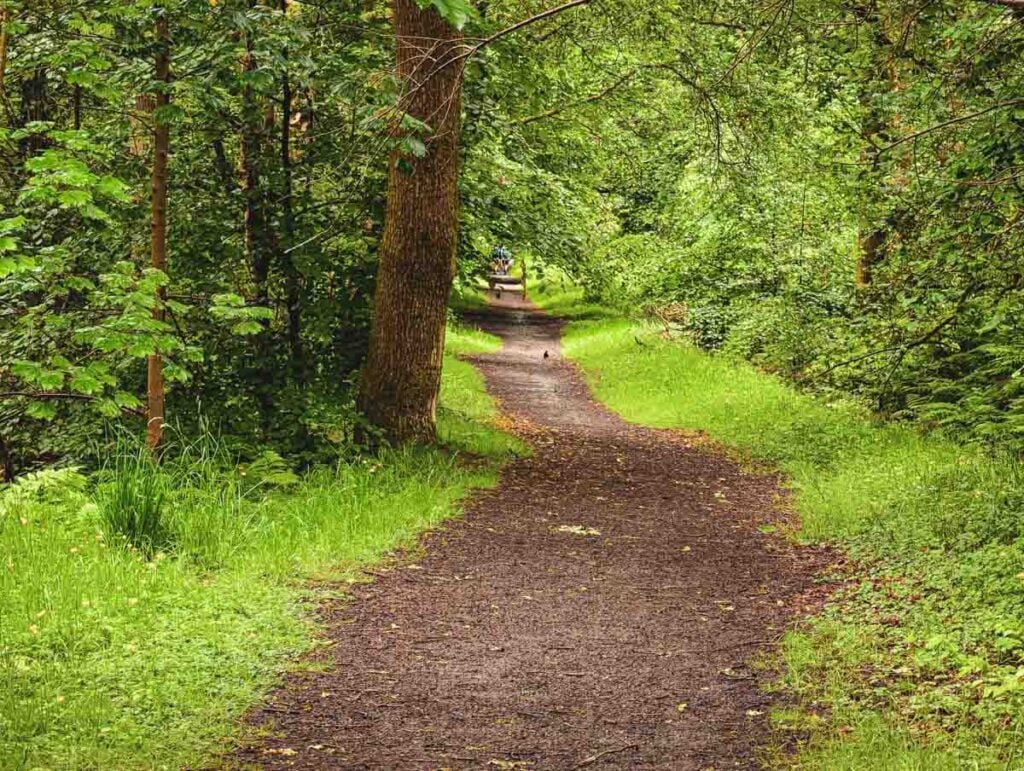
A short, half-mile stroll along the marked woodland tracks brings you to Rough Castle, the best-preserved Roman fortlet along the entire line of the wall.
You can clearly trace the defensive ramparts, the old gateways, and the unique lilia—hidden, defensive pit traps designed by Roman legions to break the charge of invading warriors.
The Ultimate Towpath Hike: Reaching The Kelpies
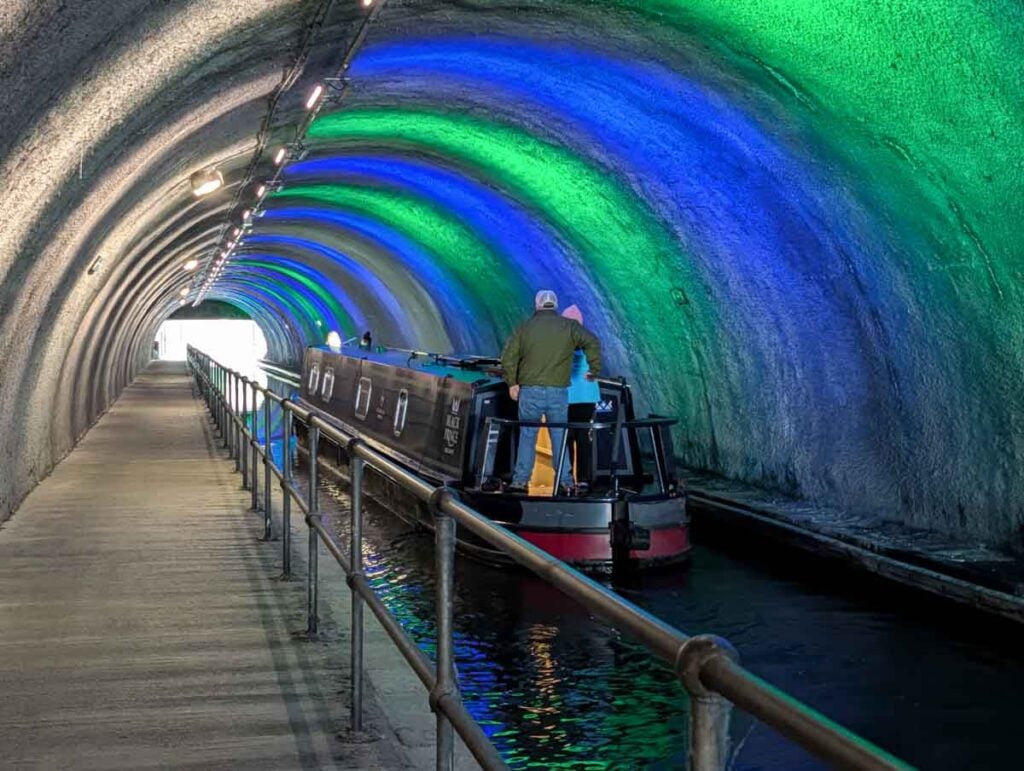
For long-distance walkers, backpackers, and cyclists, the Falkirk Wheel serves as the ultimate starting pad for a scenic 4-mile linear towpath hike through the Stirlingshire countryside.
Lace up your boots right from the lower basin and follow the level, fully paved towpath of the Forth and Clyde Canal heading east.
The route tracks quietly away from the roads, carrying you past historic stone humpback bridges, old lock-keeper cottages, and vibrant local nature reserves.
The trail is exceptionally flat and easy underfoot, making it perfect for a relaxed afternoon walk with dogs or a steady bike ride.
The route terminates at the expansive parklands of The Helix, delivering you straight into the shadows of the magnificent, 30-metre-tall steel horse heads of The Kelpies.
Combining both of Falkirk’s engineering giants into a single walking itinerary offers a world-class outdoor day out that perfectly encapsulates the industrial grit, creative mythologies, and natural rejuvenation of modern Scotland.
Explore More Spectacular Scottish Landscapes & Historic Walks
- The Highland Trek: A Walk Along Scotland’s Rob Roy Way
- The Highland Gateway: Crianlarich: A Complete Hiker’s Guide to Scotland’s Highland Gateway
- The Coastal Path: A Local’s Walking Guide Along the East Neuk of Fife