

The road unfurls ahead, a ribbon of asphalt laid over a path carved by history. Driving west on US-26, the official Oregon Trail Historic Byway, the world opens up.
Out here in southeastern Wyoming, the sky is an immense, overwhelming presence, and the rolling high plains seem to stretch into infinity. It’s a landscape that feels both empty and profoundly full—full of wind, distance, and the ghosts of the past.
I got a sense of profound isolation, a feeling that must have been a constant companion for the half-million people who passed this way not in a car, but in a wagon pulled by weary oxen.
This land is a historical document in itself. Its vastness is not a void but a character in the story of America’s westward expansion.

It was this very space that made the epic migration possible, and its scale forces you to comprehend the sheer audacity of the journey.
I’m went back to Fort Laramie, a place I visited once before, but this time with a deeper purpose. I want to stand again where the 19th century pivoted, to listen more closely to the echoes of trade and treaty, of hope and conflict, that still resonate from its restored buildings and silent, crumbling ruins.
An Oasis at the Crossroads: First Impressions of Fort Laramie
After the hypnotic rhythm of the plains, the arrival at Fort Laramie National Historic Site is a welcome shock to the senses.
The fort sits in a lush, green valley at the strategic confluence of the Laramie and North Platte Rivers, an oasis of cottonwoods and prairie grasses that made it a natural stopping point for centuries.

As I step out of the car, the first thing I notice is the arrangement of the site itself. A collection of meticulously restored 19th-century buildings stands proudly, their porches and windows staring out across a parade ground where bugle calls once marked the hours.
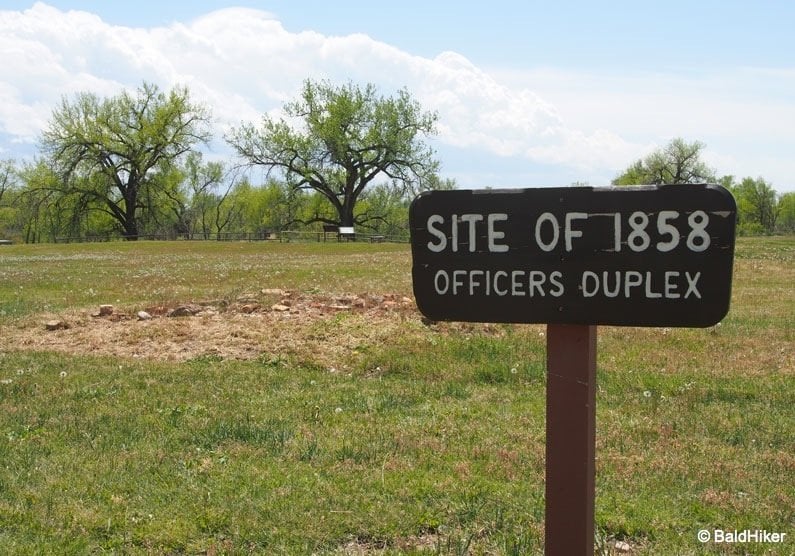
But scattered among them are the skeletal remains of others: stabilized ruins of adobe and concrete, and bare foundations that trace the outlines of structures long since vanished. It’s as if you can see the fort’s entire life cycle—its vibrant prime, its slow decline, and its eventual abandonment—all at once.
My first stop, like that of any modern visitor, is the 1884 Commissary Storehouse, which now serves as the Visitor Center.

Inside, I take the advice of a park ranger and watch the 18-minute orientation film. It’s an essential primer, a powerful distillation of 56 years of complex history that sets the stage perfectly for the exploration to come. It frames the fort not just as a collection of old buildings, but as a place that witnessed, and shaped, the entire saga of the American West.

A Fort of Two Eras: From Buffalo Robes to Blue Coats
To walk the grounds of Fort Laramie is to walk through two distinct, overlapping histories.
Before it was a military post, it was a vital centre of commerce, a place defined by exchange. Then, in a single transaction, its purpose shifted entirely to one of control and projection of power.
The Fur Trader’s Frontier (1834-1849)
I stand on the open ground near the river and try to peel back the layers of time, to imagine this place before the U.S. Army arrived. In 1834, fur traders William Sublette and Robert Campbell built the first fort here, a simple stockade of cottonwood logs named Fort William.
Its purpose was singular: to dominate the lucrative buffalo robe trade. It was soon replaced in 1841 by a more durable adobe structure called Fort John, but everyone simply knew it as the fort on the Laramie.

For years, this was a bustling, multicultural hub. I picture the scene described in historical accounts: camps of Lakota, Cheyenne, and Arapaho families pitched outside the walls, trading expertly tanned buffalo robes for tobacco, blankets, beads, and other goods from the east.
This was more than just a store; it was what historians call an “intermediary zone,” a place where economic, social, and cultural exchanges built a complex, interdependent world.
It was a place of negotiation, not just of goods, but of relationships. Though nothing remains of those early adobe walls, their memory hangs in the air, a reminder of a time when the dynamics of this land were very different.
The Army’s “Grand Old Post” (1849-1890)
The great pivot came in 1849. The California Gold Rush was on, and the trickle of emigrants on the Oregon, California, and Mormon trails had become a flood.
To protect this tide of westward expansion, the U.S. Army purchased Fort John for $4,000 and officially christened it Fort Laramie.
The architecture of the post immediately began to reflect this new mission. This was no longer just a place to trade; it was an instrument of national policy, a projection of federal authority deep into what was still Native land.

My walk through the surviving military buildings becomes a tour of this new reality:
- “Old Bedlam” (1849): My first stop is the fort’s most famous building, a striking two-story structure with wide verandas. Built in 1849 to house bachelor officers, it’s the oldest standing military building in Wyoming. Stepping inside, I’m struck by the relative comfort of the officers’ quarters. It was a detail I noted on my first visit: the stark contrast between the lives of the commissioned officers, who could sometimes have their families join them, and the enlisted men, for whom family life was forbidden.
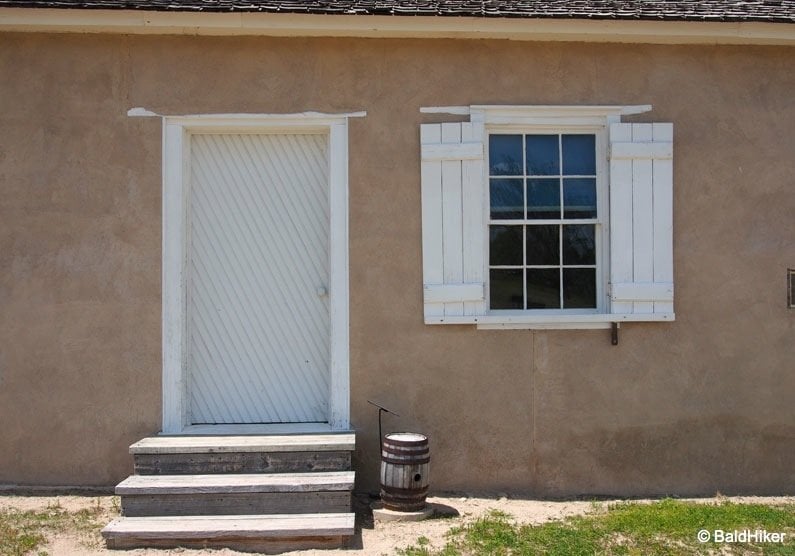
- Cavalry Barracks (1874): A short walk across the parade ground takes me to the long, restored Cavalry Barracks. The interior is spartan, filled with rows of simple beds. Life for the common soldier here was one of monotonous routine: endless drills, guard duty, and “fatigue duties” like cutting firewood or ice from the river. For many, often recent immigrants from Ireland or Germany, a five-year enlistment must have felt like a lifetime in this remote outpost.
- The Sutler’s Store: This civilian-run store was the heart of the fort’s social and economic life. Restored to its 1870s appearance, its shelves are stocked with everything from canned oysters and whiskey to fabrics and tools. It was a vital link to the world back east, a place where soldiers could spend their meager pay and emigrants could restock on essentials before tackling the Rocky Mountains.
But Fort Laramie was more than just a supply depot. It became the administrative and logistical centre for the U.S. Army’s campaigns on the Northern Plains.
It was here that solemn attempts at peace were made, and where the seeds of future wars were sown. The great Indian councils held here, resulting in the Treaty of Fort Laramie of 1851 and the Treaty of Fort Laramie of 1868, were monumental efforts to define territories and establish rules for coexistence.
Yet, these treaties were fraught with cultural misunderstandings and ultimately broken by the relentless pressure of American expansion, most egregiously by the flood of miners into the sacred Black Hills after the discovery of gold in 1874.
The fort that hosted the peace talks also served as the staging ground for the wars that followed, including the Great Sioux War of 1876.

Beyond the Fort Walls: Scars on the Landscape
To truly grasp the scale of the events that Fort Laramie witnessed, I knew I had to see the marks left on the land itself.
A short, 15-mile drive west brought me to two of the most powerful Oregon Trail sites in existence, both near the small town of Guernsey.

The Guernsey Ruts: A Wound in the Earth
First, the Oregon Trail Ruts. I’d seen pictures, but nothing prepares you for the physical reality. Here, the geography of the land forced thousands of wagons to cross a ridge of soft sandstone in the exact same place. The result is staggering. The ruts are not faint traces in the dirt; they are deep channels, in some places waist-high, carved directly into the rock.
Register Cliff: The Stone Guestbook of the Plains
A few miles away, I there are the human counterpoint to the ruts’ impersonal scale. Register Cliff is a soft sandstone bluff rising a hundred feet from the North Platte River valley, a natural resting spot a day’s journey from Fort Laramie.
Here, pioneers paused to do something profoundly human: they carved their names. Standing before the cliff face, protected now by a fence, I can make out the signatures and dates, a guestbook written in stone over 170 years ago.
The abstract idea of “pioneers” dissolves into the reality of individuals: J. Miller, 1852; A. H. Unthank, 1850. They were real people, with hopes and fears, who wanted to leave a mark, to say to the world, “I was here. I passed this way.”
The juxtaposition is powerful. The ruts show the overwhelming force of the migration; the cliff reveals the individual souls who comprised it.
A Place of Two Truths: A Final Reflection
Back on the quiet grounds of Fort Laramie as the afternoon sun casts long shadows, the full weight of the place settles in.
My first visit years ago left me with a powerful feeling, one that has only deepened today. This is a place of two truths, two conflicting legacies that must be held in mind at the same time.
It is, without question, a monument to the incredible endurance and ambition of the emigrants who risked everything for the promise of a new life in Oregon or California.
Their journey is a foundational American story, and its traces at the ruts and the cliff are profoundly moving.
But it is also, undeniably, a symbol of the tragic and violent encroachment on the lands of the Lakota, Cheyenne, Arapaho, and other tribes who had made this valley their home for centuries.
For them, the “Grand Old Post” was a frontline outpost of an invading force, a place of broken promises that ultimately led to the loss of their land and way of life.
The power of Fort Laramie National Historic Site is that it doesn’t let you choose an easy narrative. It forces you to stand in the middle of this complex, uncomfortable history and confront it all. It is a place to learn, to reflect, and to understand that the story of the American West was never simple.
It was, and is, a story of many peoples, many dreams, and many sorrows, all converging right here, in this quiet, beautiful valley where two rivers meet.

Plan Your Own Journey into History: A Visitor’s Guide
Inspired to walk this historic ground yourself? Here’s the essential information you need to plan your visit to Fort Laramie and the nearby Oregon Trail sites.
Getting There
Fort Laramie National Historic Site is located in southeastern Wyoming, 3 miles southwest of the town of Fort Laramie on State Route 160.
From Interstate 25, take exit 92 to US Highway 26 and head east. The Oregon Trail Ruts and Register Cliff are located near the town of Guernsey, about a 15- to 20-minute drive west of the fort.
When to Go
Summer (Memorial Day to Labor Day) is the most popular time, offering living history programs, ranger-led tours, and historic weapons demonstrations.
However, it can be hot. Spring and fall offer milder weather, beautiful foliage, and fewer crowds, making them ideal for a more contemplative visit.


I just got a copy of a family letter from Fort Laramie home to CT 1849 it is amazing. Researching all the tidbits of info in y he one pageants. Imagine how precious it was to receive that.
wow.. very precious