

There are few moments on a summer walk that can ground you in the present quite like coming across a vast, blazing field of sunflowers.
Rising tall against a clear blue sky, their vibrant golden faces seem to catch and radiate the very energy of the season.
It is a sight that instantly lifts the spirits, inviting you to pause, take a deep breath, and simply absorb the sheer abundance of the natural world.

Scientifically classified under the genus Helianthus, these architectural giants are a true staple of the BaldHiker lifestyle—where invigorating outdoor exploration meets creative wellbeing.
Far from being a simple, cheerful backdrop, the sunflower is a beautifully engineered, resource-dense marvel of nature.
When we slow down and examine how these plants grow, track the light, and sustain the life around them, we uncover a profound lesson in ecological connection and mindfulness.
Whether you are photographing a wild golden canopy on the trails or cultivating a towering giant against your garden wall as a therapeutic retreat, here is my holistic field manual to the science, beauty, and soul of the sunflower.
🌻 Helianthus Field Blueprint & Requirements
The Botanical Family:
Asteraceae (the composite family). What looks like a single massive bloom is actually a pseudanthium—a dense cluster of thousands of individual fertile flowers woven into a perfect geometric spiral.
The Mindfulness Rhythm:
Young plants practice heliotropism (solar tracking), moving their heads from East to West daily to maximize the sun’s light, before settling into a permanent, peaceful gaze toward the morning dawn.
Soil & Space Mechanics:
Sunflowers deploy a deep, powerful taproot that demands 2 to 3 feet (60–90 cm) of loose, uncompacted earth. They require space to breathe, thriving best when given clear structural boundaries.
The Universal Provider:
High-value biodiversity engine. A single mature flower head yields hundreds of oil-rich seeds, serving as a vital autumn fueling station for local birds, bees, and woodland fauna.
Solar Exposure Threshold:
Thrives on a minimum of 6 to 8 hours of direct, unobstructed sunlight daily to fuel its rapid vertical journey.
The Anatomy of Wonder: Nature’s Masterpiece
When you step off the main trail and approach a mature sunflower, the physical experience is incredibly grounding.
The name Helianthus tracks directly back to the Greek words helios (sun) and anthos (flower)—a perfect nod to the brilliant yellow ray petals that fan outward like living flames.
But if you practice a moment of closeness and look into the centre of the head, the true biological poetry reveals itself.
The dark central disc is composed of a mesmerizing, mathematically perfect Fibonacci spiral of miniature florets.
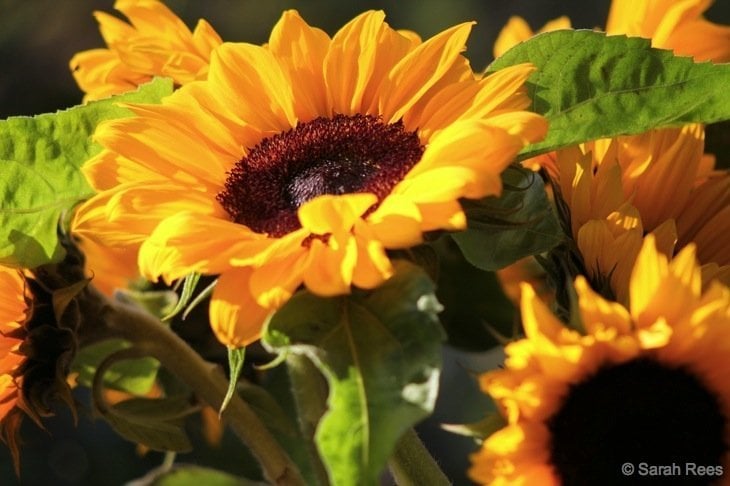
Each tiny floret is a self-contained, nectar-rich universe.
As an environmental scientist, I find the sheer efficiency of this layout fascinating; as a photographer and nature lover, I find it deeply beautiful.
Throughout the peak summer months, this golden platform becomes a bustling, rhythmic hub of biodiversity, alive with the gentle hum of honeybees and wild pollinators drinking in the seasonal bounty.
A Field Guide to Standout Sunflower Varieties
Sunflowers display a spectacular array of genetic diversity, ranging from moody, earth-toned beauties perfect for a quiet garden sanctuary to towering, thick-stemmed giants that challenge the sky.
When we select a variety to plant or observe on our walks, we are choosing the specific role that the plant will play in the local ecosystem and our own sensory space.

For those seeking visual therapy and a mindful garden pace, multi-branching cultivars offer an evolving palette of deep autumn colors that bloom continuously over many weeks.
On the other end of the spectrum, competitive exhibition giants provide a true masterclass in rapid biological growth—climbing up to a foot a week and creating massive, dramatic structural statements that redefine a landscape.
To help you find the perfect fit for your own sanctuary or recognize them on your next country walk, here is a structural breakdown of the core metrics and profiles for four standout varieties:
|
Variety Name |
Average Target Height |
The Visual & Growing Profile |
|---|---|---|
|
American Giant Hybrid |
10 to 16+ Feet (3.0 – 4.8m) |
The undisputed king of the vertical garden. It throws out massive, thick woody stems to support heavy, dazzling golden heads that look incredible against stone walls. |
|
Skyscraper |
12 to 14 Feet (3.6 – 4.2m) |
Produces immense 16-inch wide golden discs with deep orange centers. A magnificent structural variety that rewards patient gardeners with a massive seed harvest. |
|
Earthwalker |
6 to 9 Feet (1.8 – 2.7m) |
A stunning multi-branching variety defined by rich, moody autumn tones—including deep terracotta, dark chocolate, and bronze petals. Perfect for a mindful color palette. |
|
Helianthus schweinitzii |
3 to 6 Feet (0.9 – 1.8m) |
Known as Schweinitz’s sunflower. It is one of the rarest endemic wildflower varieties in North America, currently protected as a beautiful, endangered species. |
Following the Light: The Lesson of Heliotropism
There is a wonderful natural phenomenon hidden within the growth of the sunflower that offers a beautiful metaphor for our own mindfulness journeys.
It is a common misconception that fully open, mature sunflowers continuously turn their heads to follow the sun across the sky from morning until night.
If you stand on the edge of a mature field at sunset, you will notice that almost every single open bloom faces the exact same direction: due East.
The dynamic act of sun-tracking—known as heliotropism—is actually a dance reserved strictly for the young, developing green buds.
Driven by an internal circadian clock, the tender stem of a young sunflower grows slightly faster on the shaded side, gently turning the bud to face the light as the sun arcs across the sky.
Overnight, it re-adjusts, swinging back to the East to calmly await the dawn.
Once the flower head fully matures and opens, the stem hardens and locks permanently toward the sunrise.
This isn’t just an accident of nature; facing the morning sun allows the flower face to warm up rapidly, which dramatically boots nectar production and welcomes the early morning bees.
It is a beautiful reminder from the natural world of the value of staying anchored, warming our spaces, and keeping our focus directed toward the light.

Mindful Cultivation: Nurturing Your Own Giants
Bringing sunflowers into your personal outdoor space is a deeply therapeutic process.
Nurturing a plant from a small, fragile seed into a towering 14-foot giant requires a slow, intentional practice that connects you directly to the seasonal shifts of the soil:
Nurturing the Anchor: Because sunflowers rely on a singular, deep taproot system, they need space to explore. Ensure your soil is loose, uncompacted, and worked deeply down to two or three feet. This allows the plant to build a massive, wind-resistant underground foundation.
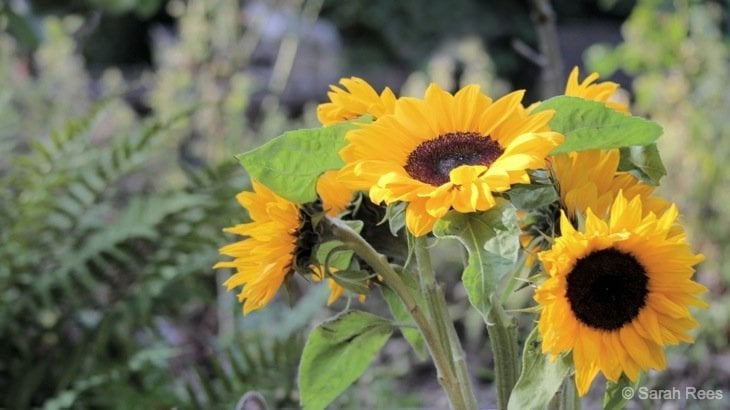
The Nutrient Journey: Sunflowers are enthusiastic consumers of soil nutrients. During their early green growth phase, enrich the soil with high-quality organic compost or well-rotted manure to build stalk thickness. Once the tight green bud forms, transition to a potassium-rich liquid feed (like a natural tomato or comfrey brew) to support the emerging golden head.
Deep, Mindful Hydration: Avoid shallow, hurried daily sprinkles with a garden hose. Sunflowers thrive on infrequent, heavy soakings that penetrate deep into the root zone. Watering deeply once or twice a week coaxes the taproot to dive further into the earth, creating a self-sufficient, resilient plant.
A Sanctuary for Local Wildlife
As the late summer sun begins to dip and the bright yellow ray petals eventually fade, the sunflower enters its most profound phase of utility.
The heavy green head bows gracefully under the weight of its own abundance, transitioning into a vibrant, living wildlife sanctuary.
For bird watchers and nature photographers, this is when the true magic happens.
The oil-dense, highly nutritious seeds become an essential fuel source for local birds—like goldfinches, greenfinches, and nuthatches—preparing for the cold winter months ahead.

Vincent van Gogh was so captured by this rustic, raw cycle of beauty and decay that he immortalized them in his famous 1880s still-life series (Tournesols) in Arles, painting them to bring warmth and a sense of welcome to his guestroom.
Whether seen hanging in a historic gallery, glowing in a vast country field on an afternoon trek, or standing as a proud, quiet guardian in your own back garden, the sunflower remains a magnificent reminder of nature’s power to restore, sustain, and brighten our lives.




Good day,
Inought some sunflowers from a market stall one day in Belgium.
And they all died when I put them in my rear garden.
I am not good with plants but why did my plants not flourish.
Many thanks
Robert Hoskins
ABSOLUTELY phenomenal! 🙂
Thank you Sarah.
The sunflowers are always bright and beautiful to watch.
Stunning pictures…the clarity is breathtaking.
Thank you, thank you, thank you, Paul! Great to see some beauty in the midst of all the bad news.
Keep on hiking!
Thank you all so much for your comments! They DO bring on a smile don’t they?!