

There are some places that photos and stories can never quite prepare you for. Caernarfon Castle is one of them.
As I made my way through the charming, colourful streets of Caernarfon, it wasn’t a gradual reveal. It was a sudden, heart-stopping confrontation.
You don’t just see this castle; it imposes itself upon you. It’s a brute of a fortress, a muscle-bound giant of stone that consumes the waterfront and looms over the town with an intimidating presence that feels as potent today as it must have 700 years ago.

Standing on the banks of the River Seiont, its mighty walls reflected in the water, you feel an inescapable sense of awe.
This isn’t just another beautiful ruin. It’s a statement. Caernarfon is part of a UNESCO World Heritage Site, grouped with the great castles of Conwy, Beaumaris, and Harlech, but even among that royal company, it is unique. For sheer scale and architectural drama, Caernarfon stands alone.
As I stood before its gates, I realised that the feeling of being dwarfed and intimidated wasn’t an accident of history; it was the entire point. This fortress was built to shock, awe, and subdue, and its power to do so has not faded with time.
A Castle Built on Legend and a King’s Ambition
To understand Caernarfon, you have to dig through layers of time. The story begins long before the first medieval stone was laid.
This strategic spit of land, guarding the Menai Strait, was first fortified by the Romans. Their fort of Segontium stood on a hill just outside the modern town, its presence giving the place its name: in Welsh, y gaer yn Arfon, meaning ‘the stronghold in the land opposite Môn’ (Anglesey).
Centuries later, after the Romans departed, the Normans arrived. Around 1090, they built a classic motte-and-bailey castle here—a defensive mound with a wooden stockade.
But this early fort was taken back by the Welsh princes, becoming a Welsh stronghold until the brutal, decisive conquest of Wales by England’s King Edward I.

In 1283, with Wales finally under his heel, Edward began his masterstroke. He didn’t just want to build a fortress; he wanted to build a capital, the administrative heart of his new northern Welsh territory.
And for this, he needed something extraordinary. He enlisted his master architect, the Savoyard genius James of St George, a man described as “one of the greatest architects of the European Middle Ages”.
Together, they created a castle that was less a military outpost and more a piece of imperial propaganda carved in stone.
On my road trip exploring Edward’s ‘iron ring’ of castles, I’d grown accustomed to his style: massive round towers and concentric walls.
But Caernarfon was different. Instead of round towers, it boasts imposing, many-sided polygonal towers. Its walls are decorated with striking bands of coloured stone. This wasn’t a Welsh or English design; it was a deliberate echo of the greatest city in Christendom: Constantinople.

Edward was styling himself as a new Roman emperor, and Caernarfon was to be his new Rome in Wales.
This was political branding at its most audacious. Edward cleverly wove his project into local Welsh legend—specifically the myth of Macsen Wledig, a Roman emperor who dreamed of a magnificent fort at the mouth of a river, “the fairest that man ever saw”.
During the construction, the body of another Roman emperor, Magnus Maximus, was supposedly discovered, and Edward ordered its ceremonial reburial in a local church, further cementing his manufactured link to an ancient, imperial past.
He wasn’t just a conqueror; he was, the castle proclaimed, the rightful heir to a legacy of power.
This grand vision came at a staggering price. The castle and town walls took 47 years to build and cost around £25,000—a truly colossal sum in the 13th century, possibly more than the annual tax revenue of the entire country.
The project wasn’t without its interruptions. In 1294, a major Welsh revolt led by Madog ap Llywelyn saw the town and the partially built castle overrun and burned. The English soon retook it, and the rebellion only spurred Edward on to complete the defences with even greater urgency and strength.
Stepping Inside: A Guide to Exploring Caernarfon’s Mighty Walls
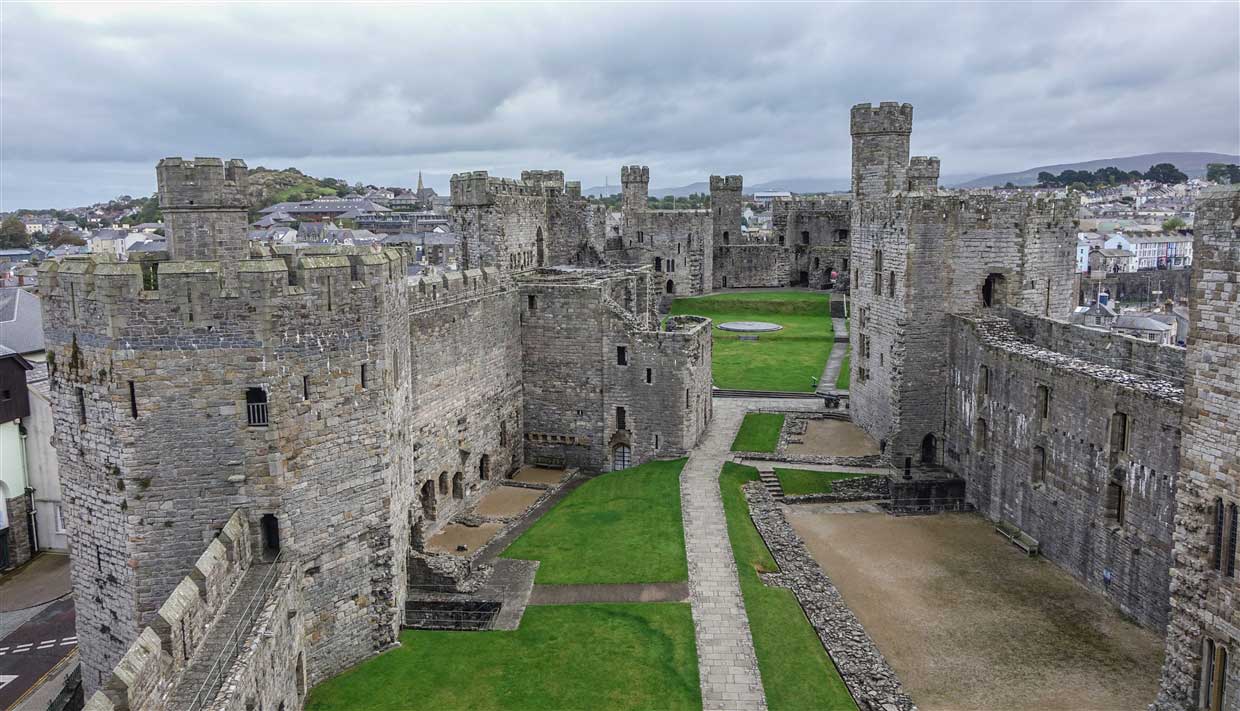
Walking through the main entrance, the King’s Gate, feels like stepping into a medieval killing field. Though never fully completed to its intended design, its defensive might is terrifyingly clear.
I imagined attackers trying to breach it, facing a deadly gauntlet of a drawbridge, no fewer than six heavy portcullises, and a terrifying series of ‘murder holes’ in the ceiling above, from which defenders could rain down boiling oil, rocks, and anything else that would stop an army in its tracks.
Once inside, the sheer scale of the inner ward is breathtaking. But the real magic of Caernarfon is found by going up.

I climbed the winding stone staircases, worn smooth by centuries of footsteps, and emerged onto the battlements.
The experience is incredible. The castle is honeycombed with continuous wall-passages at two different levels, allowing you to walk almost the entire circuit of the upper walls.
The views in every direction are spectacular. On one side, the colourful houses and narrow streets of Caernarfon are laid out like a map.
On the other, the glistening waters of the Menai Strait stretch towards the green fields of Anglesey. And framing it all, the distant, rugged peaks of Eryri (Snowdonia) rise against the sky.

The grandest of the fortress’s towers is the Eagle Tower, a magnificent ten-sided structure that was a palace in its own right.
With walls 5.5 metres thick, it was designed as the ultimate high-status accommodation, its three turrets once crowned with carved stone eagles, symbols of imperial power.This was where royalty w ould have stayed, a secure and luxurious apartment within a fortress.
What makes a visit today so remarkable is how the castle is evolving. Recent, award-winning conservation work has brought a 21st-century touch to the medieval stone.
In the King’s Gate, architects have inserted a new viewing deck, café, and visitor facilities. These modern additions are designed like bespoke pieces of ‘furniture’, sitting within the ancient structure but touching the original fabric as lightly as possible, a reversible intervention that respects the castle’s unfinished history.
Most impressively, this project includes a new glazed lift. For the first time in the castle’s 700-year history, visitors with mobility issues can now access the upper levels, providing step-free access to those incredible battlements views.
It’s a landmark achievement in accessibility for a UK World Heritage site and a wonderful example of how our most precious historic sites can be opened up for everyone to enjoy.

The Birthplace of a Prince: A Title Forged in Conquest
Caernarfon’s story is inextricably linked with one of the most famous royal titles in the world: the Prince of Wales.
In 1284, as the castle was rising from its foundations, Edward I’s son—the future King Edward II—was born here.
Some traditions say he was born within the Eagle Tower itself, while others suggest he was born in the town and ceremonially presented at the castle.

Either way, the political theatre was potent. Legend holds that Edward I promised the vanquished Welsh lords a new prince to rule over them—one “born in Wales, who did not speak a word of English.”
He then presented his newborn son, a baby who fit the description perfectly. With this single, symbolic act, he created the tradition of the English monarch’s heir apparent holding the title Prince of Wales, a tradition that has endured for centuries.
This deep connection was revived spectacularly in the 20th century. After an initial ceremony in 1911, Caernarfon became the global stage for the investiture of Prince Charles on July 1, 1969.
The event was a masterclass in modern pageantry, designed by the prince’s uncle, Lord Snowdon, to be a grand television spectacle. A futuristic-looking perspex canopy was erected in the courtyard to shield the ceremony while allowing the cameras an uninterrupted view.
Watched by 4,000 guests inside the castle and a global television audience of 500 million people, Prince Charles knelt before his mother, Queen Elizabeth II, to receive the coronet, sword, ring, and other symbols of his office.
Having spent time learning Welsh, he delivered his oath and speech in both languages. The ceremony was not without controversy; it took place against a backdrop of rising Welsh nationalism and protests, adding a layer of political tension to the day.
It was a powerful moment, using the castle’s medieval symbolism of conquest and authority to reinforce the monarchy’s modern connection to Wales in the age of mass media.

Beyond the Battlements: Two Must-See Castle Highlights
As you explore the sprawling grounds, there are two experiences within the walls that I highly recommend you don’t miss.
The Royal Welch Fusiliers Museum
Housed within two of the castle’s towers, the Queen’s Tower and the Chamberlain Tower, is the fascinating Royal Welch Fusiliers Museum.
Your castle admission ticket includes entry, and it’s well worth dedicating some time to it. The museum tells the story of over 300 years of service by Wales’s oldest infantry regiment.
The exhibits are rich with history, detailing the 14 Victoria Crosses awarded to its soldiers and telling the stories of the famous writers who served in its ranks during the First World War, including the poets Siegfried Sassoon and Robert Graves.
Whispers of the Past: Myths and Ghosts
Take a moment to soak in the atmosphere and listen to the whispers of older stories. Remember the Welsh myth of Macsen Wledig that Edward I so cleverly co-opted for his own narrative. And if you enjoy a touch of the supernatural, the castle has its share of ghost stories. Keep an eye out for the mysterious “Floating Lady” said to drift through its corridors, or listen carefully near the King’s Gate. Some say you can still hear the faint, sorrowful weeping of Queen Eleanor’s ghost.
Your Caernarfon Adventure: A Practical Guide for Modern Explorers
Planning a trip to this mighty fortress is straightforward. To make it as easy as possible, here is all the essential information you’ll need in one place.
Caernarfon Castle: Visitor Information at a Glance
| Category | Details |
| Address | Castle Ditch, Caernarfon, Gwynedd, LL55 2AY |
| Opening Hours | Mar-Jun & Sep-Oct: 9:30am-5pm | Jul-Aug: 9:30am-6pm | Nov-Feb: 10am-4pm. Closed 24-26 Dec & 1 Jan. Last admission 30 mins before closing. |
| Ticket Prices (2025-26) | Adult: £14.50 | Family: £46.40 | Senior (65+): £13.00 | Junior/Student: £10.10 | Disabled + Companion: Free. (Save 5% by booking online). |
| Booking | Purchase on arrival or book online at the official Cadw website. |
| Parking | No dedicated car park. Use nearby public pay-and-display car parks, such as Slate Quay on the waterfront. |
| Accessibility | Ramp access to entrance. Lift to King’s Gate upper levels. Accessible toilets. Many areas have steep, uneven spiral stairs. Free entry for disabled visitors + companion. |
| On-Site Facilities | Gift Shop, Café/Kiosk, Toilets, Baby Changing, Royal Welch Fusiliers Museum, Free Wi-Fi. Assistance dogs only. |
Insider Tips for Your Visit
- Allow plenty of time: To fully explore the towers, walls, grounds, and museum, I’d recommend setting aside at least 2 to 3 hours.
- Wear sensible shoes: You’ll be doing a lot of walking and climbing on uneven stone steps.
- Layer up: Even on a sunny day, it can get very windy up on the battlements, so an extra layer is always a good idea.
- Download the app: Cadw, the Welsh heritage service that manages the site, has an app that can act as a handy self-guided tour on your phone.

Don’t Just See the Castle, Experience the Town & Beyond
Caernarfon is far more than just its castle. The town itself is a vibrant hub of Welsh culture and a perfect base for exploring the breathtaking landscapes of North Wales.
Explore Caernarfon Town
- Walk the Town Walls: Edward I didn’t just build a castle; he built a fortified town. You can still walk the circuit of the remarkably complete medieval town walls, which stretch for nearly half a mile and are studded with towers and gateways. Stroll down atmospheric lanes like Hole-in-the-Wall Street to get a real feel for the medieval layout.
- Discover the Waterfront: The town’s stylishly redeveloped waterfront is a delight. Wander around Victoria Dock to admire the boats in the marina or explore the new Cei Llechi (Slate Quay), where old harbour buildings have been transformed into a vibrant space for local artisans, craft shops, and great places to eat.
- Ride the Welsh Highland Railway: For an unforgettable journey, hop on a vintage steam train at Caernarfon’s station. The Welsh Highland Railway runs for 25 scenic miles through the heart of Eryri National Park to Porthmadog, passing majestic mountains, ancient forests, and stunning lakes along the way.
- Soak up Local Culture: For a taste of history, pop into the Black Boy Inn, one of the oldest pubs in Wales, for a pint and a hearty meal. Afterwards, browse the wonderful independent bookshops, bakeries, and boutiques along colourful Palace Street.
Venture into Eryri (Snowdonia)
Caernarfon is the perfect gateway to Eryri National Park, a land of myth, legend, and epic scenery.
- Llanberis and Yr Wyddfa (Snowdon): The village of Llanberis, just a short drive away, is the main hub for Wales’s highest peak. From here, you can tackle one of the hiking paths to the summit or take the historic Snowdon Mountain Railway for a more leisurely ascent with the same jaw-dropping views. While in Llanberis, don’t miss the hauntingly beautiful ruins of Dolbadarn Castle, a true Welsh princes’ castle, standing guard over the waters of Llyn Padarn.
- Scenic Drives and Adventures: Take a drive through the dramatic, glacier-carved Llanberis Pass or Ogwen Valley for some of the most spectacular road scenery in the UK. For thrill-seekers, the underground adventures at Llechwedd Slate Caverns or the enchanting Italianate village of Portmeirion are also within easy reach.
Caernarfon’s Enduring Power
Leaving Caernarfon, the image of its towers against the sky stays with you. It is so much more than a magnificent medieval fortress. It is a symbol of power, a stage for royal pageantry, and a masterpiece of propaganda that still achieves its goal of inspiring awe. It is a story of conquest, rebellion, and the forging of a nation’s identity.
From a Roman outpost to an imperial statement, and now to a world-class heritage site that blends its formidable past with a forward-thinking, accessible future, Caernarfon is a place that truly captures the imagination.
I urge you to go, to walk its walls, to climb its towers, and to feel the immense weight of its history for yourself. It’s an experience you won’t soon forget.


