It was on a spontaneous family day out that we first took the bus from Nottingham, travelling through the lovely Nottinghamshire countryside to Southwell.
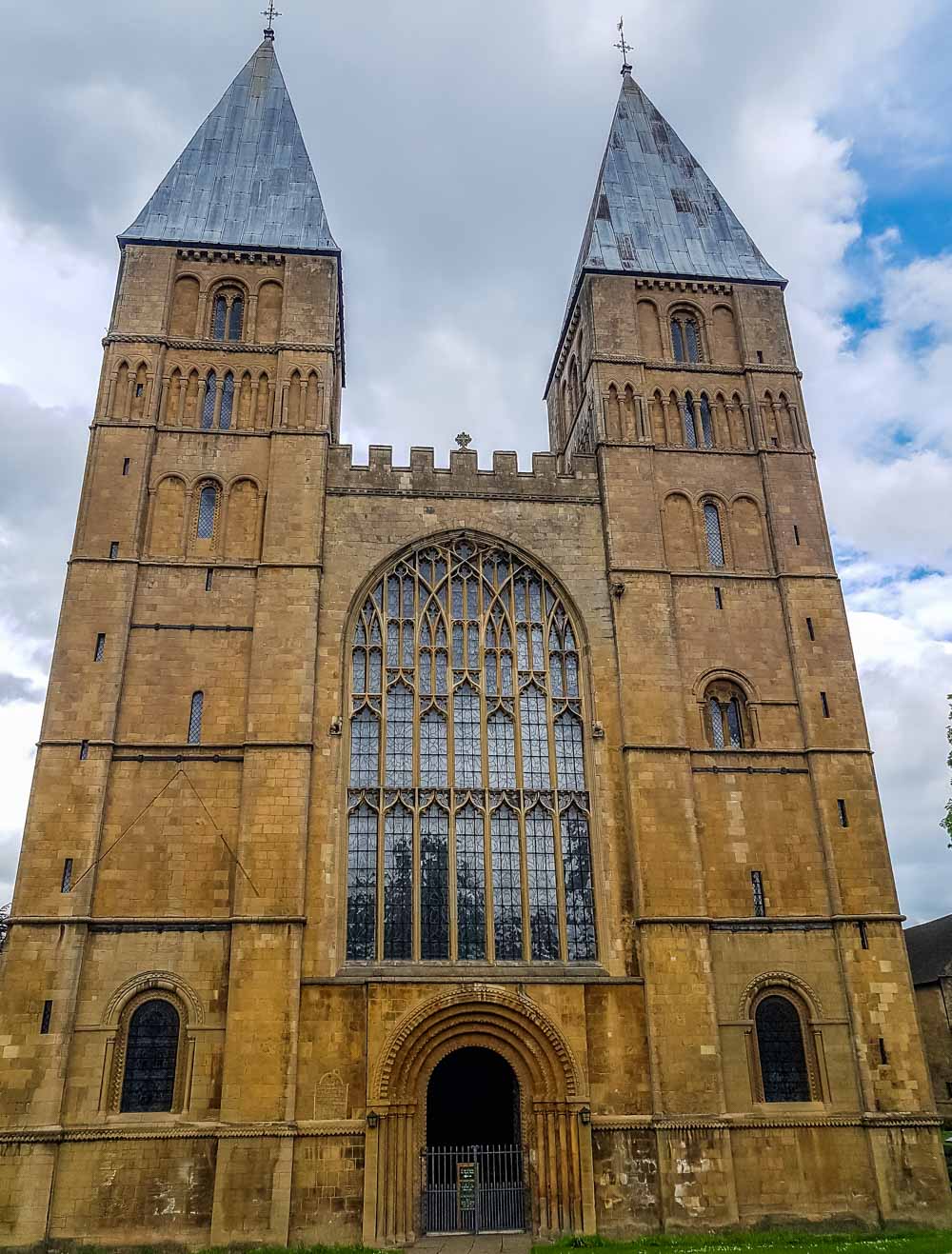
As you approach the town, you see them: the Minster’s famous ‘Pepperpot Towers’ rising above the rooftops, a dominant and captivating sight that promises something special.
This feeling of discovery is why Southwell Minster is often called the “hidden gem” of English Cathedrals—a place where centuries of history are etched into every stone.
As the mother church and official Cathedral of Nottinghamshire, it offers a captivating journey through time, showcasing a unique and powerful blend of imposing Norman architecture and delicate Gothic carving.

This guide, inspired by that first visit, contains everything you need to plan your trip, discover its world-renowned treasures, and understand why this remarkable building has captivated visitors for nearly a thousand years.
Planning Your Perfect Visit to Southwell Minster
This section provides all the practical information you need for a smooth and enjoyable visit, answering the most common questions at a glance.
Southwell Minster at a Glance
Getting There & Parking
Southwell is easily accessible from nearby Nottingham. A scenic bus journey through the Nottinghamshire countryside offers a relaxing way to travel and builds anticipation as the Minster’s famous “Pepperpot Towers” come into view.
For those arriving by car, the most convenient option is the Church Street Pay & Display car park, situated directly opposite the Minster. Coaches can use designated drop-off and pick-up points on Church Street.
Tours, Tickets, and Bookings
While general entry to the Minster is free, your donations are crucial for the ongoing maintenance of this historic treasure; a contribution of £5 is gratefully suggested.

To delve deeper into the Minster’s history, a range of paid, guided tours are available and must be booked in advance.
- Guided Tour of the Minster: Explore 1,000 years of history, including the magnificent Chapter House. (£11 per person).
- Archbishop’s Palace and Gardens Tour: Discover the atmospheric ruins and glorious State Chamber. (£8.50 per person).
- Bell Tower Tour: A fascinating look behind the scenes at the Minster’s famous bells. (£10 per person). Tickets can be booked via the official Southwell Minster website.

Accessibility & Facilities
Southwell Minster is committed to being accessible to all visitors. The building is wheelchair-friendly, with a modern cantilever lift providing full access to the famous Chapter House for the first time in its 700-year history.
A lift is also available in the Archbishop’s Palace to access the State Chamber. Large-print guides, braille guides, and a hearing loop system are available to enhance the visitor experience.
Facilities include the Minster Refectory for light meals and refreshments, the Cathedral Shop for gifts and books, and toilets, including an accessible toilet, located in the Archbishop’s Palace.

A Journey Through 1,000 Years of History & Art
From Roman foundations to its role in the English Civil War, the Minster is a living chronicle of English history.
The Story of the Minster: From Roman Villa to Cathedral
- Roman & Saxon Beginnings: The story of this sacred site begins long before the current Minster was built. It was once occupied by a grand Roman villa, and you can still see remnants of a mosaic floor and painted wall plaster from that era. Legend holds that the first church was founded on the site in 627 AD by Paulinus, the first Archbishop of York. A more formal minster church was established in 956 AD after King Eadwig granted the land to the Archbishop of York.
- The Norman Conquest & Rebuilding: Following the Norman Conquest, a wave of imposing new church construction swept across England. The Minster we see today is a product of that era, with work beginning in 1108 to replace the earlier Anglo-Saxon church with a grand new building in the Romanesque style.
- Reformation & Civil War: The Minster survived the turmoil of the Reformation relatively unscathed. It later played a dramatic role in the English Civil War when, in 1646, King Charles I spent his last night of freedom in Southwell before surrendering to Scottish troops. The conflict left its mark, with the adjoining Archbishop’s Palace being almost completely destroyed.
- From Minster to Cathedral: For centuries, the Minster served as a collegiate church. Finally, in 1884, it was elevated to its current status, becoming the cathedral for the new Diocese of Southwell and the mother church for Nottinghamshire.

An Architectural Tour: A Walk Through Time
A walk through Southwell Minster is a physical journey through changing architectural styles.
- The Norman Nave (Romanesque): Entering the nave is like stepping back into the 12th century. It is one of England’s most complete and impressive examples of Norman architecture, characterized by a sense of immense strength, severity, and solidity. Look for the key features of this fortress-like style: massive, circular drum piers, simple rounded arches, and a clear three-tiered structure of arcade, triforium, and clerestory with its unusual, porthole-like “bulls eye” windows.
- The Pulpitum Screen: Standing between the nave and the choir is the intricately carved stone Pulpitum, or choir screen. Built around 1340, it is a magnificent example of the later Decorated Gothic style, serving as a beautiful and ornate gateway between two distinct architectural eras.
- The Choir (Early English Gothic): As you pass through the Pulpitum into the choir (built 1234-1251), the atmosphere changes completely. The heavy, fortress-like feel of the nave gives way to the elegant, light, and soaring character of Early English Gothic. This style is defined by its slender, clustered columns, sharply pointed arches, and tall, narrow lancet windows, all designed to draw the eye upwards and flood the space with light.

The Crown Jewel: Discovering the Leaves of Southwell
The Minster’s greatest treasure is the collection of 13th-century stone carvings that adorn the Chapter House, known collectively as the “Leaves of Southwell”.
- What are they? These are an extraordinary collection of lifelike carvings depicting the plants, animals, and mythological “Green Men” of the English countryside. You can identify oak, maple, hawthorn, and more, all rendered with breathtaking realism in stone.
- Why are they so important? The Leaves of Southwell are widely regarded as the finest example of naturalistic carving in Europe. Their artistic genius has been praised for centuries. The architectural historian Sir Nikolaus Pevsner saw in them “one of the purest symbols of Western thought,” while the author Dame Hilary Mantel wrote it is “as if…stone has burst into florid life”. In a testament to their enduring appeal, they were recently voted the nation’s favourite cathedral treasure.
- A Modern Miracle: Conservation & Accessibility: A recent £2.2 million project, supported by the National Lottery Heritage Fund, has conserved these delicate masterpieces for future generations. This ambitious project also funded the installation of a new cantilever lift, making the Chapter House fully accessible for the first time in its 700-year history, ensuring everyone can experience its unique beauty.

Hidden Treasures & Quirky Details to Find
Beyond the main architectural features, the Minster is filled with fascinating details. See if you can spot these on your visit:
- The Saxon Tympanum: The oldest carving in the Minster, this lintel in the north transept shows St Michael fighting a dragon and dates back to the original Anglo-Saxon church.
- The “Donald Trump” Carving: A quirky Norman stone head with a distinctive hairstyle that bears an uncanny resemblance to the former US president. It was likely a depiction of a man wearing a cap common in the era.
- Mousey Thompson’s Mice: A fun challenge for families is to find the 28 wooden mice carved into the church furniture by the famous 20th-century craftsman Robert ‘Mousey’ Thompson.

- The Newstead Lectern: This magnificent brass eagle lectern has a remarkable story. Originally from Newstead Abbey, it was thrown into a lake by monks to save it from destruction during the Reformation. It was rediscovered centuries later, in 1805, when the lake was dredged.
- WWI Stained Glass: A modern commemorative window, installed in 2018, depicts scenes from World War I in Nottinghamshire, including a tribute to local flying ace Albert Ball.

Beyond the Minster Walls
Your visit doesn’t have to end at the Minster doors. The surrounding area is steeped in history and charm.
- The Archbishop’s Palace and Gardens: Adjacent to the Minster stand the atmospheric ruins of the former palace of the Archbishops of York. Explore the gardens and the magnificent, intact State Chamber with its medieval vaulted ceiling. This was once home to powerful figures like Cardinal Wolsey and was where King Charles I surrendered to the Scots.
- Exploring the Historic Town of Southwell: The Minster is the heart of a delightful market town. Take a stroll to admire the handsome Georgian architecture and browse the independent shops. Southwell is also famous as the original home of the Bramley Apple and has historical links to the poet Lord Byron. For another powerful historical experience, consider a visit to the nearby National Trust property, The Workhouse at Southwell.