

Crimdon Beach is a landscape I have walked many times, in every imaginable kind of weather.
Whether it’s under the blazing heat of a midsummer afternoon or wrapped up tight against the freezing, sideways rain of a late autumn gale, this stretch of the Durham coast never fails to deliver.
It is one of those rare, joyous places where you can stretch your legs across a spectacular, massive expanse of golden sand and, more often than not, find it surprisingly quiet.
For decades, it has stood as one of the North East’s best-kept secrets. Situated beautifully between Blackhall Rocks to the north and Hartlepool to the south, it treats walkers to sweeping, uninterrupted horizons across the North Sea.
But what I love most about Crimdon is its story of rebirth.
It is hard to believe that only twenty or thirty years ago, this entire shoreline was a landscape heavily scarred by heavy industry, with beaches blackened by colliery waste.

Thanks to years of monumental environmental cleanup and restoration work, nature has firmly taken back the reins. Today, the dark industrial past has completely vanished, replaced by a thriving, vibrant coastal sanctuary.
Crimdon Beach At-A-Glance
Location:
South Durham Coastline, nestled between Blackhall Rocks and Hartlepool.
Best For:
Wild beach walking, birdwatching, dune exploring, and peaceful dog walks.
Parking:
Ample dedicated parking at the modern Crimdon Dene Coastal Hub.
Facilities:
Public toilets, disabled access ramps, and a beach-front café.
Top Wildlife:
Rare nesting Little Terns (summer) and hyperactive Sanderlings (winter).
🚗 Location & Getting Here
Crimdon Beach is exceptionally easy to reach, making it an ideal base for a coastal day trip or a stepping stone for a larger hike along the Durham Heritage Coast.
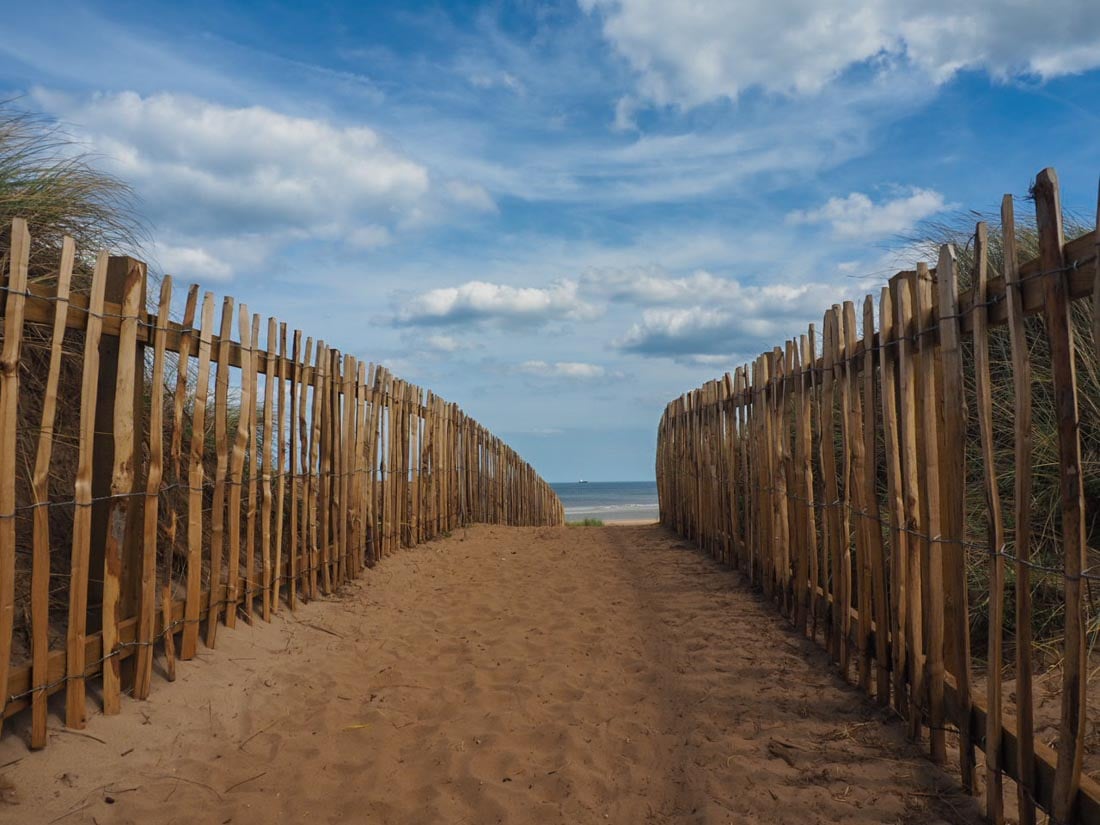
By Car: Located just a short drive from Hartlepool and Seaton Carew, the beach is easily accessible via the A19 dual carriageway. Follow the signs down toward the coast, turning onto the local access roads that lead straight to the shoreline.
By Rail & Bus: The nearest major transport hub is Hartlepool Railway Station, which connects directly to major northern hubs like Newcastle, Sunderland, and Middlesbrough. From the station, frequent local bus services run straight down to the beach area.
Accessibility: Once you arrive at the main front, you will find a beautifully designed infrastructure. The local council has installed comprehensive accessibility features, including smooth concrete ramps for wheelchair users and strollers, ensuring that absolutely everyone can get down to enjoy the edge of the surf safely.

🏛️ Deep History: From Mesolithic Camps to Miners’ Caravans
Long before it became a sanctuary for modern hikers, Crimdon was drawing in travellers.
If you walk into the sheltered valleys of Crimdon Dene, you are walking through an ancient landscape that was actively utilized by prehistoric hunter-gatherers during the Mesolithic period.
Archaeologists have discovered ancient hearth sites, alongside a wealth of worked flints and stone tools scattered across the dene floors.
Fast forward to the early 20th century, and Crimdon transformed into a vibrant seaside escape for the hard-working mining communities of County Durham.
By the 1940s, the clifftops were famous for hosting massive holiday camps and rows of colourful caravans, providing thousands of working-class families with their very first taste of sea air and coastal freedom.
Today, those old holiday camps have evolved into modern caravan parks, and the landscape itself has successfully transitioned into a protected nature reserve.

This delicate balance between recreation and strict environmental conservation is exactly what makes the beach so remarkable to explore today.
🦅 Flora, Fauna & The Shorebird Spectacle
The undulating sand dunes flanking the beach are far more than just a beautiful backdrop—they are a complex, vital ecosystem.
The dunes are heavily covered in thick clumps of sharp marram grass.
This tough, deep-rooted plant performs the critical job of stabilizing the shifting sands, holding the dunes together against the erosive power of the North Sea winds and creating a safe microclimate for thousands of unique insects and wildflowers.

The Water’s Edge Fleet
As an occasional birdwatcher, my absolute favourite pastime here is simply standing near the surf line and watching the hyperactive winter wading birds.
You will instantly spot flocks of tiny Sanderlings and Dunlins moving like clockwork.
They stick together in tight, synchronized groups, frantically sprinting forward onto the wet sand the exact second a wave retreats to snatch up tiny crustaceans, before spinning on a dime and sprinting backward to stay dry as the next wave crashes in.
It is an incredibly entertaining natural comedy routine to witness.
To help you identify these busy travelers on your next coastal walk, be sure to read my standalone field guide to spotting sanderlings and dunlins on Crimdon Beach to learn how to tell them apart by their winter plumage and distinctive feeding movements.
The Return of the Little Terns
Crimdon Beach has achieved international ecological fame as one of the most critical nesting sites in the UK for the Little Tern, one of Britain’s rarest and most threatened seabirds.
Every single May, these tiny, elegant birds complete a staggering 3,000-mile migration journey all the way from the West Coast of Africa to lay their eggs directly onto the open shingle banks of Crimdon.
Because they nest on the open ground rather than high cliffs, their eggs and chicks are incredibly vulnerable.
A dedicated team of local wardens and passionate volunteers monitor the colonies around the clock throughout the summer, erecting protective boundary fences to ensure these rare African visitors can raise their young in total peace before flying back south in August.

🐾 The Four-Legged Team Dispatch
Malc & Pete’s Trail Notes
For dogs, Crimdon is absolute paradise. The sheer width of the sand at low tide means Malc and Pete have endless room to sprint, fetch tennis balls, and splash around in the shallow waves.
Because the beach is so vast and flat, it is incredibly easy to keep a visual lock on your pack.
The Golden Conservation Rule: While the freedom here is unparalleled, we dog owners have a massive responsibility here between May and August.
Because the endangered Little Terns nest directly on the pebbles, you must keep your dogs on a short lead and stay completely clear of the clearly marked, fenced-off nesting sanctuaries in the dunes.
The local wardens do an incredible job protecting these birds, and keeping our dogs controlled around the colony is a tiny price to pay to ensure these brilliant birds keep returning to our coast.
Outside of the summer nesting window, the dunes and beaches are wide open for responsible exploration!
🍽️ Refueling & Beyond: The Dunes Café
After a long, windy stomp along the sand, there is nothing quite like peeling off your boots and grabbing a warm drink.
The Dunes Café, located right inside the modern Crimdon Dene Coastal Hub building, has become a fantastic addition to the seafront. It is incredibly welcoming, completely dog-friendly, and serves up excellent artisan coffees, homemade cakes, and hot breakfast baps with a panoramic view looking straight out across the marram grass toward the sea.
Nearby Gems to Explore
If you want to turn your trip to Crimdon into a full day of exploration, there are some spectacular locations sitting right on its doorstep:
The Heugh Battery Museum: Located just a few miles south on the historic Hartlepool Headland, this is a must-visit. You can explore the underground magazines and view the big guns at the only official World War I battlefield on British soil. Check out my full visitor guide to the Heugh Battery to plan your historical detour.
Seal Sands: Head a bit further south toward the mouth of the Tees to watch the massive colonies of common and grey seals basking peacefully on the tidal mudflats.



I do not know how it was before but it is very calm and beautiful at the moment. Congrats for the photos, especially the photo with the dog in the water is just great.
So beautifully shot. I remember walking that beach 25 years ago when the beach was black from the coal waste casually dumped in the sea and washed back o the shore. I mist get back there soon.
Hi Ian,
You must get back. So much has changed.. Clean, open, full of wildlife. 🙂 You would never think it was ever black from the coal industry