A Flash of Lemon: My Encounter with the Riverside Dancer
There are moments on a walk when the landscape offers a small, perfect gift. On a recent trip near Rydal Water, away from the usual crowds, the riverbank delivered just such a moment.
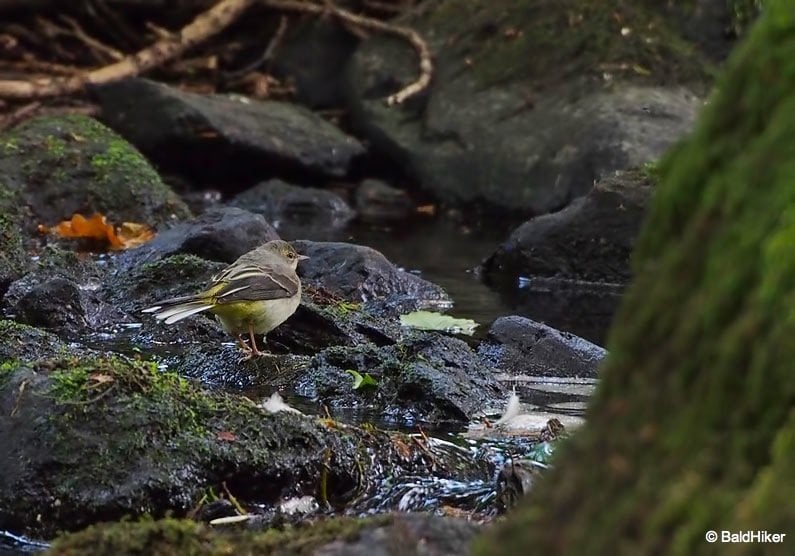
Against the grey, water-worn stones, a flash of lemon yellow caught my eye. It was a Grey Wagtail, a bird so vibrant and full of life it seemed to make the water itself sparkle.
Watching it dip and dance, its impossibly long tail bobbing with relentless energy, was a reminder of the wild beauty hidden in plain sight.
This bird, a flash of sunshine on a cloudy day, is a favourite for many, yet it’s often misunderstood.

In this guide, we’ll dive deep into everything you need to know about this remarkable bird, from identification and calls to where you can find one for yourself.
Grey Wagtail at a Glance
Common Name:
Grey Wagtail
Scientific Name:
Motacilla cinerea
Family:
Motacillidae (Wagtails and Pipits)
UK Conservation Status:
Amber List
UK Population Estimate:
Approximately 37,000 breeding pairs
Length:
18–19 cm
Wingspan:
25–27 cm
Weight:
18–21 g
Average Lifespan:
3 years (up to 7 years recorded)
Diet:
Primarily insects (flies, midges, mayflies, beetles), also snails, tadpoles, and small crustaceans
Breeding Habitat:
Fast-flowing, clear rivers and streams, typically in upland areas
Winter Habitat:
Lowland areas, farmyards, canals, town centres, and coastal areas
How to Identify a Grey Wagtail: A Detailed Guide
General Appearance and Key Features
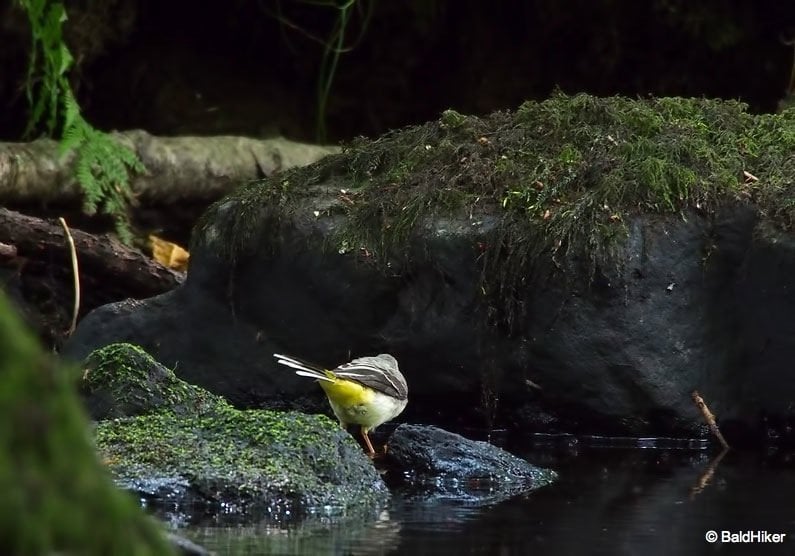
The Grey Wagtail is a slim, elegant bird. Its most striking features are the slate grey back, head, and wings, which provide a sharp contrast to its vibrant lemon-yellow belly and undertail.
A key identifier is its remarkably long, black-and-white tail, which is noticeably longer than that of other wagtails and is almost constantly in motion.
Other subtle but important marks include a narrow white supercilium (eyebrow stripe), a broken white eye-ring, and pale pinkish-grey legs.

Male vs. Female: Spotting the Difference in Breeding Season
During the breeding season, from April to July, the male Grey Wagtail becomes particularly distinctive. He develops a solid, jet-black throat or “bib,” which is framed by a clean white “moustache” stripe.
The female is similar but lacks this solid black bib; her throat is typically whitish, sometimes with a greyish or mottled appearance.
The yellow on her underparts is also often less intense than the male’s. Outside of the breeding season, the male loses his black bib, and the sexes become very difficult to tell apart.

Identifying Juvenile and Winter Plumage
Juvenile Grey Wagtails are much duller than adults. Their underparts are a washed-out, buff-white colour, and they completely lack the black throat patch of a breeding male.
The characteristic yellow is confined to the rump and the area under the tail. In winter, adult birds of both sexes have duller plumage and resemble the female, making identification more of a challenge.
The Name Game: Grey Wagtail vs. Yellow Wagtail vs. Pied Wagtail
One of the biggest points of confusion is the Grey Wagtail’s name, which seems to ignore its most colourful feature. Clarifying the differences between the UK’s three wagtail species is key to confident identification.
- Grey Wagtail vs. Yellow Wagtail: This is the most common mix-up. The crucial difference is the back colour and habitat. The Grey Wagtail has a slate grey back and is almost always found near fast-flowing, rocky water. The Yellow Wagtail has an olive-green back, a shorter tail, and prefers damp lowland meadows, often seen among grazing cattle.
- Grey Wagtail vs. Pied Wagtail: This comparison is more straightforward. The Pied Wagtail, a familiar bird of towns and car parks, is strictly black, white, and grey, with no yellow in its plumage at all. The presence of any bright yellow immediately rules out a Pied Wagtail.

The Sights and Sounds of the Grey Wagtail
The Famous Wagging Tail and Undulating Flight
The constant bobbing or “wagging” of the long tail is the family’s defining characteristic.
As the Grey Wagtail has the longest tail of the British wagtails, it is a particularly energetic tail-wagger.
While the exact reason for this is unknown, theories suggest it could be a signal to predators, a way to communicate with other wagtails, or a method for flushing out insects.
In flight, the Grey Wagtail has a distinctive bounding or undulating motion, typically flying low over the water.
Unlike the more sociable Pied Wagtail, the Grey Wagtail is usually seen alone or in pairs and is highly territorial during the breeding season.
What Does a Grey Wagtail Sound Like? (Call and Song)
A bird’s call is often the first clue to its presence. The Grey Wagtail’s vocalisations are adapted to its noisy riverside habitat, with a sharp, high-pitched sound that cuts through the noise of running water.
- Call: The most common sound is its flight call, a sharp, piercing, and metallic sound. It is often described phonetically as a “ti-zick” or “t-zick,” which is higher-pitched than the Pied Wagtail’s call. Other descriptions include a sharp “zi-zit” or “chi-cheep”.
- Song: The song is less frequently heard. It is a series of rapid, sweet, and tinkling trills, sometimes described as a repeated “zri-zri-zri” or a buzzing series of rising and falling notes.
Where to See Grey Wagtails in the UK: Habitat and Distribution
The Ideal Habitat: A Bird of Fast-Flowing Water
The Grey Wagtail is intrinsically linked to clean, fast-flowing water. Its prime breeding habitat consists of upland streams and rivers with rocky beds, riffles, and small waterfalls, which provide an abundance of aquatic insects.
Because of this strong link, the Grey Wagtail is considered an indicator species; its presence is a positive sign of a healthy, low-pollution river ecosystem.
In recent decades, improving water quality in many lowland rivers has allowed the species to expand its breeding range.
Seasonal Movements: From Upland Rivers to Urban Gardens
In winter, as insect life becomes scarce at higher altitudes, most Grey Wagtails perform an “altitudinal migration,” moving down into lowland areas.
During this time, they can be found in a much broader range of habitats, including slower rivers, canals, lakes, and reservoirs. They are also frequently spotted in more urban environments, including farmyards, sewage treatment works, and even town centres.
UK Distribution and Hotspots
The Grey Wagtail is widespread across the UK and Ireland, but its population density varies. The highest breeding densities are found in the upland areas of Wales, the Pennines, Scotland, and the West Country.
They are much scarcer during the summer in the low-lying regions of East Anglia and South East England. In winter, the distribution becomes more even as birds spread out across the lowlands.
Diet, Breeding, and Lifecycle
What Do Grey Wagtails Eat?
The Grey Wagtail is an insectivore whose diet is closely tied to its waterside habitat.
It feeds on a wide variety of aquatic insects and invertebrates, including flies, midges, mayflies, and beetles, which it picks from the water’s surface or catches in mid-air.
They also consume small water snails, tadpoles, and crustaceans found in the shallows.
While they are unlikely to visit standard bird feeders, they have been known to take mealworms or scavenge for fallen sunflower hearts in gardens with water features.

Nesting, Eggs, and Raising Young
The breeding season runs from April to July. Grey Wagtail pairs are monogamous and defend a linear territory along a stretch of river.
The nest is a cup built by both parents from moss, twigs, and grass, lined with fine hair.
They are very adaptable, nesting not only in natural crevices in riverbanks and tree roots but also frequently using man-made structures like holes in bridges, weirs, and drainpipes.
The female lays a clutch of 3 to 6 cream-coloured eggs with grey speckles.
She incubates them for about 13 days, and once hatched, the chicks are fed by both parents for 14 to 15 days before they fledge. A pair may raise a second brood if conditions are good.

Conservation Status: A Story of Resilience and Risk
The Grey Wagtail is on the Amber List of UK Birds of Conservation Concern, indicating a species of moderate concern.
The UK is home to an estimated 37,000 breeding pairs, and while the long-term population trend is considered broadly stable, the species has experienced significant fluctuations.
The species is both resilient and vulnerable. It is highly adaptable, benefiting from cleaner UK rivers and readily using man-made structures for nesting.
However, it is also highly susceptible to severe winter weather, as prolonged freezing temperatures can lock away its food source of aquatic insects, leading to significant population declines.