

Madagascar. The name itself conjures images of a land untouched by time, a place where evolution has carved a path uniquely its own.
It’s a land of dancing lemurs, otherworldly baobabs, and a vibrant culture with roots reaching across continents.
I once heard that a trip to Madagascar as a “mission,” and that sentiment still rings true today. It’s a mission to get to, a mission to navigate, and, most importantly, a mission to protect.
But for those who answer the call, the reward is an unparalleled adventure into one of the most biodiverse places on Earth.
Cast adrift from the African mainland some 160 million years ago, Madagascar has followed its own evolutionary rhythm, a symphony of life that has produced a cast of creatures and plants found nowhere else.
An astonishing 95% of its reptiles, 89% of its flora, and 92% of its mammals are endemic to the island. This isn’t just a country; it’s a living laboratory, a sanctuary of the strange and the beautiful.
From the dense, emerald rainforests of the east to the spiny deserts of the southwest, the landscapes are as diverse as the life they cradle.
My journey through Madagascar was more than just a trip; it was an immersion into a world that felt both ancient and alive. It was a kaleidoscope of colours, sounds, and experiences that left an indelible mark on my soul.
This is not a destination for the faint of heart, but for the intrepid traveller, the wildlife enthusiast, and the seeker of the extraordinary, Madagascar is, quite simply, the adventure of a lifetime.
The Land of Lemurs: The Soul of Madagascar
You cannot speak of Madagascar without speaking of lemurs. These charismatic primates are the island’s most famous residents, and encountering them in the wild is a truly magical experience.
With over 100 species, from the diminutive Madame Berthe’s mouse lemur, the world’s smallest primate, to the statuesque Indri, with its haunting, whale-like calls, the diversity of lemurs is a showcase of Madagascar’s unique evolutionary history.
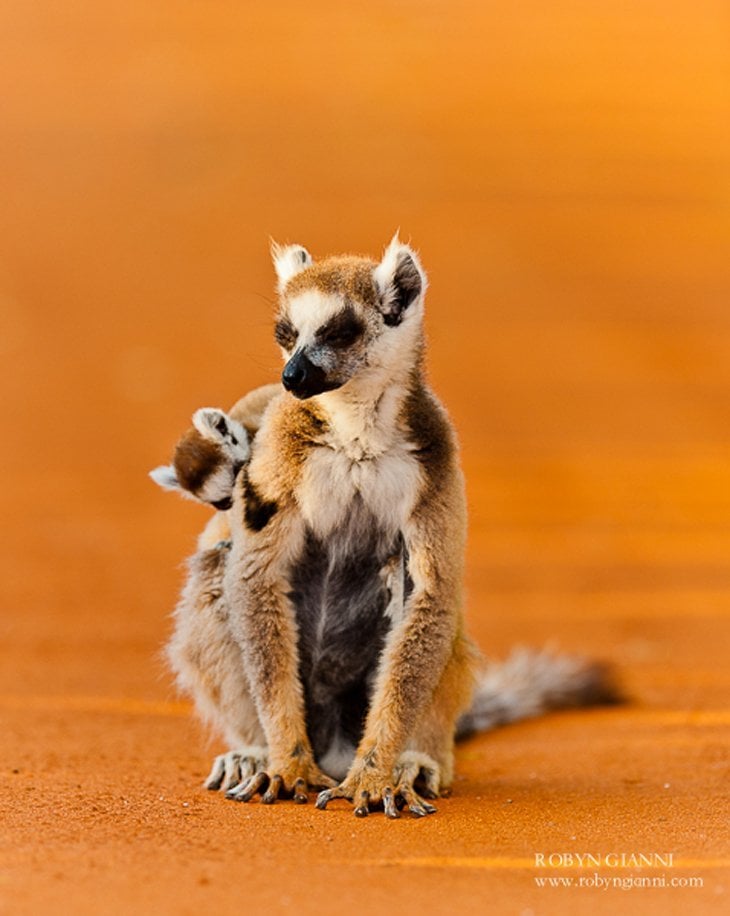
One of my most cherished memories is of watching a troop of ring-tailed lemurs sunbathing in the early morning light. They sat in what can only be described as a yoga-like pose, arms outstretched, soaking in the warmth.
This isn’t just for relaxation; they have scent glands on their wrists, and this sun-worshipping posture helps to warm and disperse their unique scent.
But the world of lemurs is far more complex and fascinating than just their sunbathing habits. Did you know that lemur society is predominantly female-dominated?
The females are the leaders, the first to eat, and the ones who fiercely protect their troop. It’s a matriarchal society that challenges our own primate perspectives.
And then there’s the hypnotic, “dancing” of the Verreaux’s sifaka. As they move from one spiny octopus tree to another, they launch themselves into the air, their white bodies a stark contrast against the green canopy. On the ground, they move with a sideways, bipedal hop, a balletic performance that is both comical and graceful.
To truly appreciate the diversity of lemurs, you must venture into Madagascar’s national parks.
In the rainforests of Andasibe-Mantadia National Park, the morning air is filled with the ethereal song of the Indri. This is the largest of the living lemurs, and their calls can travel for miles, a hauntingly beautiful soundtrack to the Madagascan rainforest.
In the dense, humid jungles of Ranomafana National Park, you might be lucky enough to spot the rare golden bamboo lemur, a species that was only discovered in the late 20th century.
And in the dramatic, sandstone landscapes of Isalo National Park, the ring-tailed lemurs are the undisputed kings of the canyons.

Beyond the Lemurs: A World of Unique Wildlife
While lemurs may be the stars of the show, Madagascar’s supporting cast of creatures is equally captivating. This is a land where chameleons abound, with more than half of the world’s species found here.
From the giant Parson’s chameleon, a creature that can reach the size of a small cat, to the minuscule Brookesia micra, which can comfortably sit on the head of a match, the variety is astounding.
Their ability to change colour is not just for camouflage; it’s a form of communication, a way of expressing their mood, and a tool for attracting a mate.
And let’s not forget the fossa, Madagascar’s largest predator. With the body of a cougar, the face of a mongoose, and the agility of a squirrel, the fossa is a truly unique creature. It is the only predator on the island large enough to prey on lemurs, and its elusive nature makes it a prized sighting for any wildlife enthusiast.
The birdlife of Madagascar is a riot of colour and sound. The island is home to over 280 species of birds, with more than 100 of them being endemic.
From the stunning, blue-hued feathers of the blue coua to the bizarre-looking helmet vanga, with its massive, hooked bill, the birdwatching opportunities are endless.

A Landscape of Contrasts: From Rainforests to Deserts
The diversity of Madagascar’s wildlife is a direct result of its incredibly varied landscapes. The island can be broadly divided into three main geographical regions: the eastern rainforests, the central highlands, and the western and southern dry forests and deserts.
The eastern coast is a verdant paradise, a sliver of land that is home to some of the most extensive rainforests in the Indian Ocean.
Here, the air is thick with the scent of vanilla and cloves, and the constant hum of insects is a reminder of the life that teems in the dense undergrowth.
National parks like Andasibe-Mantadia and Ranomafana are the green jewels of the east, offering a glimpse into a world of cascading waterfalls, lush vegetation, and unparalleled biodiversity.
The central highlands are the backbone of Madagascar, a spine of mountains and plateaus that run the length of the island.
The landscape here is a patchwork of terraced rice paddies, rolling hills, and traditional villages. The capital city, Antananarivo, is a chaotic and colourful hub, a city that seems to be in a constant state of flux.

To the west and south, the landscape transforms into a dry, spiny desert, a world of thorny octopus trees, bulbous baobabs, and surreal sandstone formations.
Isalo National Park is the crown jewel of the south, a place where deep canyons, natural swimming pools, and sacred burial sites are carved into the ancient rock.
And then there is the iconic Avenue of the Baobabs, a dirt road lined with towering, ancient trees that seem to reach for the heavens.
To witness a sunset here, with the sky ablaze in hues of orange and purple and the silhouettes of the baobabs standing like sentinels against the dying light, is a moment of pure, unadulterated magic.
The Heart of Madagascar: The Malagasy People and Culture
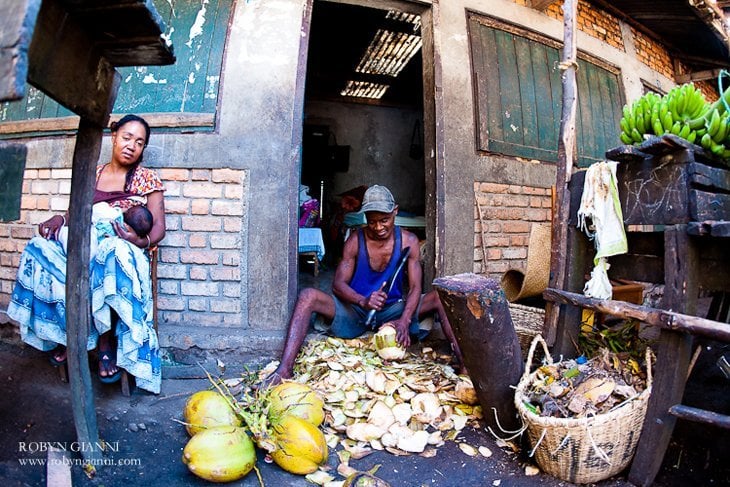
Madagascar is not just a land of unique wildlife and stunning landscapes; it is also a country with a rich and vibrant culture, a melting pot of African, Asian, and European influences.
The Malagasy people are a warm and welcoming people, with a deep respect for their ancestors and their traditions.
One of the most fascinating and unique aspects of Malagasy culture is the ‘Famadihana’, or the “turning of the bones.” This is a sacred ritual where the bodies of ancestors are exhumed from their tombs, re-wrapped in fresh silk shrouds, and celebrated with music, dancing, and feasting.
While it may seem macabre to outsiders, for the Malagasy people, it is a joyous occasion, a time to reconnect with their loved ones and to show their respect for the dead.
The Malagasy people have a complex system of beliefs and taboos, known as ‘fady’. These vary from region to region and can dictate everything from what you can eat to where you can point.
It is a sign of respect to be aware of and to adhere to the local ‘fady’, and it is always a good idea to ask your guide about the local customs.

A Mission to Save a Fragile Paradise
Madagascar is a land of unparalleled beauty and biodiversity, but it is also a land in peril. The very things that make Madagascar so special – its isolation and its unique evolutionary history – also make it incredibly vulnerable.
Deforestation is the single biggest threat to Madagascar’s wildlife. The slash-and-burn agriculture, known as ‘tavy’, has decimated the island’s forests, and it is estimated that only 10% of the original forest cover remains.
This loss of habitat has had a devastating impact on the island’s wildlife, and many species, including a large number of lemurs, are now critically endangered.
The situation is dire, but there is hope. A number of conservation organizations are working tirelessly to protect Madagascar’s remaining forests and to promote sustainable livelihoods for the local communities.
As a traveller to Madagascar, you have a role to play in this mission to save a fragile paradise. By choosing to visit the national parks, you are providing a vital source of income for the local communities and demonstrating that the forests are worth more standing than they are cut down.
By hiring local guides, staying in eco-lodges, and buying locally made handicrafts, you are supporting the local economy and empowering the people who are on the front lines of conservation.
Practicalities for Your Madagascar Adventure
A trip to Madagascar is not your typical beach holiday. It is an adventure that requires a certain amount of planning and preparation. Here are a few practical tips to help you make the most of your trip:
Best Time to Visit: The best time to visit Madagascar is during the dry season, from April to October. This is when the weather is at its best, and the roads are most accessible.
Getting Around: Getting around Madagascar can be a challenge. The roads are notoriously bad, and travel can be slow. The best way to see the country is to hire a 4×4 with a driver. This will give you the flexibility to explore at your own pace and to reach some of the more remote areas.
What to Pack: Pack light, breathable clothing, as the weather is generally hot and humid. A good pair of walking shoes is essential, as you will be doing a lot of hiking. Don’t forget to pack insect repellent, sunscreen, a first aid kit, and a good camera with a zoom lens.
Health and Safety: Malaria is a risk in Madagascar, so it is important to take precautions. Consult your doctor about anti-malarial medication and be sure to use insect repellent. It is also a good idea to drink bottled water to avoid stomach upsets.
Cultural Etiquette: The Malagasy people are a conservative people, and it is important to dress modestly, especially when visiting villages and religious sites. Always ask for permission before taking someone’s photograph.
The Final Word
Madagascar is a land that will challenge you, inspire you, and leave you with a profound sense of wonder. It is a land where the ordinary is extraordinary, and where the line between the real and the magical is blurred. It is a land that is in desperate need of our help, a land that is fighting for its survival.
So, if you are looking for an adventure that will take you off the beaten path, a journey that will open your eyes to the beauty and fragility of our planet, then answer the call of Madagascar. It is a mission, yes, but it is a mission that will reward you in ways you never thought possible. It is a journey into the heart of the eighth continent, a journey you will never forget.


Wow, I didn’t need any persuasion, but these photos are just incredible. I’ve wanted to go to Madagascar ever since seeing David Attenbourgh there! Such amazing wildlife and it sounds like there is a really interesting culture too.
Thanks, It very good
Gorgeous set of pictures!
Wow, just looks so magical! Those pictures are breathtaking
You just confirmed my belief that Madagascar is magical…those pictures are out of this world..
I was sold on the idea of Madagascar years ago. One year every time I traveled airlines were showing a John Cleese documentary about lemurs and I never got tired of seeing it, although it was a year I traveled quite a bit!
Gorgeous, gorgeous pictures!
Great pics. Have always wanted to go, now even more.
Next year – definitely – I’ll make to it to Madagascar!
go for it 🙂
Looks wonderful! will be sure to visit it in the near future.
Great pictures !
The little girl is a true negociator ! She should be at school studying Business … if she ever gets a chance.
I’ve heard that even if Madagascar is a huge island, it feels small … How did you feel about it ?
Love the colorful photos in this post. Looking forward to reading more post about Africa, especially South Africa and hope you’ll be visiting Cape Town in the near future too
Looks beautiful and colorful.