

There is a distinct, raw magic to the Eden Valley, particularly as the afternoon light begins to drop low over the Pennines.
While crowds of tourists jostle for position over at Castlerigg or line up at the ticket barriers of Stonehenge, a few miles outside of Penrith lies something vastly grander, infinitely quieter, and deeply mysterious.
Long Meg and Her Daughters is the largest stone circle in Cumbria, the third largest in Britain, and the sixth largest in all of Europe.
Yet, for all its staggering size and historical splendour, it remains a wonderfully peaceful, overlooked monument.

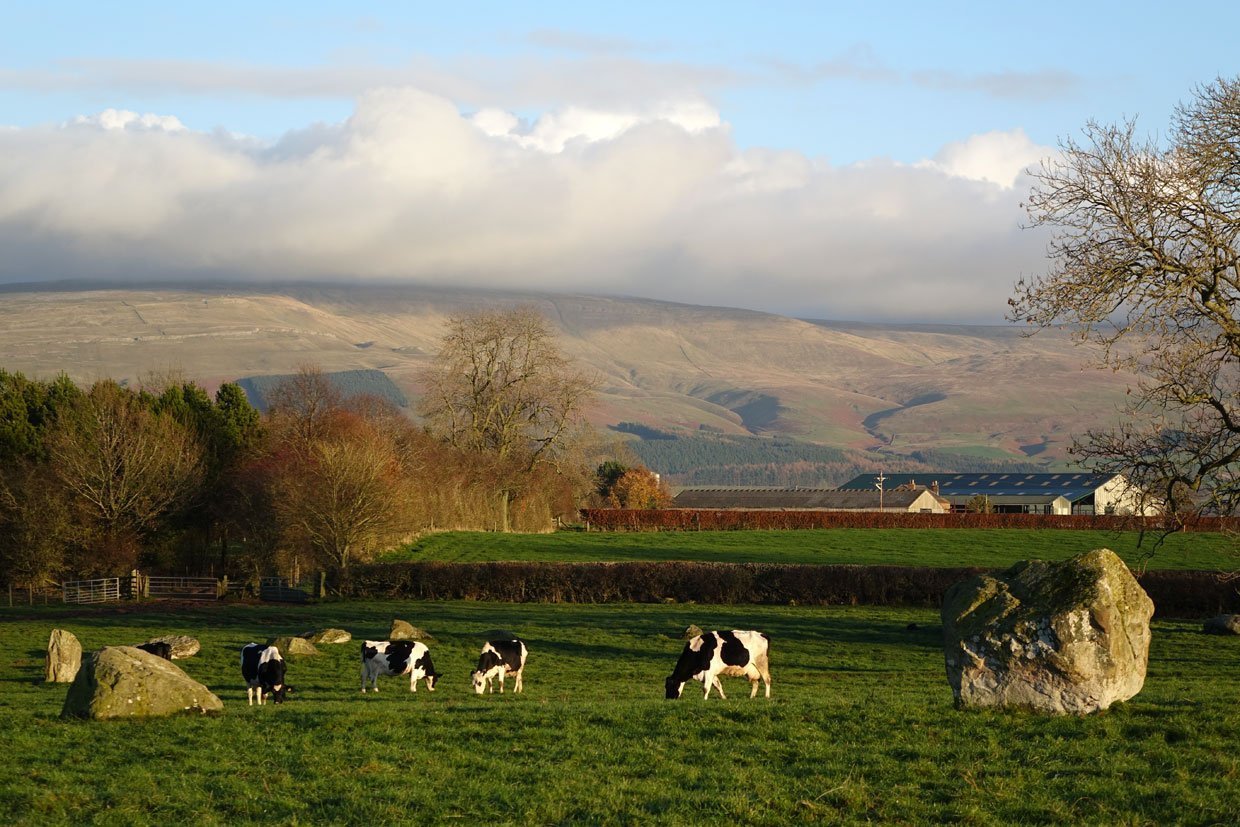
When you step into this massive pasture near the village of Little Salkeld, you will often find yourself entirely alone, save for a few grazing cattle or a local dog walker.
To truly understand the scale of this ancient site, you have to stand right in the center of its footprint.
The entire perimeter of Stonehenge would fit comfortably inside this colossal ring with room to spare.
It is an awe-inspiring space that demands you slow down, camera in hand, to watch how the shifting Cumbrian weather brings a completely new character to the stones with every passing hour.
🗺️ Long Meg and Her Daughters Trail Blueprint & Logistics
Geographic Location:
Little Salkeld, near Penrith, Cumbria. Postcode: CA10 1NJ.
Grid Reference:
NY 576 372.
Trail Distance:
Approximately 3.5 miles (5.6 km) for the complete circular loop.
Terrain Index:
Easy walking across quiet country lanes, traditional sunken bridleways, and open pasture. Expect mud in the low lanes after typical Cumbrian downpours.
Dog-Friendly Policy:
Dogs are very welcome but must be kept on a short, fixed lead. The stones sit inside an active working farm pasture with grazing cattle and sheep.
Parking Logistics:
Mindful roadside parking is available near the Little Salkeld village mill, or you can use the small, dedicated visitor layby located just outside the main farm gate entrance.
Best Horizon Window:
Arrive during a clear late autumn afternoon or the explicit Midwinter Solstice sunset to catch the true prehistoric alignments.
The Stones: A Tale of Two Geologies
Estimated to have been constructed during the late Neolithic or early Bronze Age (around 2500 to 1500 BC), this monument is one of the oldest and most complex ritual sites in the British Isles.

What makes it immediately fascinating to anyone inspecting it with boots on the ground is that it is an intentional geological hybrid.
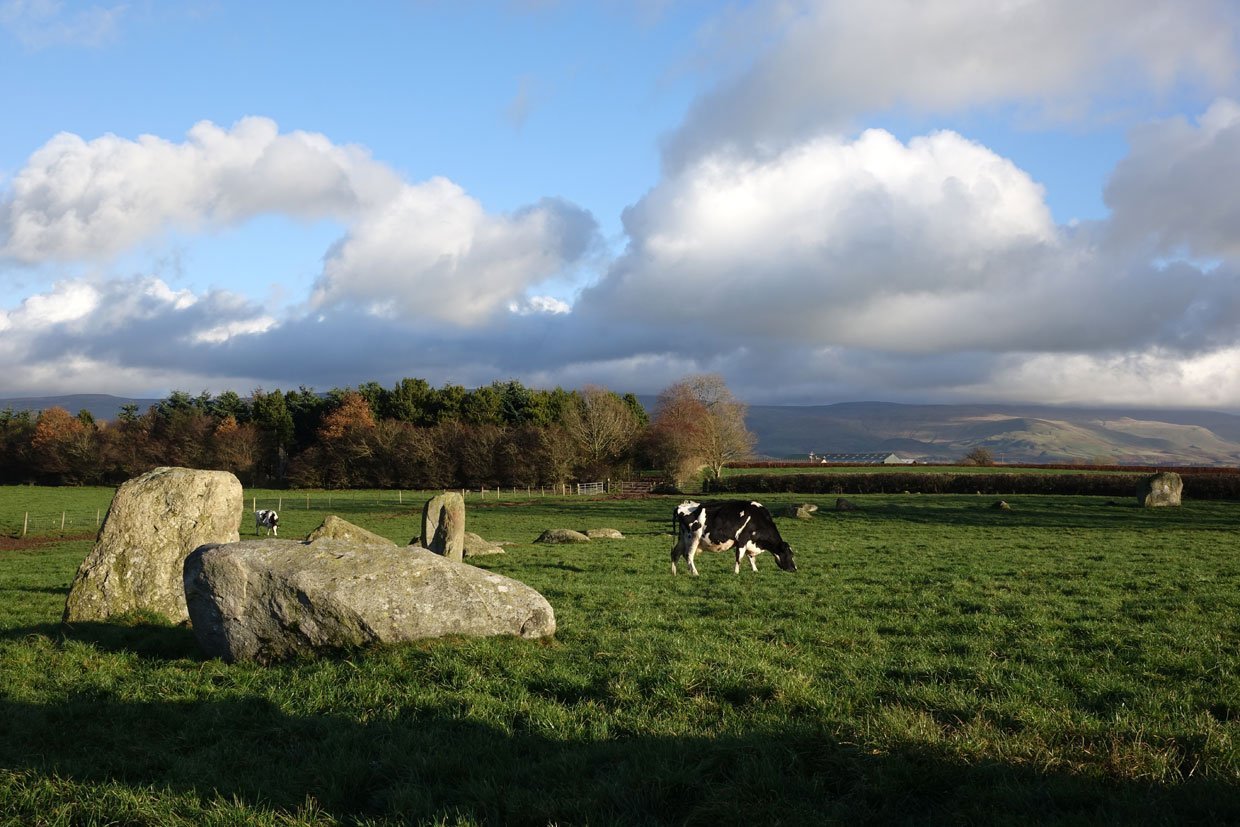
The main body of the monument—the “Daughters”—consists of 69 massive boulders arranged in a sprawling, slightly flattened oval measuring roughly 109 meters across its longest axis.
Today, 27 of these giants still stand tall. These boulders average 12 feet in height and are composed entirely of granite and volcanic glacial erratics.

Millions of years ago, ice sheets dragged these immense rocks down the valley from the high fells, leaving them scattered across the Eden landscape for prehistoric builders to collect, sort, and hoist into place.
If you look closely at specific portal stones flanking the entrances, you can still spot distinct veins of natural crystal intentionally aligned by the builders.
Then there is Long Meg herself.
Standing completely isolated 80 feet outside the southwestern perimeter of the main ring, Long Meg is a towering, four-sided sandstone monolith rising nearly 12 feet into the air.
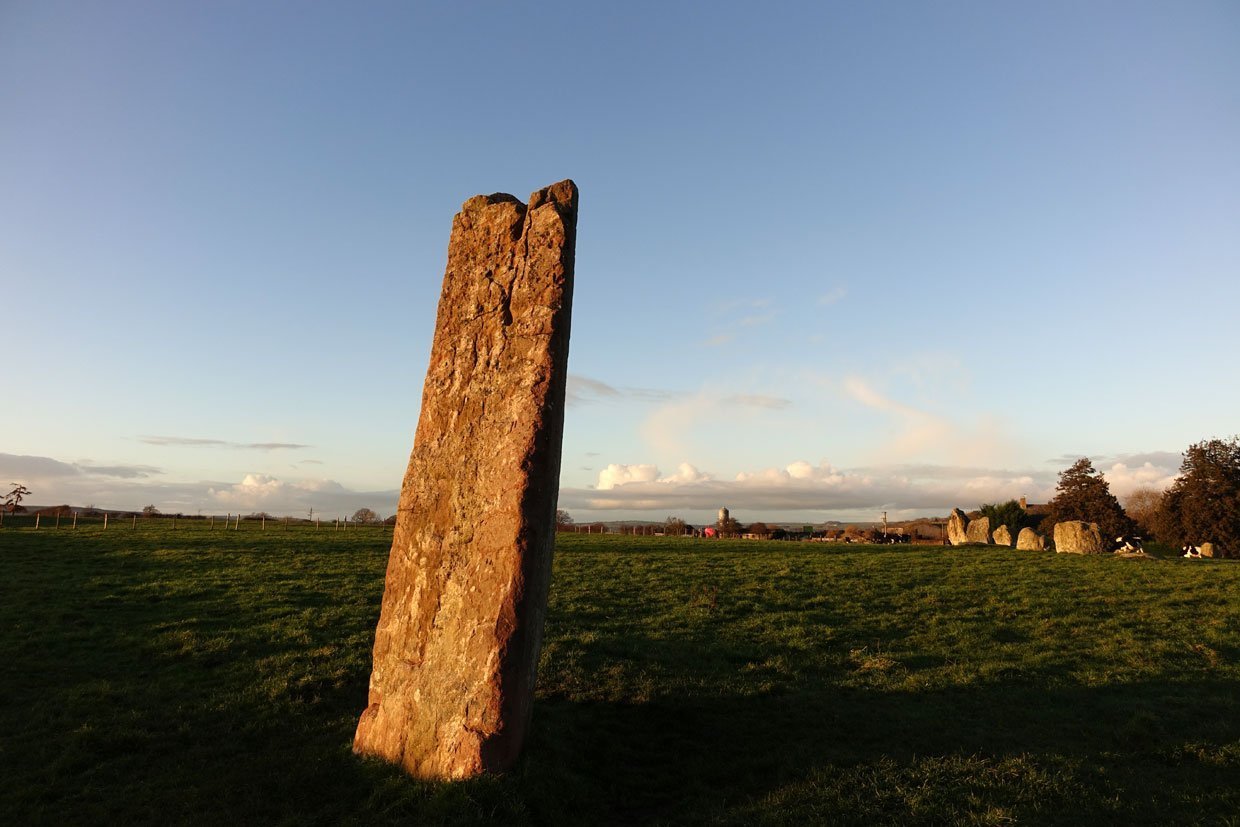
She doesn’t belong to the local glacial debris. She is carved from Triassic red sandstone, a material that had to be intentionally quarried and hauled over a mile up the steep valley slopes from the banks of the River Eden or the high Lazonby Fells.

Her distinct four-sided profile is no accident either; each corner points directly to the four cardinal points of the compass.
The Solar Alignment: Long Meg’s position is a masterclass in ancient engineering. If you stand dead centre within the main oval during the Midwinter Solstice, the sun sets directly behind her red sandstone pillar, casting a dramatic, elongated shadow straight through the heart of the daughters.
Decoding the Prehistoric Art & The Hidden Complex
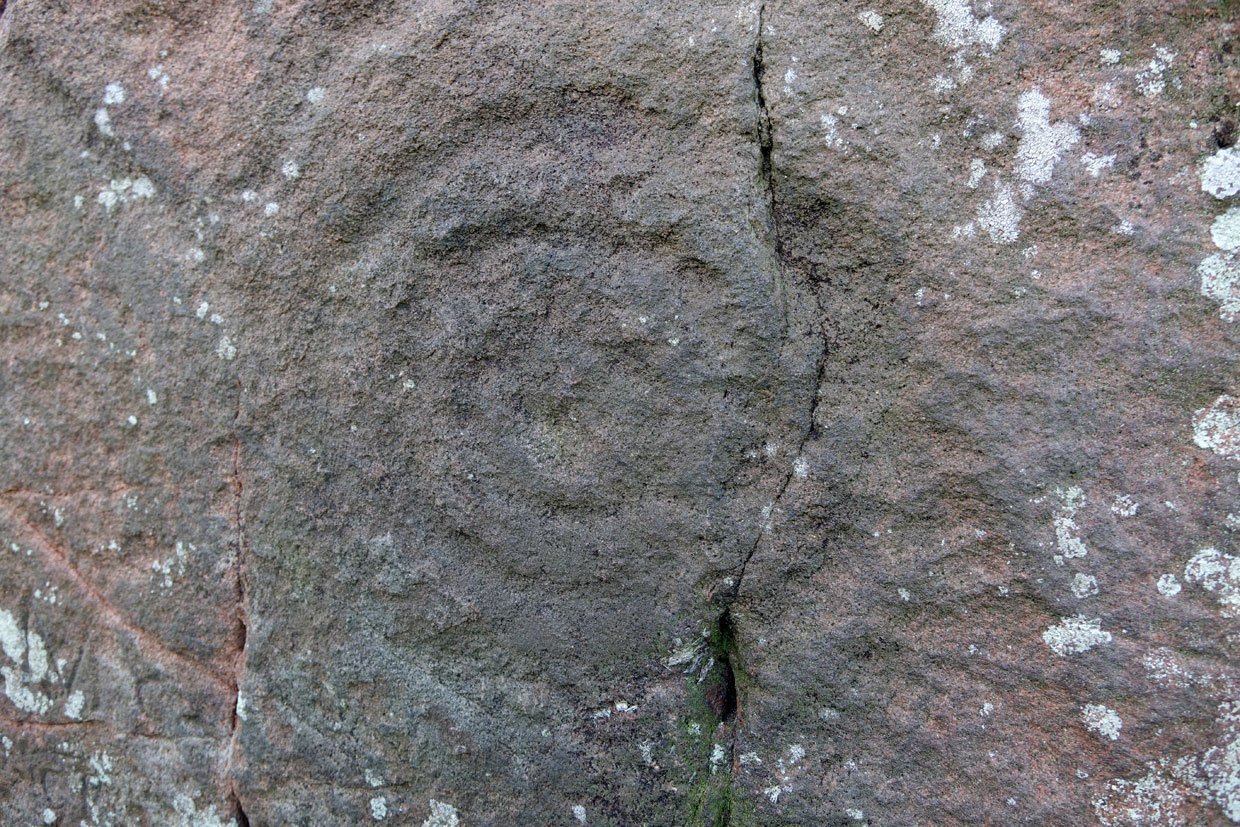
Long Meg isn’t just a physical marker; she is a canvas. On her weather-beaten sandstone face—specifically the side facing entirely away from the stone circle—is a rare collection of prehistoric rock art.
If you run your fingers along the stone when the side-lighting is just right, you can trace deeply etched cup-and-ring marks, concentric circles, ovoids, and a beautiful, distinct spiral.

These motifs are incredibly rare within Cumbria. Instead, they mirror the sacred visual language found on the passage tombs of Ireland and the boyne valley, signaling that this corner of Cumbria was a major hub for high-status prehistoric travellers and regional trade.
But the archaeology goes far deeper than what meets the eye. Modern aerial photography and cropmark analysis have revealed that the stone circle is just the visible anchor of a massive, hidden ritual complex:
The Older Enclosure: The slight flattening of the stone circle on its northern edge happened because the Bronze Age builders intentionally altered their design to respect a massive, pre-existing Neolithic earthwork enclosure that sits directly to the north, now partly underlying Longmeg Farm.
The Lost Cursus: Stretching out to the west of the stones lie the buried ditches of a 600-meter Neolithic Cursus—a monumental, enclosed ceremonial processional avenue that led tribal gatherings up from the River Eden straight to the monument’s southwestern portal.
🥾 The Tactical Walk: The Little Salkeld Loop
While there is a small parking area near the farm for accessibility, the absolute best way to experience the scale of the landscape is to approach on foot from the village below. This 3.5-mile circuit allows the history to reveal itself slowly.
The Watermill Start: Mile 0.
Park mindfully in the quiet village of Little Salkeld. Begin your trek near the historic 18th-century watermill, following the clearly signposted public bridleway heading northeast along the country lane.
The Sunken Lane Ascent: Mile 1.2.
The modern tarmac gives way to an ancient, sunken farm track bordered by towering hedgerows. The path climbs steadily but gently away from the riverbed, rising onto the sandstone terrace above.
The Active Thoroughfare: Mile 1.8.
Pass through the wooden kissing gate to enter the monument field. In a bizarre twist of modern utility meeting ancient history, a working farm track cuts directly through the dead center of the stone circle.
Keep a sharp eye out for farm vehicles, tractors, and grazing livestock as you explore the interior.

The Woodland & Church Return: Mile 2.7.
Continue along the bridleway past the farm buildings, tracking north through a pocket of woodland.
The path curves west toward the walled graveyard of St. Michael’s Church at Glassonby, before following the lower valley tracks back into the meadows of Little Salkeld.
Witches, Curses, and the Weather Shield: The Folklore
A monument this ancient and imposing naturally breeds a heavy cloak of Cumbrian folklore.
The local superstitions give the pasture a dark, mythic atmosphere that lingers long after you turn back toward the lane.
The Sabbath Coven
Local legend attributes the monument to a notorious 17th-century witch known as Meg of Meldon.
It is said that Meg and her numerous daughters wildly insulted the Christian Sabbath by holding an ecstatic, profane dance across the hillside.
A powerful medieval wizard named Michael Scot happened upon the scene and, in a flash of judgment, instantly petrified the entire coven where they stood—leaving Long Meg guarding her frozen daughters for eternity.
The Uncountable Curse
A deeply rooted local superstition claims that the stones possess a shifting, supernatural energy that makes it completely impossible to count the “daughters” correctly twice in a row.
The warning passed down through generations is clear: if an outsider ever manages to arrive at the exact same tally on consecutive attempts, the ancient spell will instantly shatter, the witches will awaken, and immense misfortune will dog the footsteps of the counter.
Colonel Lacy’s Storm
For centuries, locals believed the site was protected by a cosmic weather shield.
Any attempt to alter, damage, or disrespect the stones was said to conjure instantaneous, violent tempests.
In the late 18th century, the local landowner, Colonel Samuel Lacy, decided to test this myth.
Wanting to clear the field for traditional plowing, he hired a gang of labourers to pack gunpowder into the bases of the standing stones.

The moment the fuses were laid, an unnatural, terrifyingly fierce thunderstorm materialized directly over the field out of a perfectly clear sky.
Terrified by what they perceived as the wrath of the witches and divine intervention, the workers dropped their tools and fled. The stones were never meduin with again.
Inspired Past: Wordsworth’s Awe
The sheer, isolated gravity of this lonely sisterhood has moved creative minds for generations.
When the legendary Cumbrian poet William Wordsworth walked up from the river to see the monument, he was so profoundly overwhelmed by its ancient scale that he penned his famous sonnet directly to the stones:
“A weight of awe not easy to be borne,
Fell suddenly upon my spirit—cast
From the dread bosom of the unknown past,
When first I saw that sisterhood forlorn;
And Her, whose strength and stature seemed to scorn
The power of years, pre-eminent, and placed
Apart, to see the brawling stream defaced
By mists that sweep the valley, dews of morn,
Tingeing the morning carpet.
Speak Giant-mother! tell it to the Morn,
While she dispels the cumbrous shades of night;
Let the Moon hear, emerging from a cloud,
When, how and wherefore, rose on British ground
That wondrous Monument, whose mystic round
Forth shadows, some have deemed, to mortal sight,
The inviolable God that tames the proud.”
— William Wordsworth
Final Field Thoughts: A Monument Kept Wild
What makes Long Meg and Her Daughters truly spectacular in the modern world is everything it doesn’t have.
There are no gift shops, no ropes keeping you twenty yards back from the archaeology, and no commercial tourist gloss. It remains exactly what it has been for thousands of years: a wild, open, working piece of the living Cumbrian landscape.

As you stand by that red sandstone pillar and watch the late sun turn the granite daughters a deep gold, you realize that our urge to step out into these fields, to track the old ridges, and to find a quiet space within the landscape isn’t a modern invention.
It’s an ancient instinct, woven directly into the bedrock of the Eden Valley. Tie up your boots, pack your camera, and go seek out the sisters—it is an outdoor experience that stays with you long after the Cumbrian mist rolls in.
📚 Explore More Ancient Wonders & Lake District Trails
- The Valley Neighbor: Castlerigg Stone Circle: A Field Manual to the Lake District’s Solar Amphitheater
- Why follow this trail: Compare Long Meg to Cumbria’s other legendary stone ring. Set against the dramatic mountain peaks of Blencathra, Castlerigg offers an entirely different, high-altitude energy.
- The Iconic Keswick Viewpoint: Ashness Bridge & Surprise View: The Most Photographed Spot in the Lake District
- Why follow this trail: Located just a short trek from Keswick, this traditional packhorse bridge offers the ultimate framing of Derwentwater and Skiddaw.


A lovely description of an ancient place. What a wonderful spot to while away the hours in peaceful thoughts.
beautiful Paul the anciënniteit history thanks i enjoy it
So many mysterious from the past. The ring marks on the stone so intriguing. Beautiful photos of a beautiful place. Wordsworth’s poem so beautiful and appropriate to the space.
Hi Lyn, thanks so much,,, yes a very intriguing place 🙂
A beautifully photographed post!
Thank you! 🙂
Great photos. I love that circle, especially the cup and ring marks on the stones.
Interesting place isn’t it Sue?
Wonderful story Paul. Ancient wonders are always fascinating.
Thanks Rachel. Looking forward to doing more articles like that now
I could spend hours on this post and feel some of the emotions and connections those who visit feel. Thank you for sharing not only your great photos, but also your thoughts. I appreciate following you Paul.
Hi Jeanette, it truly is a fascinating spot to be at. Any time of year or day