

The views of the Lake District from the summit of Orrest Head are nothing short of spectacular. Yet, the physical effort required to get up there is genuinely minimal, making it one of the absolute best short walks in Cumbria for families, first-time visitors, and anyone looking for big mountain views without a gruelling five-hour climb.
Even more than the panorama, Orrest Head holds a legendary place in British outdoor history. It was this exact short climb—and the jaw-dropping view from the top—that gave Alfred Wainwright the inspiration to go and discover the mountains and fells of the Lake District.
As you can see from the scenes I captured up there, the views are incredible in every single direction, trust me.
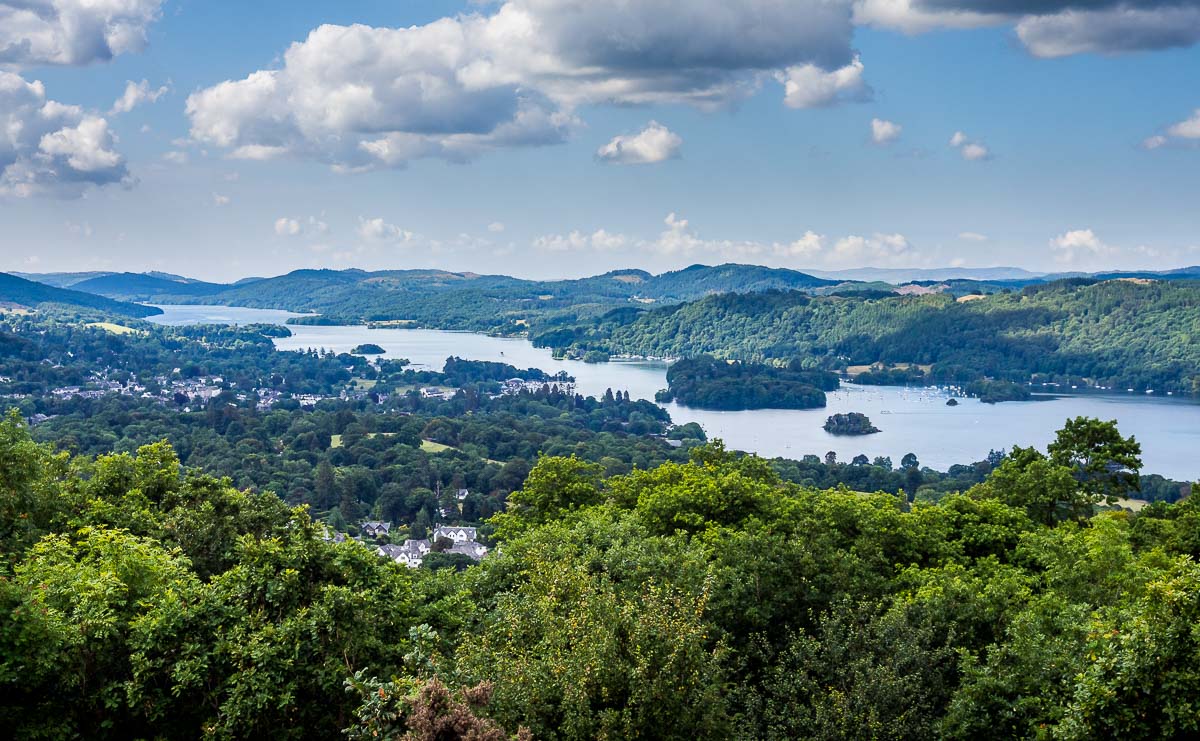
People in the know, of all ages and walking abilities, take the time to spend half an hour on this summit just watching the light shift across the high fells and the water below.
Even if you aren’t a hardened mountain trekker, this walk saves you from only ever seeing the Lake District through a car windscreen or from the busy pavements of the tourist towns.
Orrest Head Walk At-a-Glance
- Distance: Approx. 2.5 to 3 miles (4 to 5 km) circular / 1.5 miles direct round trip
- Time Needed: 45 minutes to 1.5 hours (approx. 20 mins up from the station)
- Total Ascent: Approx. 130m (426 ft) – Summit height: 240m (784 ft)
-
Start Point:
Windermere Railway Station / A591 (
LA23 1AH/ Grid Ref:SD 414 986) - OS Map: OS Explorer OL7 (The English Lakes: South-Eastern Area)
- Terrain: Tarmac lane, woodland paths, and stone steps (step-free accessible switchback path also available).
The History: How Orrest Head Sparked Wainwright’s Love Affair
That accessibility is actually how Alfred Wainwright’s own story began. In 1930, aged 23, Wainwright saved up for a week’s walking holiday with his cousin and arrived at Windermere station from Blackburn.
Before heading any further into the National Park, they decided to take the short wander up Orrest Head.
Standing on the summit, he fell completely and utterly in love—not just with the view looking straight down over Windermere, but with the rugged, dramatic skyline of high Lakeland fells laid out across the horizon.
It was his very first ascent in the Lakes, and as we all know, it was definitely not his last. Reflecting on that life-changing moment, Wainwright famously wrote:
“Our first ascent in Lakeland, our first sight of mountains in tumultuous array across glittering waters, our awakening to beauty.”
Later in life, in The Outlying Fells of Lakeland, he also described Orrest Head as:
“A fitting finale, too, to a life made happy by fellwandering.”
While his ashes were ultimately scattered by Innominate Tarn high up on his beloved Haystacks, he saw gentle little Orrest Head as the ultimate full-circle hill—the place that sparks a walker’s passion in youth, and the welcoming summit you can still climb when your legs have finally retired from the high peaks.

Where to Park and Finding the Trailhead
The path up Orrest Head is well-trodden and remarkably easy to find right from the centre of Windermere.
Where to Start: The trail starts directly off the A591, right opposite the old NatWest bank building and just yards from Windermere Railway Station (postcode LA23 1AH). Look out for the large wooden sign reading Path to Orrest Head (with a notice stating no vehicle access for non-residents).
The sign even gives you a reassuring clue about the effort required, stating 20 minutes to the top.
Parking Options: Because you are right next to the transport hub, there are plenty of parking options. You can use the Windermere Train Station car park, the adjacent Booths supermarket car park (always double-check the current parking time limits on the boards if you plan to linger for lunch afterwards!), or the Broad Street pay-and-display car park in Windermere village.
Step-by-Step Route Guide: Two Ways Up Through Elleray Woods
Once you pass through the gate by the A591, the walk begins up a wide, surfaced tarmac lane heading into Elleray Woods. Almost immediately, you have two ways to play the ascent depending on who you are walking with:
1. The Woodland Trail & Gruffalo Shortcut (My Route)
Soon after starting up the lane, you can branch off onto the magical woodland footpath weaving straight through the trees. This is a brilliant option if you have children in tow—not only does the winding forest trail make the walk feel like a proper adventure, but you’ll also be greeted by a fantastic wooden Gruffalo, carved out of a tree trunk by a local craftsman!

Even though you’ve only been walking for 10 or 15 minutes at this point, you are already closing in on the summit.
You wouldn’t necessarily guess it because you are tucked beneath the woodland canopy, until you pass through a small metal kissing gate, climb the last few rocky steps out of the treeline, and emerge onto the open summit plateau.
2. The Step-Free Accessible Route (Miles Without Stiles)
If you are visiting with an all-terrain buggy, a wheelchair, or just want to avoid steep steps altogether, stay on the wider, well-graded main track that zig-zags gently up through Elleray Woods.
As part of the Lake District National Park’s Miles Without Stiles initiative, this route has been resurfaced to remove barriers, leading all the way up to the summit area on a steady, manageable gradient.

What You Can See from the Summit of Orrest Head (240m / 784ft)
Wainwright adored the view from the summit, and because it is so accessible, people of all walking standards can share that exact same feeling.
To help you enjoy the panorama properly, there are several wooden benches facing in different directions, along with a 360-degree bronze panorama plaque on the summit cairn that points out every single peak on the horizon.
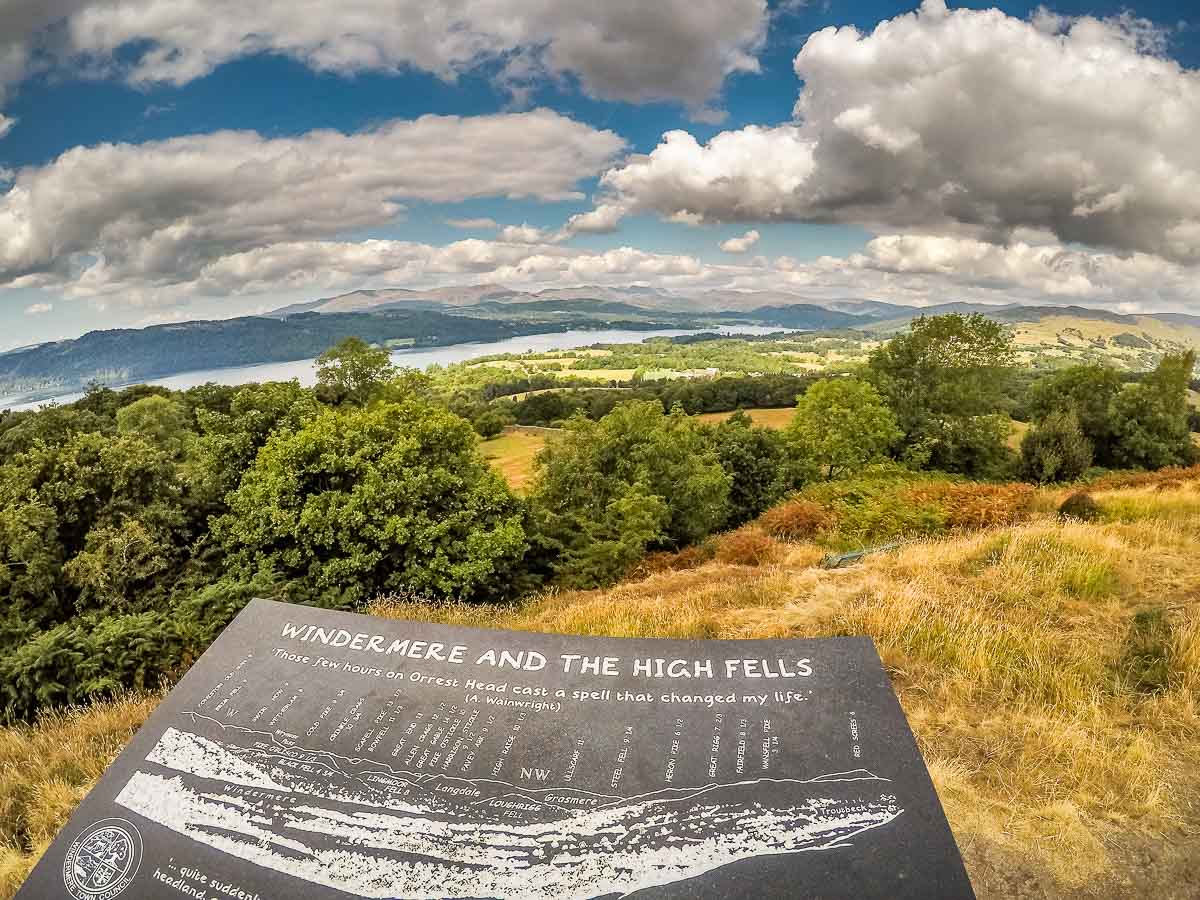
Although it doesn’t take mountain-climbing time to reach, the views deserve to be savoured over a proper sit-down—so bring a flask and take your time.
South & West: The True Scale of Windermere
From the summit, you get a breathtaking sense of just how vast Windermere really is. As the largest natural lake in England—stretching over 10.5 miles in length—even from this vantage point high above its middle section, you struggle to see both ends at once.
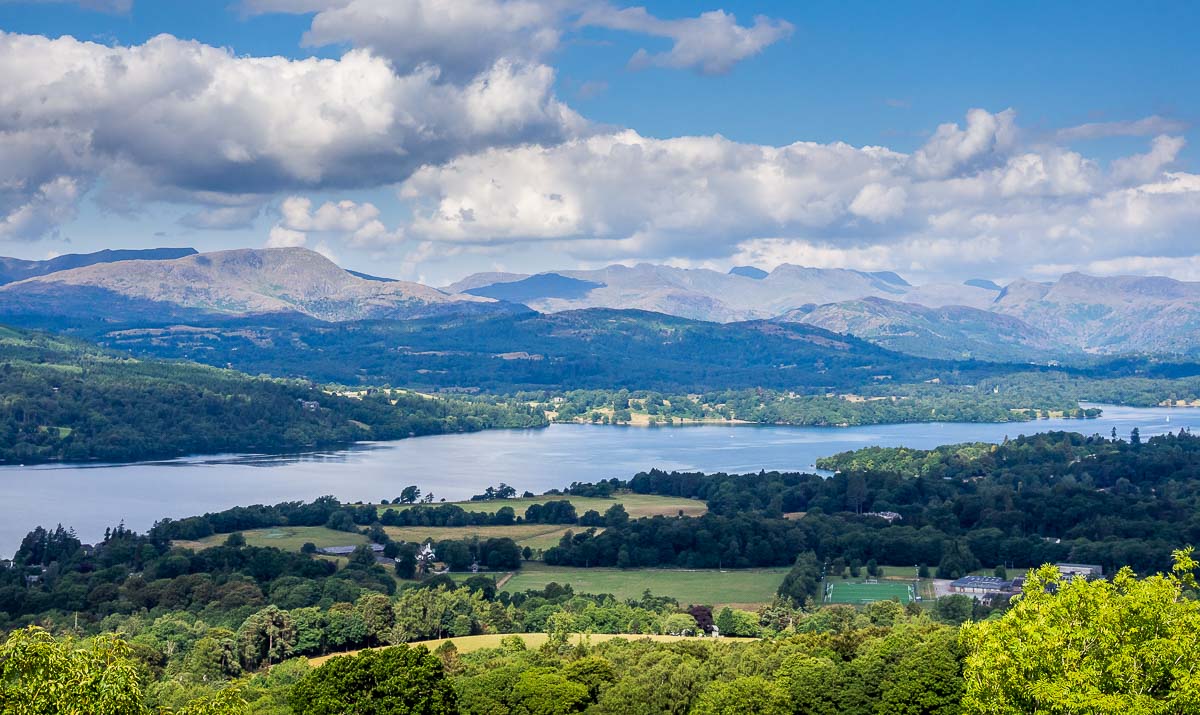
Directly below you sit the bustling towns of Windermere and Bowness-on-Windermere. Even during the height of the summer holidays when the streets down there are packed with visitors, they look wonderfully calm and quaint from up here.
North & Northwest: The High Lakeland Fells
Look across the water to the opposite shore and the great mountains of the Lake District rise up in an unbroken wall across the horizon. All the famous giants are on display:
- The Old Man of Coniston and the Coniston fells to the southwest
- Scafell Pike (England’s highest mountain), Scafell, and Great End
- Bowfell, Crinkle Crags, and the unmistakable silhouette of the Langdale Pikes
- Great Gable and Fairfield further round to the north
For me, standing up here always triggers fond memories of standing on the summits of many of those distant peaks myself—while inevitably giving me a dozen new ideas for the next adventure!

Turning It Into a 3-Mile Circular Walk
Orrest Head may technically be a modest hill at 784 ft (240m) above sea level, and going straight up and down the direct path is only around 1.5 miles in total.
However, if you want to stretch your legs for an hour or two and turn it into a 2.5 to 3-mile circular walk, you don’t have to retrace your steps straight back down to the station:
From the summit plateau, take the path heading north-east / north down the back of the hill towards a metal kissing gate and out across open pastureland (keep dogs on a lead here as sheep and cattle often graze these fields).
Follow the clear path down to a country lane (Moorhow Road / Cross Street) and turn left, passing the historic St Mary’s Church at Applethwaite.
From the A591 near church, you can either follow the pavement straight back into Windermere, or cross over to allen Knott / Millerground by the lakeshore before looping back up to Windermere station.
Height isn’t everything in the Lake District—experience, atmosphere, and feelings are.
Whether you spend 40 minutes nipping up and down or turn it into a lazy morning circular walk with a coffee stop in Windermere afterwards, I promise you Orrest Head will be one of the most memorable hills you ever climb.
Frequently Asked Questions
How long does it take to walk up Orrest Head?
Walking directly from Windermere railway station to the summit takes around 20 to 25 minutes uphill at a steady pace, making the straightforward out-and-back walk roughly 45 minutes to 1 hour (plus time spent enjoying the benches at the top).
If you take the longer circular route via St Mary’s Church, allow 1.5 hours.
Is Orrest Head good for dogs?
Yes, Orrest Head is a brilliant dog walk! If you stay within Elleray Woods and the main summit area, it is very dog-friendly (though keeping dogs under close control near the busy summit benches and family trails is best).
If you extend your walk onto the circular farmland pastures behind the hill, you must keep dogs on a lead due to grazing sheep and cattle.
Is the Gruffalo still in the woods on Orrest Head?
Yes! The carved wooden Gruffalo sits along the woodland path through Elleray Woods on the ascent from Windermere, along with wood carvings and nature trail features that make the 20-minute climb fly by for younger kids.


