There’s a certain magic to the drive to Whitby. As the road carves its way through the vast, heather-clad expanse of the North Yorkshire Moors, the world seems to fall away.
You feel wonderfully, thrillingly cut off, as if you’re journeying to a coastal enclave that time has carefully preserved.
I remember this feeling from childhood trips with my parents, and it’s a sensation that has never faded. Whitby still feels like a town huddled at the edge of the map, where the River Esk meets the cold, grey churn of the North Sea.
Even on a cloudy, cool day, the air here is a tonic, perfect for a few hours of refreshing discovery. But to truly understand Whitby, to peel back its layers of history, legend, and industry, you have to walk it.
This isn’t just a stroll; it’s a pilgrimage through the sacred history of saints, the global adventures of Captain Cook, the brutal legacy of whaling fleets, and the gothic shadow of Dracula.
Our walk begins where all eyes are inevitably drawn: to the commanding heights of the East Cliff, before descending into the town’s vibrant, time-worn heart.

The Gothic Heights – Where History and Horror Collide
At the Abbey’s Edge: A View Through Centuries
My walk starts, as it should, on the East Cliff, in the imposing presence of Whitby Abbey.
The first thing that hits you is the air—sharp, salty, and carried on a wind that feels like it has travelled across the entire North Sea just to greet you.
Below, a panorama of red-roofed cottages tumbles down the cliffside towards a bustling harbour, a perfect miniature town cradled by the coast.
And above it all, the skeletal, soaring arches of the Abbey stand silhouetted against the sky, a magnificent ruin that has watched over this town for centuries.
Standing here, you realise the Abbey isn’t just one story; it’s all of Whitby’s stories written in stone. Its tale begins long before the Gothic splendour we see today.
In 657 AD, the Anglo-Saxon princess St. Hild founded a “double monastery” for both men and women on this very headland, establishing it as one of the most important religious centres in the Anglo-Saxon world.
It was here, in 664 AD, that the pivotal Synod of Whitby was held, a council that aligned the Northumbrian church with Roman traditions, setting the date of Easter and shaping the future of Christianity in England.
This was a place of learning and power, where kings were buried and where a humble cowherd named Caedmon was miraculously inspired to become the first named poet in the English language.
The magnificent Gothic structure whose ruins now dominate the skyline was a later Benedictine abbey, begun in the 12th century.
After its dissolution by Henry VIII in the 1540s, it fell into the graceful decay we see today. Yet, even as a ruin, it served a vital purpose for this maritime town, its unmistakable shape acting as a crucial navigation marker for sailors guiding their ships into the harbour.
This place has been a religious powerhouse, a royal court, a sailor’s landmark, and, most famously, a gothic muse.
It was this “gorgeous spectral” ruin that captured the imagination of author Bram Stoker during his visit in 1890. The windswept headland, the dramatic ruins, and the swooping bats around the nearby churchyard provided the perfect atmospheric backdrop for his novel, Dracula. Through the eyes of his character Mina Murray, he wrote: “Right over the town is the ruin of Whitby Abbey… It is a most noble ruin, of immense size, and full of beautiful and romantic bits; there is a legend that a white lady is seen in one of the windows”.
That legend of a white lady, sometimes identified as the ghost of a nun named Constance de Beverley who was bricked up in the walls for breaking her vows, adds a chilling layer of local folklore to the Abbey’s fictional horrors.

Descending the 199 Steps: A Pilgrim’s Path to the Harbour
From the Abbey, there is only one way down: the famous 199 Steps. As I begin the descent, I hear the chatter of children diligently counting each step, a sound that seems to be a permanent feature of this landmark.
The stone is worn smooth by centuries of footsteps, and with every downward step, the view of the harbour and the higgledy-piggledy rooftops of the old town becomes more intimate and detailed.
This stairway is a journey through time in itself. First recorded in 1340, the steps were originally made of wood, only to be replaced by stone in 1774.
For centuries, they served as the main route for townspeople to reach St Mary’s Church, a climb often regarded as a test of Christian faith.
As you walk, you’ll notice several flat landings, or “benches.” Today they offer a welcome rest, but their original purpose was far more sombre. They were coffin rests, placed to give pallbearers a moment to catch their breath while carrying their dead up to the graveyard—a solemn tradition that continued until as recently as 1933.
Of course, the steps are most famous for their role in literature. It is here, in one of horror’s most iconic scenes, that Count Dracula, disguised as a huge black dog, bounds ashore after his ship, the Demeter, is wrecked off the coast.
He scrambles up these very 199 steps to find sanctuary in the graveyard of St Mary’s Church, which waits at the top.
The church itself is a wonderfully squat and curious building, surrounded by weathered gravestones that lean against the sea wind, some teetering precariously on the cliff edge.
It was from one of these very headstones that Stoker borrowed the name “Swales” for Dracula’s first unfortunate victim in Whitby.
Descending these steps feels like crossing a threshold. You leave the world of the sacred and the supernatural on the clifftop—the Abbey, the church, the graveyard, the ghosts—and enter the world of the living below: the bustling harbour of commerce, community, and daily life.
It is a physical passage between Whitby’s two distinct realms.
The Old Town’s Heartbeat – Cobbles, Kippers, and Legends
Into the Labyrinth: The Timeless Charm of Church Street
At the bottom of the steps, you plunge into the old town, and it feels, as I’ve always thought, like stepping back in time.
The world shrinks to a labyrinth of narrow, cobbled lanes like Church Street, Sandgate, and the wonderfully named Grape Lane.
I love exploring the hidden “yards” that branch off from the main thoroughfares—little alleyways like Argument’s Yard that whisper of centuries of untold stories.
This part of town is an assault on the senses. The air is thick with the pungent, smoky aroma of kippers from Fortune’s Kippers, a family-run smokehouse that has been curing herring in the same way since 1872. It’s a smell that is quintessentially Whitby. Shop windows gleam with the deep, polished black of
Whitby Jet, a unique gemstone formed from the fossilised wood of Jurassic-era trees. Its popularity soared in the 19th century when Queen Victoria wore it as mourning jewellery after the death of Prince Albert, making it the height of fashion.
The sounds are a gentle cacophony: the cries of gulls echoing between the tall houses, the murmur of conversation from pub doorways, and the cheerful bell above a shop door.

A Taste of the Sea: The Great Whitby Fish & Chip Pilgrimage
It would be rude, as I noted on my last visit, not to indulge in some fresh seafood.
For many, a trip to Whitby is a pilgrimage with one holy grail in mind: a perfect portion of fish and chips. It’s more than just a meal; it’s a delicious, tangible connection to the town’s enduring fishing heritage.
Choosing where to go is a serious business, a friendly rivalry that divides visitors and locals alike.
| Restaurant | Atmosphere | Signature Dish | What Makes It Special |
| The Magpie Cafe | Historic, bustling, and traditional. A distinctive black-and-white building with queues often forming outside. Multiple floors with harbour views. | Haddock & Chips in beef dripping, Seafood Chowder, extensive seafood platters. | An iconic institution since 1939. Famous for its incredibly long menu and “no-nonsense” traditional service. |
| Quayside | Modern, family-friendly, and award-winning. A licensed, air-conditioned restaurant with great harbour views. | Award-winning sustainable Cod or Haddock & Chips. Also offers homemade gelato. | National Fish & Chip Awards winner. Strong focus on sustainability and offers excellent gluten-free options. |
| Trenchers | Classic and highly-rated, often mentioned alongside the others as a top contender. | Traditional fish and chips with a reputation for quality. | Consistently wins awards and is known for its crisp batter and perfectly cooked fish, offering a slightly less frenetic experience than The Magpie. |
Hidden Histories: From Captain Cook to Local Haunts
Wandering down Grape Lane, you’ll find the handsome 17th-century house that is now the Captain Cook Memorial Museum.
This is no replica; it is the very building where a young James Cook lodged as an apprentice to the shipowner John Walker.
It was here, in this bustling port, that he learned the seafaring skills that would eventually take him on three world-changing voyages of discovery. The very ships he sailed, including HMS Endeavour, were built in Whitby’s shipyards, a testament to the town’s outsized role on the world stage.
Yet, these same cobbled streets hold stories of a much more local, and spectral, nature. As you walk, listen carefully.
On a quiet night, you might just hear the mournful cry of the Oyster Man of Whitby. As the legend goes, he was a familiar figure, selling his wares in the local pubs.
One night, after being mocked by a group of men in the Golden Lion, he accidentally stabbed and killed his tormentor with his small oyster knife.
Though acquitted of murder, he was consumed by guilt and died within a year. His ghost is said to still walk these lanes, his cry of “Oysters alive-ho!” forever tinged with remorse.
It’s this blend of global history and intimate local folklore that gives the old town its unique soul.

Across the Esk – Piers, Whales, and West Cliff Vistas
Crossing the Swing Bridge: A Town of Two Halves
Leaving the ancient, cramped lanes of the East side, I cross the swing bridge that spans the River Esk. The atmosphere shifts.
The West side is more open, its architecture more Victorian and grand. The harbour is a hive of activity, with fishing boats bobbing alongside pleasure cruisers offering trips out to sea.
Families line the railings, dangling crab lines into the water below—a timeless seaside ritual.
Framing the Perfect Memory: The Whalebone Arch
On the West Cliff, a path leads up to one of Whitby’s most iconic landmarks: the Whalebone Arch.
Erected in 1853, these magnificent jawbones are a stark monument to the town’s formidable, and brutal, whaling industry. In the 18th and 19th centuries,
Whitby was a major whaling port, sending fleets of ships to the perilous Arctic waters in pursuit of a fortune in oil and bone. It was a trade that brought great wealth but also great danger.
Men like the celebrated captain William Scoresby, who is credited with inventing the modern crow’s nest, became local heroes.
The arch serves as a powerful reminder of this history, but it’s also an act of curation. The raw, bloody reality of the whaling industry has been transformed into a clean, beautiful, and intensely photogenic landmark.
It perfectly frames a view of the Abbey and St Mary’s on the opposite cliff, creating a visual link between the town’s two great historical pillars: faith and the sea.
The current bones, donated by Whitby’s sister town of Barrow, Alaska, in 2003, continue this tradition of presenting a complex past as a picturesque present.
A Walk to the Lighthouse: Embracing the North Sea
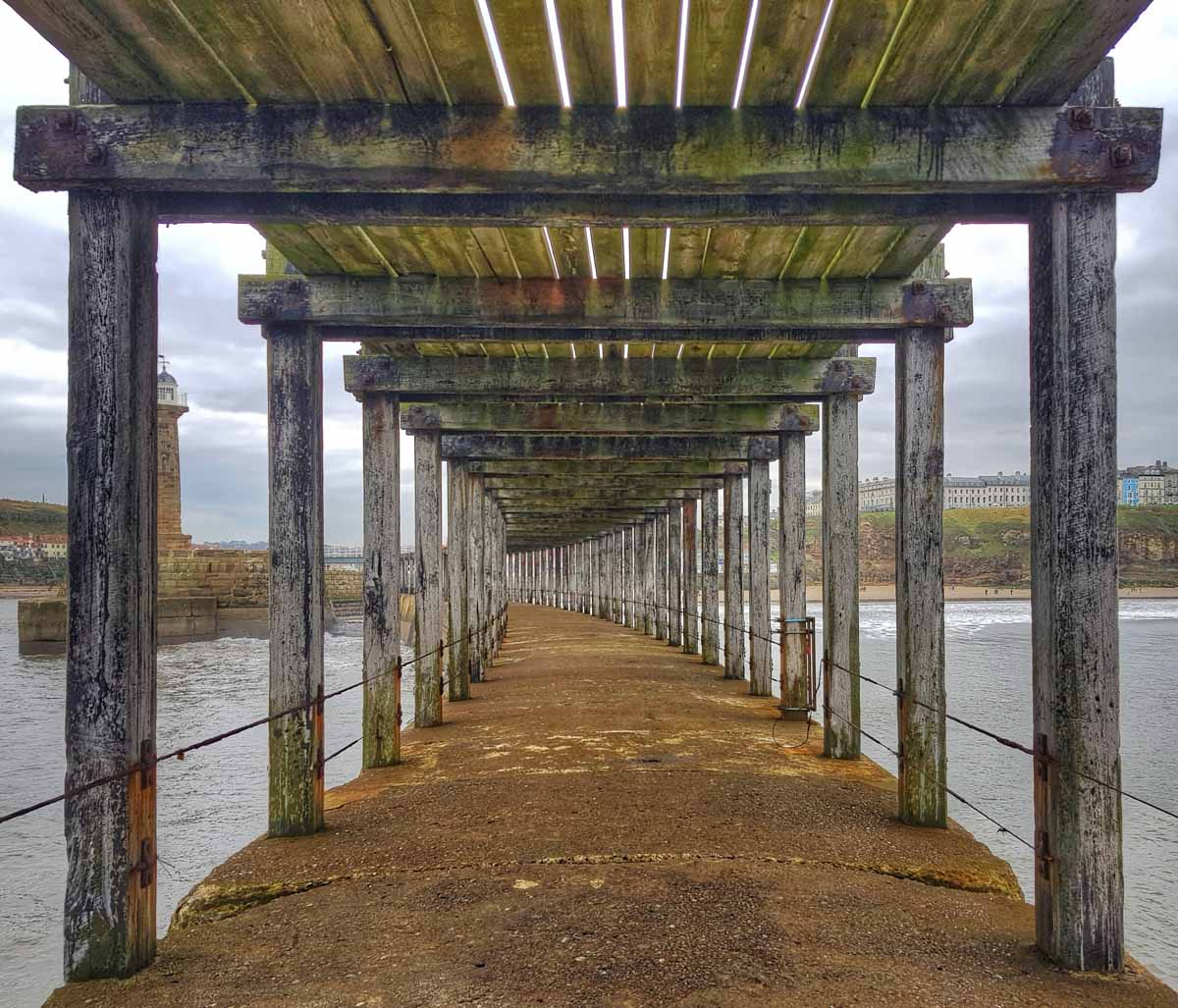
My walk concludes, as it did years ago, with a stroll out along the long stone arm of the West Pier towards the 19th-century lighthouse.
Out here, you feel the full force of the North Sea. The wind is stronger, the cries of the gulls are louder, and the rhythmic crash of waves against the pier walls is a constant, powerful presence. It’s a place that feels both exhilarating and humbling.

Even out here, the stories persist. Local legend tells of the Brave Lighthouse Keeper who, during a terrible storm, noticed his lamp had gone out.
He battled his way through the wind and rain to relight it, but on his way back down the wet, treacherous steps, he slipped and fell to his death. His ghost is said to still haunt the pier, forever repeating his final, dutiful journey to protect the sailors at sea.
From the end of the pier, I turn and look back. The entire town is laid out before me: the two cliffs rising like guardians on either side of the Esk, the Abbey standing sentinel on its perch, the harbour nestled safely below, and the jumble of houses clinging to the slopes.
It’s the perfect, culminating view, a moment to take it all in. The fresh air has done me good, and the walk has done more, reconnecting me with the many overlapping worlds that make Whitby so endlessly fascinating.

Beyond the Town – Coastal Walks from Whitby
While the town itself offers more than enough to fill a day, its position on the stunning Cleveland Way National Trail makes it a perfect base for more adventurous coastal walks.
If you have the time and the inclination to stretch your legs further, two classic hikes begin right at your feet.
South to Saltwick Bay: A Hunt for Fossils and Wrecks
For a shorter but incredibly rewarding walk, I recommend the three-mile circular route south to Saltwick Bay. Starting from the bottom of the 199 Steps, you can head along the beach beneath the cliffs.
A crucial tip: always check the tide times before you set off, as the bay is best explored at low tide, and it’s easy to get cut off by the incoming sea.
North to Runswick Bay: A Classic Cliff-Top Hike
If you’re looking for a longer day’s walk, the route north to Runswick Bay is one of the most scenic stretches of coastline in England.
This nine-mile linear walk follows the Cleveland Way, taking you past the village of Sandsend and along dramatic, undulating cliff tops. The views from Kettleness headland, looking back towards Whitby or ahead to the sweeping curve of Runswick Bay, are simply breathtaking.
Your Whitby Pocket Guide
A few practical tips to help you plan your own adventure through Whitby’s storied streets.
Essential Bites & Brews
For Real Ale Lovers: Step into The Black Horse Inn on Church Street. As one of Whitby’s oldest pubs, this CAMRA-recognised gem offers a fantastic selection of traditional cask ales in a wonderfully historic setting.
For Craft Beer Fans: Head up the hill to Whitby Brewery. Housed in a converted barn right in the shadow of the Abbey, it serves its own excellent brews, from the pale Abbey Blonde to the rich Jet Black stout.
For a Sweet Treat: Don’t leave without trying a “Lemon Top” ice cream—a swirl of soft-serve vanilla topped with a tangy lemon sorbet. It’s a Yorkshire coast classic.
Uncovering Whitby’s Other Treasures
For the Curious: Visit the Whitby Museum in Pannett Park. It’s a treasure trove of local history, from incredible Jurassic fossils to the macabre and legendary “Hand of Glory”—the mummified hand of a hanged felon, once believed by thieves to hold magical powers.
For the Brave: Immerse yourself in the town’s gothic side at The Dracula Experience on Marine Parade. It’s a fun, spooky walkthrough featuring live actors and special effects that bring the legend to life.
For a Quiet Moment: Escape the bustling crowds in the beautifully maintained floral gardens of Pannett Park, a peaceful oasis in the heart of town.
Planning Your Visit: The Essentials
Best Time to Go: For pleasant weather with fewer crowds, the shoulder seasons of May-June and September are ideal. Summer (July-August) is the busiest time, with a classic seaside buzz.
For a truly unique experience, visit during the biannual Whitby Goth Weekend (typically April and October), when the town fully embraces its dark side.
- Getting There:
- By Train: Northern Rail runs services from Middlesbrough, a scenic journey through the Esk Valley. For a touch of nostalgia, the North Yorkshire Moors Railway operates heritage steam trains from Pickering to Whitby.
- By Bus: Arriva and Coastliner services provide good connections to nearby towns and cities like Scarborough, York, and Middlesbrough.
- By Car: Whitby is accessible by car, but be aware that parking can be very challenging, especially in summer. Much of the town operates on a disc parking system, so be sure to check local signage. The best car park to use is by the Abbey then descend the 199 steps.
- Accessibility: Whitby’s historic character, with its steep hills, cobbled streets, and the 199 Steps, can present challenges for visitors with mobility issues. The West Cliff area is generally flatter and more accessible. For those unable to climb the steps, the open-top tour bus provides a service up to the Abbey.
The Enduring Magic of Whitby
As I head for home, the feeling is the same as it always is after a day here: a sense of refreshment and wonder. Whitby’s magic lies in its multiplicity.
It is a classic bucket-and-spade seaside town, a site of profound religious history, a hub of maritime adventure, and a gothic wonderland, all at once.
It’s a place where you can eat fish and chips on a pier haunted by a ghostly keeper, buy a piece of Jurassic jet on a street where a global explorer once lived, and climb a sacred staircase forever associated with a fictional vampire. It’s a town of stories, and the best way to hear them is to simply start walking.
What’s your favourite memory of Whitby, or which legend will you be looking for on your visit?