
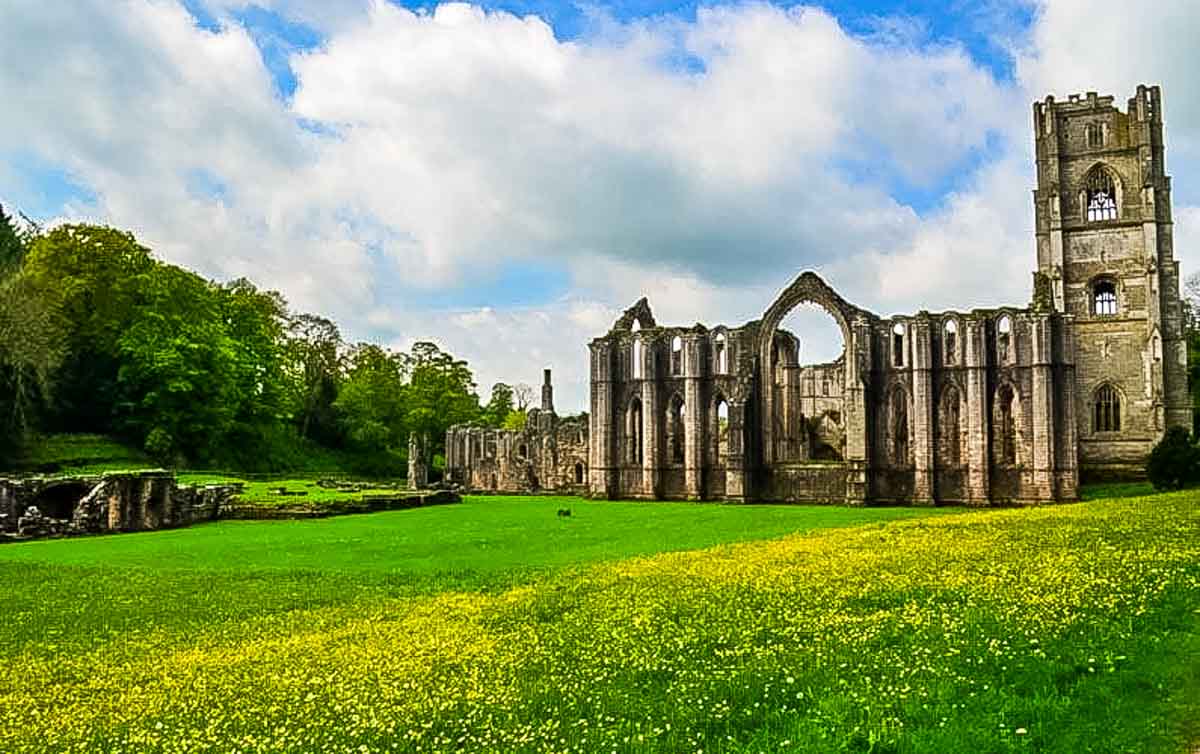
Fountains Abbey and Studley Royal Water Garden is a stunning UNESCO World Heritage Site located in North Yorkshire, England. This beautiful area combines the ruins of a 12th-century Cistercian abbey with an exquisite water garden that showcases the artistry of 18th-century landscape design.
At its peak it was one of the wealthiest monasteries in England. It has a great history of rise and fall with preservation allowing it to be enjoyed by myself and many.
It is now a grade l listed building and is said to be one of the largest and best preserved ruined Cistercian monasteries in England.
It is always a joy for me to visit here. With the family or sometimes as part of or the end of a great walk.

Visitors do flock here and are drawn not only to the remarkable historical architecture but also to the breathtaking natural beauty of the gardens.
The History of Fountains Abbey
Foundation and Early Years
Fountains Abbey was founded in 1132 by a group of Cistercian monks who sought a more austere lifestyle away from the distractions of the world. At the time there was unrest at St Mary’s abbey in York.
The monks fled under the protection of Archbishop Thurstan who gave them the land to start a new abbey.
They established their new home in a secluded valley, which offered the perfect environment for contemplation and prayer. The abbey flourished throughout the medieval period, becoming one of the wealthiest and most influential religious establishments in England.
Its expansive land allowed the monks to engage in agriculture, craftwork, and trade, which contributed significantly to their financial stability and community involvement.
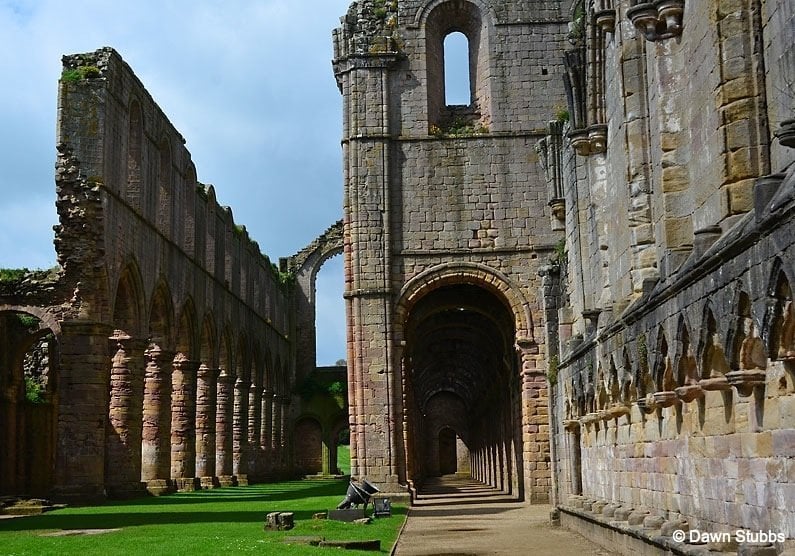
Over the next few centuries, the abbey underwent various phases of construction and expansion. This included the addition of remarkable buildings such as the church, the chapter house, and the impressive cellarium, which served as the monks’ storage area for food and supplies.
Life in the Abbey
Daily life within the abbey was governed by a strict schedule that revolved around religious observance and communal activities. The monks would rise early for prayers and meditation, followed by work in the fields or workshops. They maintained a simple and austere lifestyle, dedicating their days to labor, prayer, and study. The abbey also served as a centre for education, where monks copied manuscripts and engaged in theological discussions.
Throughout its history, Fountains Abbey was not just a religious sanctuary but also a vibrant community hub. It attracted pilgrims, visitors, and even royalty, who were drawn to its spiritual significance and the tranquility of the surrounding landscape. The abbey’s influence extended beyond its walls, shaping the cultural and economic fabric of the region.
The Dissolution of the Monasteries
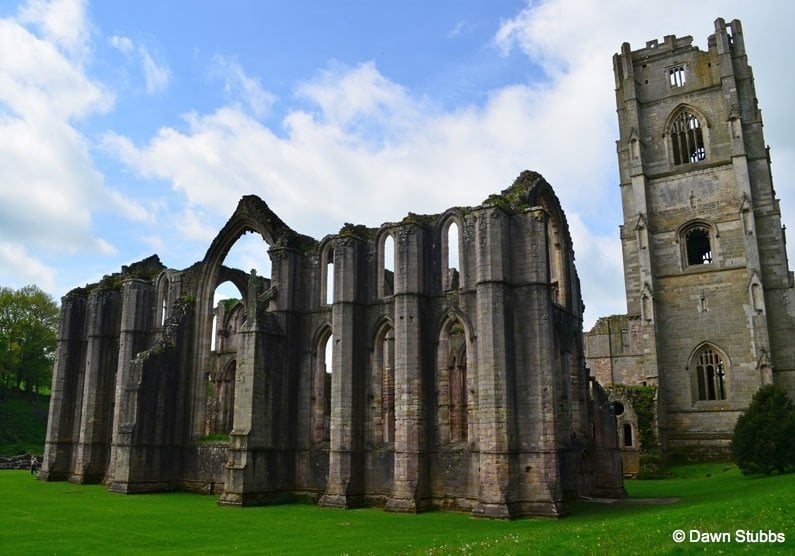
The dissolution of the monasteries in the 16th century marked a dramatic turning point for Fountains Abbey. In 1539, under King Henry VIII’s orders, the abbey was closed, and its lands were seized by the crown.
Then the abbey was sold on 1 October 1540 to Sir Richard Gresham, who at the time was a Member of Parliament and had previously been the Lord Mayor of London, also the father of Sir Thomas Gresham.
It was Richard Gresham who had supplied Cardinal Wolsey with the tapestries for his new residence of Hampton Court and who had paid for the Cardinal’s funeral.
Sir Thomas Gresham despoiled a sacred site that was a world-class architectural marvel, he stripped some of the fabric of the site, stone, timber, and lead etc for sale as building materials to help recoup some of the cost of the purchase.
In 1597 the site was acquired by Sir Stephen Proctor, who further vandalized the monastic complex for stone to build Fountains Hall.
Between 1627 and 1767 the estate was owned by the Messenger family. They sold the hall to William Aislaby who was responsible for combining it with the Studley Royal Estate.

17th Century Onwards
The Abbey passed through several hands until it became the property of John Aislabie in 1693.
After his death in 1742, the ownership of the ruins were taken by his son William who landscaped the abbey gardens, incorporating statues and follies. Between the two of them they created what is believed to be the most important water garden in England.
Then, in 1767 William Aislabie, in buying the Abbey ruins, created the combination of what is Fountains Abbey and Studley Royal Water Garden.
The site has since been preserved and cared for by the National Trust, ensuring that future generations can appreciate its historical significance and architectural grandeur.
The National Trust have owned the estate since 1983 and English Heritage carry out any conservation work need on the abbey.

Studley Royal Water Garden: A Masterpiece of Landscape Design
Design and Inspiration
Adjacent to Fountains Abbey lies the Studley Royal Water Garden, a stunning example of 18th-century landscape design. Developed in the 1750s, this picturesque garden was inspired by the principles of the English landscape movement, which emphasized natural beauty, harmony, and the integration of architecture with nature.
The garden was designed by John Aislabie, who ingeniously transformed the site into a breathtaking work of art that encapsulated the ideals of the time.
The layout of the garden is characterized by its sweeping vistas, carefully positioned trees, and a series of water features that reflect the beauty of the surrounding countryside. The water garden is one of only three remaining throughout the country.
Aislabie drew upon the natural contours of the landscape, creating a sense of fluidity and movement that enchants visitors as they explore the grounds.
The water gardens complement the abbey ruins, offering a serene setting that encourages quiet reflection and admiration of the natural world. The site, in North Yorkshire has an area of 323 hectares (800 acres.)

Key Features of the Water Garden
The Studley Royal Water Garden is home to several key features that contribute to its charm. One of the most striking elements is the Grand Cascade, a spectacular waterfall that tumbles down a series of stone steps, creating a soothing soundtrack of flowing water. Visitors can admire the cascade from various vantage points and enjoy the refreshing mist it generates on warm days.
Another highlight is the ornate Temple of Piety, a classical structure that serves as a focal point within the garden. Surrounded by lush greenery and colorful flowerbeds, the temple invites visitors to pause and take in the beauty of the landscape. Additionally, the garden features several ponds and canals, which not only enhance the aesthetic appeal but also serve as habitats for an array of wildlife.
Must-See Attractions at Fountains Abbey
The Abbey Ruins
The main attraction of Fountains Abbey is, of course, the ruins themselves. These magnificent remnants showcase the grandeur of the original structure and provide insight into the architectural prowess of the Cistercian monks.
Visitors can wander through the remains of the church, chapter house, and cloisters, imagining the bustling community that once thrived within these walls. The ruins are particularly striking against the backdrop of the surrounding countryside, making for breathtaking photographs.
A good proportion of the ruins remain intact today. There is sound evidence of the Romanesque architectural methods used to construct this stunning building.
Fountains Hall
Studley Royal House (or Hall) stood in the north-west corner of the park. The hall was originally a medieval manor house, having a main block with forward projecting wings, it unfortunately burned down in 1716 and it was rebuilt by John Aislabie.
He filled in the centre, to which his son William added a portico in 1762 to complete its Palladian appearance. The building was destroyed by fire in 1946. A large stable block, built between 1728 and 1732, survived and is now a private house.
The Cellarium
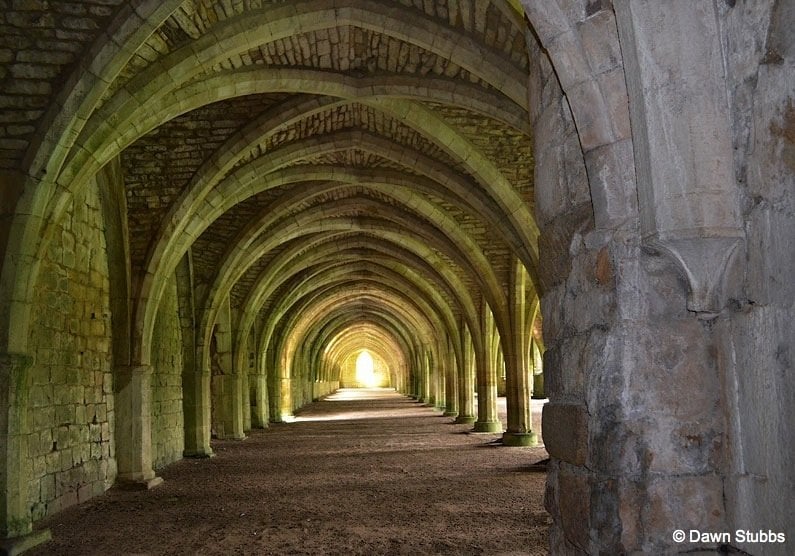
The Cellarium is another must-visit attraction at Fountains Abbey. This impressive structure served as the storage area for the monks’ provisions and is one of the best-preserved parts of the abbey.
The unique vaulted ceilings and stone arches create a sense of grandeur that transports visitors back in time. Inside, guests can see how the monks carefully stored food and supplies, ensuring their self-sufficiency throughout the year.

Film location
Fountains Abbey and Studley Royal Gardens have been used as a film location on many occasions including an appearancein the final scenes of Omen III in 1980: The Final Conflict.
Other productions that have used locations at the abbey include the films Life at the Top, The Secret Garden and The History Boys; and the TV shows Flambards, A History of Britain, Terry Jones’ Medieval Lives, Cathedral, Antiques Roadshow, Treasure Hunt, and Gunpowder.

Visitor Information
Opening Times and Ticket Prices
Fountains Abbey and Studley Royal Water Garden welcome visitors year-round, with varying opening times depending on the season. Typically, the site opens at 10 am and closes at around dusk at 4 pm, ensuring ample time for exploration.
Ticket prices are reasonably set, with discounts available for families, students, and senior citizens. Members of the National Trust can enjoy free entry.
Transport and Getting There
Fountains Abbey and Studley Royal Water Garden are conveniently located near major transport links, making it easy for visitors to reach the site. It is to the west of Ripon near the A61 towards Pateley Bridge. You will find signage on the A1(M) too. The Abbey is around 12 miles to the north of Harrogate.
It is free to park at the Visitor Centre and West Gate car park however the Studley Royal car park is pay and display and it costs £7 for 4 hours and £10 for the whole day.
Location details for a sat nav or other devices is: Fountains, Ripon HG4 3DY
Cycling is popular here in this area and the Abbey provides bike sheds for thos arriving on 2 wheels.
For those who prefer a more scenic route, walking trails connect the site to nearby villages and towns, offering an opportunity to explore the beautiful Yorkshire countryside along the way. Whichever mode of transport you choose, the journey to Fountains Abbey and Studley Royal Water Garden is sure to be enjoyable.
Conclusion
Fountains Abbey and Gardens are abundant with history and have a special ambiance like no where else. The walks are beautiful and steeped in history, with a surprise at every turn.
Even on a dull day, the estate is beautiful and views of the abbey from Ann Boleyn’s seat is one to behold. Let the imagination take over and take time to absorb the past. A magical place for all.The combination of the abbey’s rich past and the stunning water garden creates a unique experience that appeals to history buffs, nature lovers, and families alike. A visit to this UNESCO World Heritage Site is an unforgettable experience.
More in the area:
Ripley Castle – Walk The Grounds and Gardens
The Kilburn White Horse, North Yorkshire
Byland Abbey – The 12th Century Cistercian Inspiration
What are the opening hours for Fountains Abbey and Studley Royal Water Garden?
Opening hours vary by season, typically from 10 am until dusk.
Are there guided tours available?
Yes, guided tours are available and provide insightful information about the history and significance of the site.
Can I bring my dog?
Well-behaved dogs are welcome in some areas of the gardens, but they must be kept on a lead. Please check specific site guidelines for restrictions.
Are there any dining options on-site?
The Visitor Centre features a café offering a variety of meals and snacks, perfect for refueling during your visit.


Gorgeous! Makes me want to have a picnic!