

There is an interesting paradox at the heart of Cumbrian hiking.
Most people assume that to experience the absolute finest panoramic drama the Lake District has to offer, you have to strap on a heavy pack, pull out a compass, and grind your way up a grueling, steep fell.
Yet, tucked away on a high, wooded ridge between the beautiful villages of Coniston and Hawkshead sits a location that completely shatters that rule: Tarn Hows.
It is arguably one of the most celebrated, photographed, and visited beauty spots in the entire country—and for very good reason.
What makes Tarn Hows an absolute triumph of landscape design is its radical accessibility.
It offers a landscape where anyone—regardless of age, physical mobility, or hiking experience—can immerse themselves directly in the restorative power of the high fells without needing to scramble over technical mountain terrain.
However, because of its immense popularity, visiting this icon requires a bit of tactical planning if you want to avoid the worst of the summer crowds and experience it in its true, serene spirit.
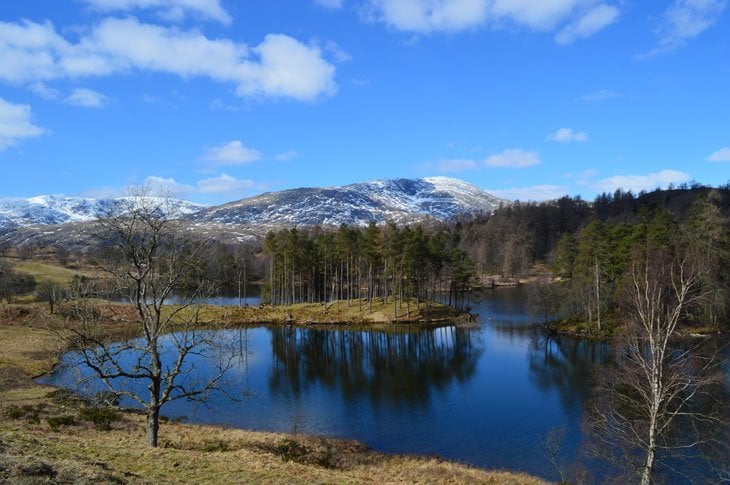
Here is my first-person field manual and local guide to exploring Tarn Hows.
🏔️ Tarn Hows Expedition Blueprint & Logistics
Geographic Location:
Set on high ground between Coniston Water and Esthwaite Water in the Southern Lake District, Cumbria.
The Navigation Hub:
Accessible via narrow, twisting single-track lanes directly from the B5285. Use Postcode: LA22 0PP for the main car park.
Trail Distance & Terrain:
A beautifully maintained 1.5-mile (2.4 km) circular loop. The path consists of hard-packed, level gravel with gentle gradients, making it fully accessible for wheelchairs, mobility scooters, and all-terrain pushchairs.
Parking Constraints & Hacks:
Managed by the National Trust. Parking is Free for National Trust members (remember to scan your card at the machine), but can be quite expensive for non-members staying the full day.
Dog-Friendly Parameters:
Superb trail utility. Dogs are entirely welcome, but they must be kept under close, effective control—and on short leads across the main pastures—due to active conservation grazing by local livestock.
On-Site Facilities:
Includes accessible public toilets near the main entrance and a small National Trust information barn. On most clear mornings, you will also spot a local refreshment van serving hot drinks and morning fuel by the main car park loop.
The Circuit: Accessible Perfection and Tactical Alternatives
The primary loop around the water is a masterclass in inclusive trail design.
If you track the wide, well-consolidated gravel path clockwise from the main car park, you are treated to an effortlessly smooth stroll that can be comfortably wrapped up in about 45 minutes to an hour of steady walking.
Because the trail is kept completely clear of exposed tree roots, loose scree, or sudden muddy bogs, it provides a completely stress-free environment for family walks, picnics, or a mindful, slower-paced escape into the fresh mountain air.

However, if you are an experienced hiker looking for a bit more muscle engagement and an escape from the primary tourist flow, the main loop is just the spine of a much larger trail network.
If you glance up toward the western slopes, you will spot several narrower, rougher single-track paths branching off and climbing straight up into the higher woodland and open heather.

Branching out onto these upper mountain tracks instantly rewards you with a higher vantage point, shedding 90% of the foot traffic and opening up far more expansive, dramatic views over the water.
The Surprising History: A Victorian Masterpiece
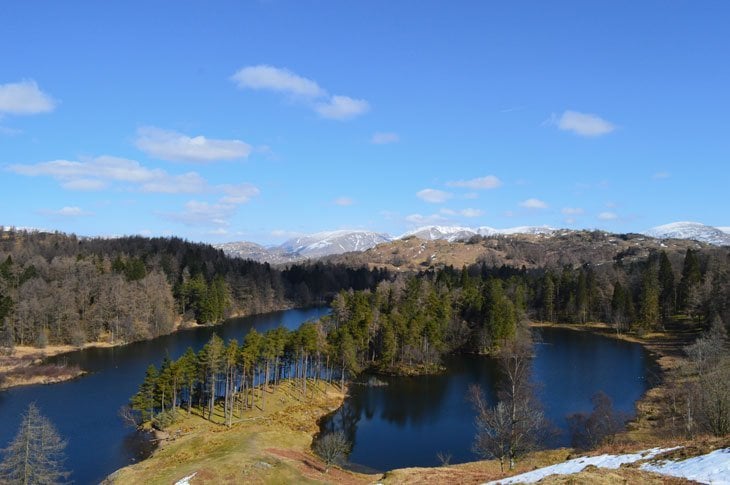
One of the most fascinating aspects of Tarn Hows—and something that trips up almost everyone who visits—is that this seemingly “wild” mountain lake is completely man-made.
If you stood on this exact ridge back in the early 1800s, you wouldn’t have seen a single grand lake. Instead, you would have been looking at three separate, smaller, and rather marshy pools: Low Tarn, Middle Tarn, and High Tarn.
The landscape you see today was entirely engineered by wealthy Victorian landowners who wanted to create a stylized, romantic “Switzerland in Cumbria” aesthetic.

To help you track how this mountain basin evolved from a boggy pasture into a preserved national treasure, here is a breakdown of its core historical timeline:
|
Era / Year |
Prominent Figures involved |
Historical Milestone & Landscape Impact |
|---|---|---|
|
Early 1800s |
Local Cumbrian Farmers |
The site operates as raw, open mountain pasture containing three separate, isolated boggy tarns. |
|
1862 |
The Marshall Family (Grange Estate) |
Purchases the land and constructs a series of stone dams to artificially join the three tarns into one massive, cohesive body of water. |
|
Late 19th Century |
Victorian Landscape Architects |
The Marshalls aggressively plant a massive variety of non-native conifers, including Scots Pine, Larch, and Spruce, to create a dramatic alpine aesthetic. |
|
1929 |
Beatrix Potter (Mrs. Heelis) |
The legendary author and conservationist steps in to buy the entire 4,000-acre Monk Coniston Estate at auction to protect it from commercial developers. |
|
1930 |
Transition to Public Heritage |
Beatrix Potter immediately sells the core Tarn Hows acreage directly to the National Trust, ensuring its preservation for the public. |
Dog-Friendly Navigation and the Herdwick Factor
If you travel with dogs like I do, Tarn Hows is a fantastic destination, but it requires a high degree of situational awareness.
Whenever I am out here tracking the paths, my dogs are always focused and dialed in, and that is because this basin is an active, working agricultural landscape.
The National Trust utilizes this area for vital conservation grazing, which means you will regularly encounter iconic, hardy Herdwick sheep and docile Belted Galloway cattle roaming right up to the water’s edge.

Because these animals are accustomed to visitors, they can appear remarkably relaxed, but a loose or overly curious dog can instantly trigger an emergency.
If you are walking a high-drive breed, keep them on a short, fixed lead across the main open sections of the circuit.
The absolute best tactical tip for dog owners is to arrive early—ideally before 8:30 AM. Arriving at dawn gives your dogs a completely quiet, distraction-free environment to enjoy the morning scent trails before the main waves of families and coaches arrive.
The Panoramic Mountain Horizon
While the immediate lakeside reflection of the pine trees on the water is stunning, the true power of Tarn Hows sits in its massive backdrop of legendary Cumbrian fells.
As you walk the northern arc of the path and look across the water, the horizon opens up to reveal a spectacular, multi-layered skyline of the high peaks.
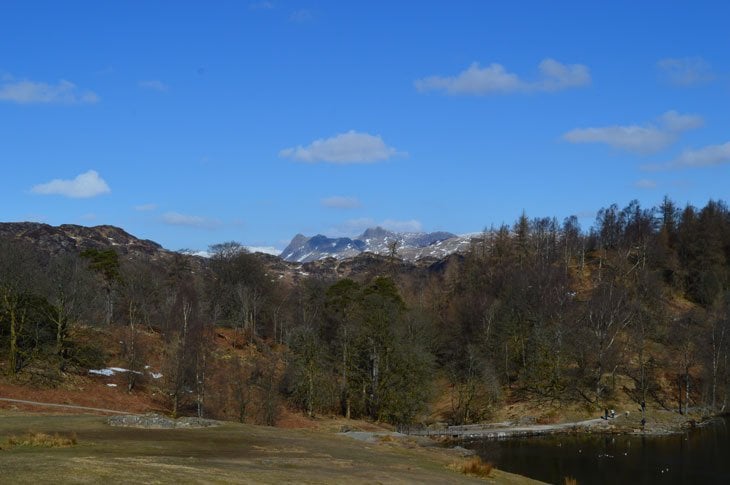
Looking directly out over the water, your eyes are immediately drawn to the jagged, unmistakable peaks of the Langdale Pikes dominating the mid-ground.
Turn your gaze slightly to the west, and the massive, bulky mass of The Old Man of Coniston cuts into the skyline.

On a crisp autumn or spring morning, when the remnants of the winter snow are still clinging to the high gullies of The Old Man and the low sun is casting a mirror-like reflection across the tarn, there are very few places in the UK that offer such a profound sense of natural stillness.

Turn around to face the opposite direction, and on a clear day, you can trace the massive silhouettes of Helvellyn and the Eastern Fells fading into the distance.
Hidden Treasures: Rose Castle Cottage and Smart Parking Hacks
Before you wrap up your circuit and head back to the car, there are a couple of local details that can completely transform your day trip from a standard tourist loop into something far more rewarding.
Tracking Down Rose Castle Cottage
If you branch off the main gravel track just a few hundred meters near the southeastern corner of the loop, you can discover one of the area’s finest hidden architectural treasures: Rose Castle Cottage.

This beautiful, isolated 19th-century stone cottage is tucked completely out of sight from the main tourist trail.
Maintained beautifully by the National Trust, it is currently operated as a completely off-grid, Gadget-free holiday cottage.
Standing outside its stone walls gives you a wonderful glimpse into what living in this valley must have felt like before the modern world arrived.
The Local Parking Hack
The main National Trust car park can fill up exceptionally quickly on sunny weekends, and if you aren’t a member, the parking fees can add up fast.
If you want to inject some proper hiking miles into your day and save some change, consider skipping the main lot entirely.

Instead, look for the small, free forestry laybys and pull-offs scattered along the winding approach roads leading up from Coniston or Ambleside.
Parking further down the hill allows you to tackle an extra two to three miles of spectacular uphill walking through old oak woodlands, culminating in that absolute jaw-dropping moment when you top the final ridge and see the entire waterscape of Tarn Hows reveal itself beneath you.
Explore More Spectacular Walks & Lakes of Cumbria
- The High Mountain Escape: A Walk Up To Alcock Tarn From Grasmere: Navigating the Low Cloud Trails
- The Historic Frontier Town: A Walk Around Sedbergh: Exploring 1,000 Years of Cumbrian Heritage
- The Western Fell Outpost: Murton Pike: Conquering the Iconic Conical Hill of the Eden Valley


Breathtakingly beautiful!
I have visited there couple years ago. Before I was really into photography. These photos have really captured some stunning scenery and surrounding area. Time to go back and re visit . Perfect pictures…perfect place.
so kind Jackie, ty
I was back ‘home’ recently and spent a day in the Lakes with my dad. I’d suggested Tarn Hows as I haven’t been there for years. My dad wouldn’t go, saying that he felt it was a all a bit ‘country park’ nowadays.
Hi Alan, yes it is a lot more touristic lately.. best to go out of season to get more natural and wonderful feel
Paul, the photos are great and show the place off really well. It’s a great place to take a walk and the views are superb. We quite often go there on the morning we travel home. A circuit and a bacon butter from the van that’s nearly always parked there fill a morning up perfectly. I’m pretty sure that it’s free to park for National Trust members too.
Beautiful photos Paul!
Thx so very much
Lovely photos, Paul… we seem to be enjoying some beautiful cool, crisp days in Cumbria at the moment.